
Table of Contents
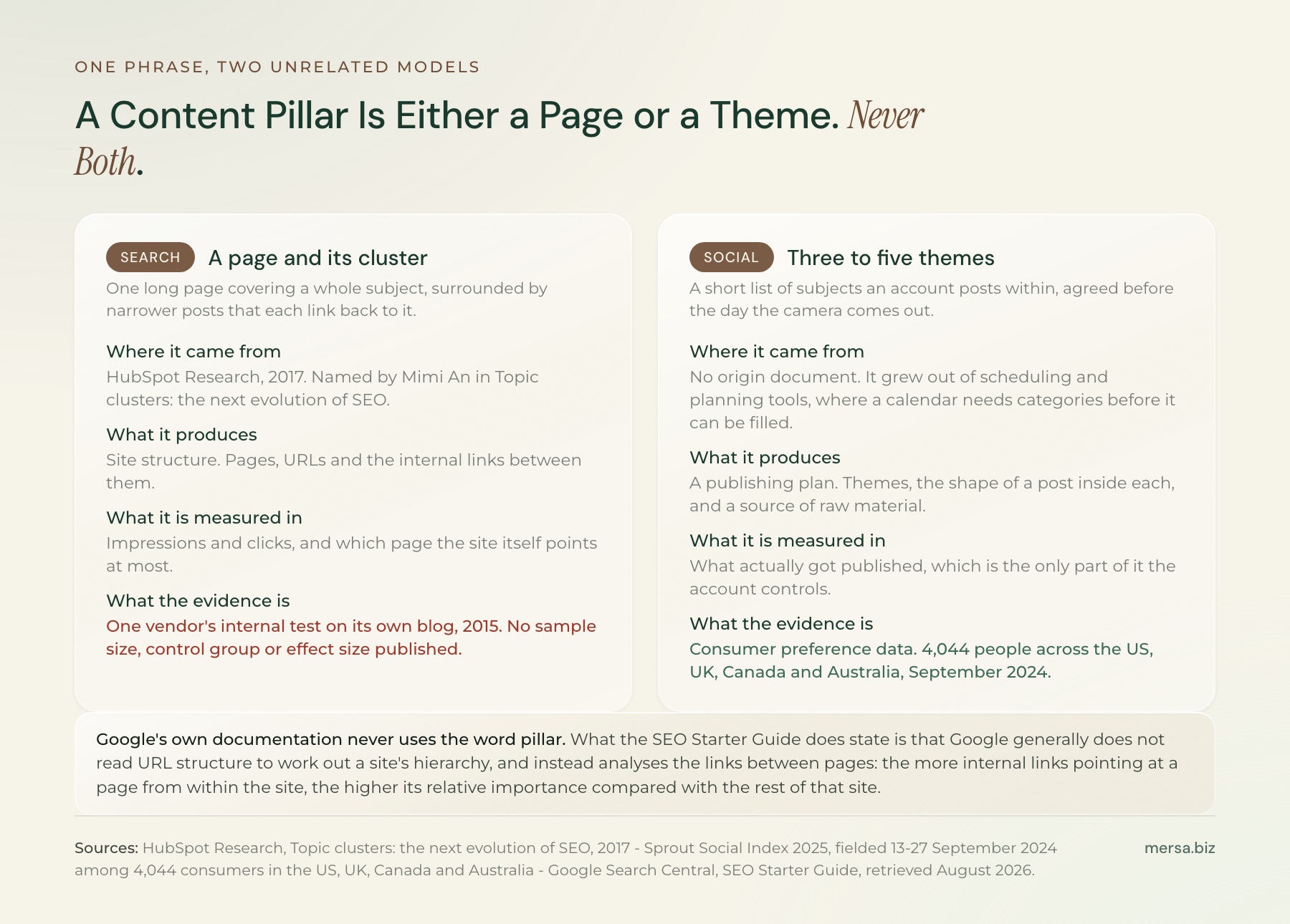
A content pillar is one of two unrelated things. In the search sense a content pillar is a single long page covering an entire subject, surrounded by narrower posts that link back to it; in the social sense a content pillar is one of three to five recurring themes an account publishes within. Neither method transfers to the other.
Key Takeaways
- The search meaning was named by HubSpot Research in a 2017 publication, and the supporting evidence for it was an internal test conducted on HubSpot’s own blog in 2015, reported without a sample size, a control group or an effect size.
- Google’s search documentation does not use the word pillar anywhere. What that documentation does state is that relative importance within a site is derived from the internal links pointing at a page rather than from the URL structure of the site.
- Sprout Social’s 2025 Index surveyed 4,044 consumers across the US, UK, Canada and Australia between 13 and 27 September 2024, and a third of those consumers said that jumping on viral trends is embarrassing for a brand.
- 97% of the 1,015 B2B marketers surveyed by the Content Marketing Institute and MarketingProfs between June and August 2025 reported having a content strategy, which is a materially different claim from having documented one.
- Three to five is the content pillar count repeated by nearly every guide on the first page of results, and no published test sits behind that number.
Two marketers asked what a content pillar is will describe different work. One will draw a hub-and-spoke diagram of a website, and the other will list buckets such as educational, behind-the-scenes and promotional. Neither description is wrong. They are answers to different questions, and the search results do not separate them.
The difficulty with this phrase is therefore the labelling rather than the advice. A reader arrives with one job and departs with a method constructed for the other, which is an expensive substitution in either direction.
Where Each Meaning Came From
The search meaning has a documented origin. HubSpot Research published Topic clusters: the next evolution of SEO in 2017, written by Mimi An, and that publication named the model: one broad page covering an entire subject, a set of narrower posts covering its subtopics, and internal links between related pages tying the group together. The broad page was the content pillar, and almost everything published since has been a restatement of that arrangement.
The social meaning has no comparable origin document. It emerged from scheduling and planning tools, in which a calendar requires categories before it can be filled, and those categories eventually acquired the same name. By the time the usage reached the first page of results, nothing distinguished it from the HubSpot model any longer.
Both meanings survive because both describe something real. A website does benefit from an organisation built around subjects, and an account does benefit from knowing what it publishes about before the camera comes out. The failure is only that one phrase performs both jobs.
The Search Meaning: A Page and Its Cluster
What the Model States
In the search sense a content pillar is a page rather than a theme. The page covers one subject broadly enough that a reader requires nothing else for an overview, and it is surrounded by narrower posts that each take one part of the subject in depth, with every narrow post linking up to the pillar page and the pillar page linking down to each of them.
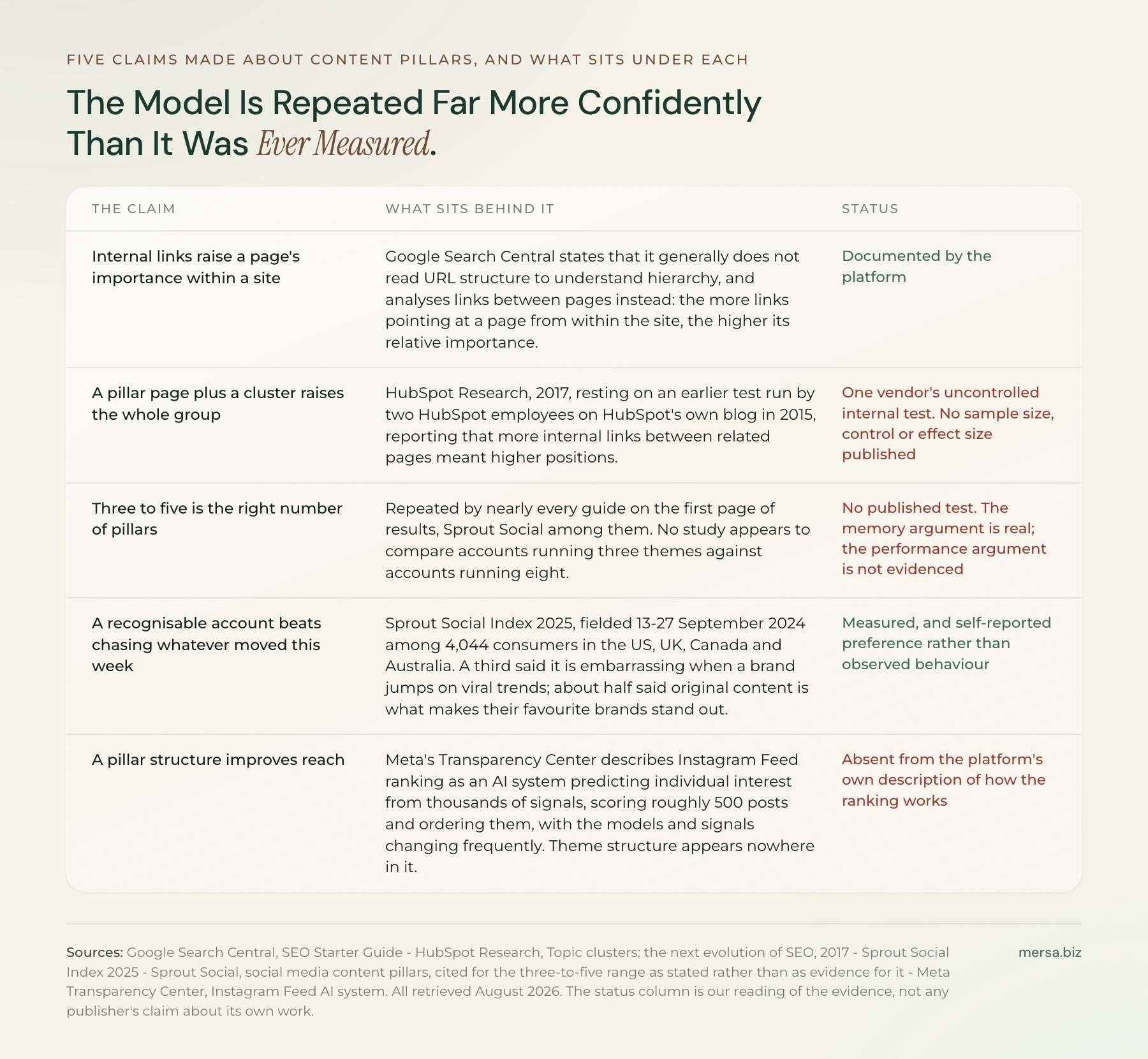
The claim attached to the model is that this arrangement raises the entire group in search results, on the reasoning that the internal links between related pages indicate which page on the site owns the subject.
What the Evidence Behind It Actually Is
The model deserves considerably more scepticism than it ordinarily receives. The 2017 publication rests on earlier work by two former HubSpot employees, Anum Hussain and Cambria Davies, who tested the approach on HubSpot’s own blog and reported that the more internal links between related pages they added, the higher those pages climbed in results. No sample size, no control group and no effect size accompanied that finding.
The founding evidence for the most repeated structural model in content marketing is therefore one vendor’s uncontrolled test on its own property, conducted in 2015. That does not make the model wrong. It does mean that the confident diagrams constructed on top of it carry considerably more weight than the measurement underneath them.
What Google Actually Documents
Google’s own material is more useful here precisely because it is narrower, and the word pillar does not appear anywhere in it. What the SEO Starter Guide does state is that links are the primary means by which new pages are discovered, and that Google generally does not read URL structure to understand a site’s hierarchy; the links between pages are analysed instead, and the more internal links pointing at a page from within the site, the higher its relative importance compared with the rest of that site.
Read plainly, that documentation supports the mechanism rather than the branding. Internal linking between related pages is documented behaviour, a content pillar page is one arrangement of it, and Google has never described that arrangement as the required one.
The same logic applies one level up wherever a site has to be legible to machines rather than only to readers. Post 06 in this series examined whether anything actually reads your llms.txt, and the answer there followed the same pattern: the structure a vendor recommends and the structure a platform documents are two different claims, and only one of them has server logs behind it.
The Social Meaning: Three to Five Recurring Themes
Where Three to Five Came From
Nearly every guide on the first page of results settles on three to five recurring themes, Sprout Social among them, and none of those guides publishes a test behind the number. No study appears to exist comparing accounts running three recurring themes against accounts running eight.
The range is probably sensible regardless, for a reason unconnected to distribution. Below three recurring themes a plan amounts to one idea and exhausts itself, and above five the list becomes unmemorable and consequently stops being consulted at all. That is an argument about human memory rather than an argument about performance, and it deserves to be stated as one.
What the Consumer Data Does Support
Real measured data exists on this side of the phrase, and it argues for consistency without promising anything. Sprout Social’s 2025 Index surveyed 4,044 consumers alongside 900 social practitioners and 322 marketing leaders across the US, UK, Canada and Australia, fielded between 13 and 27 September 2024. A third of those consumers said that jumping on viral trends is embarrassing for a brand, and about half said that original content is what makes their favourite brands stand out.
That is the honest case for maintaining content pillars at all. The case is not that themed publication is rewarded by a platform; the case is that a recognisable account outperforms an account chasing whatever moved that week, according to the people being asked.
Why No Content Pillar Can Promise Distribution
The platform determines what is displayed, and states as much in its own documentation. Meta’s Transparency Center describes the Instagram Feed AI system as selecting and ordering posts by predicting what each person is likely to be interested in, using thousands of signals, and scoring roughly 500 posts in order to arrange them. The same documentation states that those models and their input signals change frequently.
Nothing in that description contains a content pillar set. A theme structure determines what is produced and how recognisable the account becomes; it does not determine what a ranking system built from thousands of changing signals elects to display. Anyone selling a content pillar framework on a promise of reach is selling something the platform’s own documentation does not support.
Which Meaning You Need
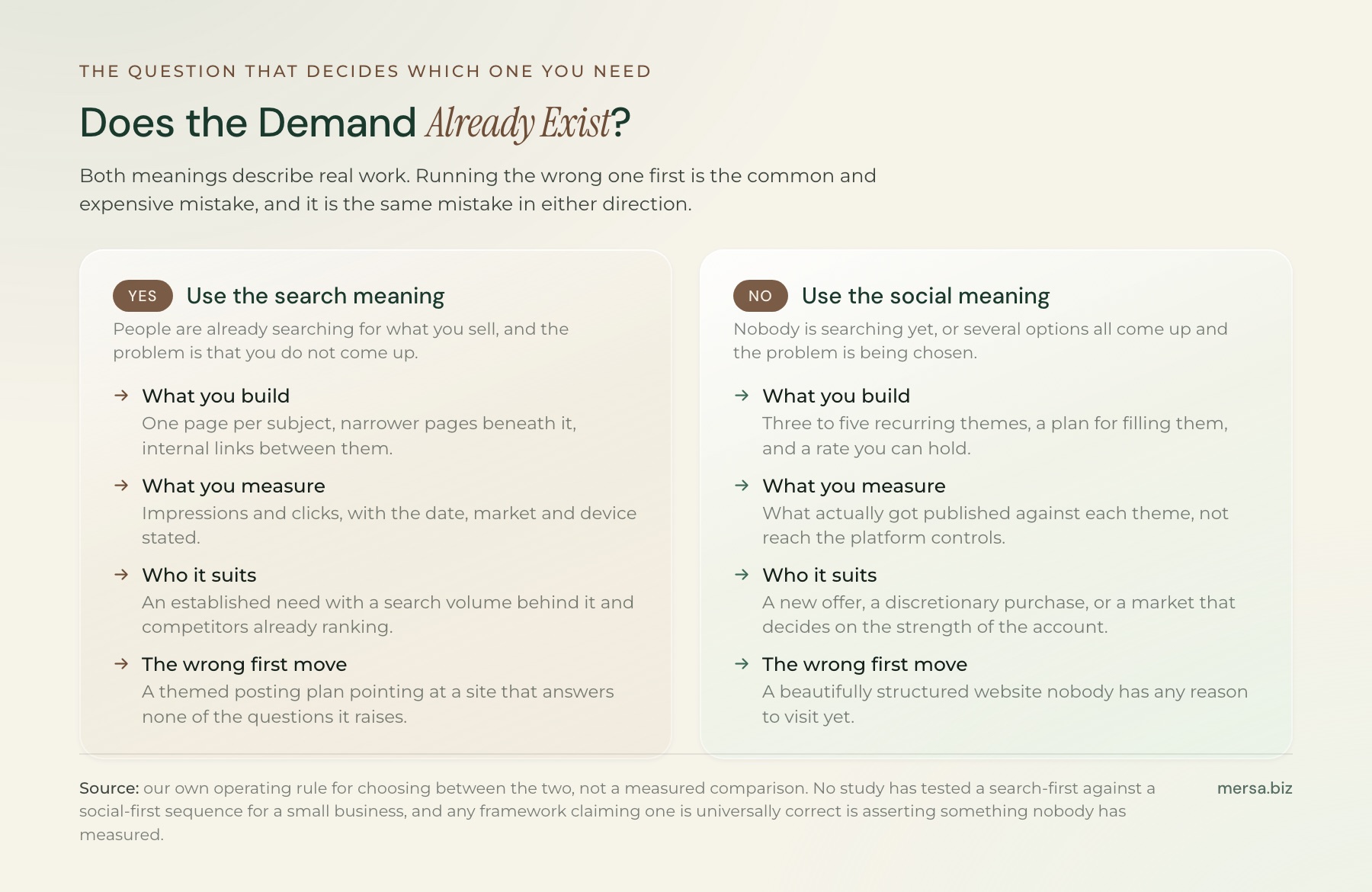
The question to resolve first is what the work is intended to accomplish, and there are only two available answers to it.
Where people are already searching for what you sell and the difficulty is that your site does not appear, the search meaning is the one required. That is a website structure job: one page per subject, narrower pages beneath it, and internal links between related pages. It is measured in impressions and clicks, and the honest measurement rules for it are set out in post 08 on SEO reporting.
Where people are not searching for what you sell, or where they are choosing between you and three others who all appear, the social meaning is the one required. That is a publishing job: a short list of recurring themes, a plan for filling them, and a rate that can be sustained. It is measured in what was actually published, which is the only part of the arrangement under your control.
Most small businesses require both meanings eventually and only one of them immediately. Running the wrong one first is the common and expensive mistake, and it presents either as a beautifully structured website nobody has any reason to visit yet, or as a busy account pointing at a site that answers none of the questions it raised.
How to Choose Social Content Pillars That Are Actually Yours
The Test a Generic Content Pillar Set Fails
The test worth applying to a content pillar set is a simple one. A pillar list handed to your closest competitor either could or could not be published against unchanged, and where it could, what exists is not a content pillar set but a list of content categories. Educational, inspirational, behind-the-scenes and promotional is the version at which almost everybody arrives independently.
Content categories are not useless, since they prevent a calendar from being empty. They carry nothing that only you could say, however, and an account publishing them is interchangeable with every other account in its industry.
Content pillars that pass the test name a subject on which the business has a specific claim: work it actually performs, a constraint under which it actually operates, or a question its customers actually ask that nobody else answers well. The test is not whether the list sounds strategic. The test is whether somebody else could lift it.
What Belongs Inside Each Content Pillar
Each content pillar requires three things written down before it becomes real: what the theme is, what a post inside it looks like, and where the raw material originates. The third is the one routinely skipped and the one that kills the plan.
A theme with no source of material is a wish. Where the content pillar is your work, somebody has to photograph the work, which means a camera on site on a known day; where the content pillar is customer questions, somebody has to be recording them as they arrive. The content system we run monthly is built around shoot days and a strategy signed off in advance rather than around a posting schedule for exactly that reason: the schedule is never the constraint, and the raw material always is.
How Many Posts a Content Pillar Should Carry
Ratios are best ignored here. The four-one-one and eighty-twenty splits circulating in this space hold the same evidential status as the three-to-five rule, which is to say none published.
What matters considerably more is that every content pillar is actually used. A theme that produced nothing over two months is not a content pillar but an intention, and cutting it is the correct response rather than an admission of failure. Three content pillars that can be sustained beat five that cannot.
What a Content Pillar Cannot Do
Being explicit about the limits is worthwhile, because the frameworks sold around this phrase rarely are.
A content pillar cannot compel a platform to display your posts. It cannot produce followers, reach or sales, and any number attached to those outcomes inside a content pillar framework was invented by whoever is selling the framework. It cannot substitute for having something to say, and it cannot repair a business whose actual difficulty is the offer rather than the marketing.
What a content pillar can do is smaller and genuinely useful. It removes the daily question of what to post, which is what kills most small-business accounts; it makes an account recognisable, which the consumer data does support; and it makes the work reviewable, because with the recurring themes written down a quarter can be examined for which of them were actually served.
That is the standard the remainder of this site holds to. A marketing audit reports what is measurable and states plainly what is not, and a content pillar deserves the same treatment rather than a diagram promising growth.
Common Questions
What is a content pillar in social media marketing, in plain terms?
A content pillar is one of a small set of recurring themes an account publishes within, usually three to five of them, agreed in advance so that the question of what to post is settled before the day arrives. Each content pillar names a subject, the shape of a post inside it, and the source of the raw material. The purpose is consistency and recognisability rather than distribution, which remains under the platform’s control and is not promised by any theme structure.
Is a content pillar the same thing as a pillar page in SEO?
No, and conflating the two is the most common error around this phrase. A pillar page is a single long page covering one subject, surrounded by narrower posts that link back to it, named by HubSpot Research in 2017. A social content pillar is a recurring theme rather than a page, and it produces no site structure at all. The two are measured differently, constructed differently, and neither method can be substituted for the other.
How many content pillars should a small business have?
Three to five is the range repeated across nearly every published guide, and no test appears to have been published behind that number. The practical argument is one of memory rather than performance: below three recurring themes a plan exhausts its material, and above five the list stops being consulted. Fewer content pillars that are genuinely served beat more content pillars that are listed and then abandoned, and a theme producing nothing over two months should be cut.
Does having a content pillar structure improve reach on Instagram?
No such effect is documented by the platform. Meta’s Transparency Center describes Instagram Feed ranking as an AI system predicting individual interest from thousands of signals, scoring roughly 500 posts per session, with those models and signals changing frequently. A content pillar structure is absent from that description entirely. It governs what is produced and how recognisable an account becomes, which are worthwhile outcomes, but reach is determined by a ranking system nobody outside the platform controls.
What evidence supports the topic cluster and pillar page model?
Considerably less than its popularity implies. The 2017 HubSpot Research publication that named the model rests on an earlier internal test run on HubSpot’s own blog, reporting that adding internal links between related pages raised those pages in results, with no sample size, control group or effect size published. Google’s own documentation never uses the word pillar, though it does state that internal links, rather than URL structure, indicate a page’s relative importance within a site.
How can a set of content pillars be told apart from a generic category list?
By whether a direct competitor could publish against the same list unchanged. Where they could, what exists is a list of content categories rather than a content pillar set, and educational, inspirational, behind-the-scenes and promotional is the version most accounts arrive at independently. A genuine content pillar names a subject on which the business has a specific claim: the work it actually performs, a constraint under which it actually operates, or a question its customers ask that nobody else answers well.
Where the choice between the two meanings remains unclear, that is ordinarily a sign that the underlying question is which channel deserves the next month rather than which framework to adopt. Both are covered by the flat-price marketing audit, and the social half by the monthly content system, neither of which carries a lock-in.
Sources
- Google Search Central: SEO Starter Guide, on links as the primary means of page discovery, and on relative importance within a site coming from internal links rather than URL structure
- Meta Transparency Center: Instagram Feed AI system, on prediction-based ranking, thousands of signals, roughly 500 posts scored, and models changing frequently
- HubSpot Research: Topic clusters, the next evolution of SEO, 2017, by Mimi An, naming the pillar and cluster model and citing the earlier internal-linking test by Anum Hussain and Cambria Davies
- Sprout Social Index 2025, fielded 13 to 27 September 2024 across the US, UK, Canada and Australia among 4,044 consumers, 900 social practitioners and 322 marketing leaders
- Content Marketing Institute and MarketingProfs: B2B Content and Marketing Trends, Insights for 2026, surveying 1,015 B2B marketers between 24 June and 14 August 2025, primarily North America, sponsored by Storyblok
- Sprout Social: social media content pillars, cited for the three to five range as it is stated on the first page of results, not as evidence for it