

Table of Contents
A one-off SEO report must carry six things a monthly deck can omit: the date, market, device and tools behind the data; findings ordered by what to fix first; the reasoning and not merely the recommendation; what was not checked; an owner and an effort estimate per finding; and the limits of the data itself.
Key Takeaways
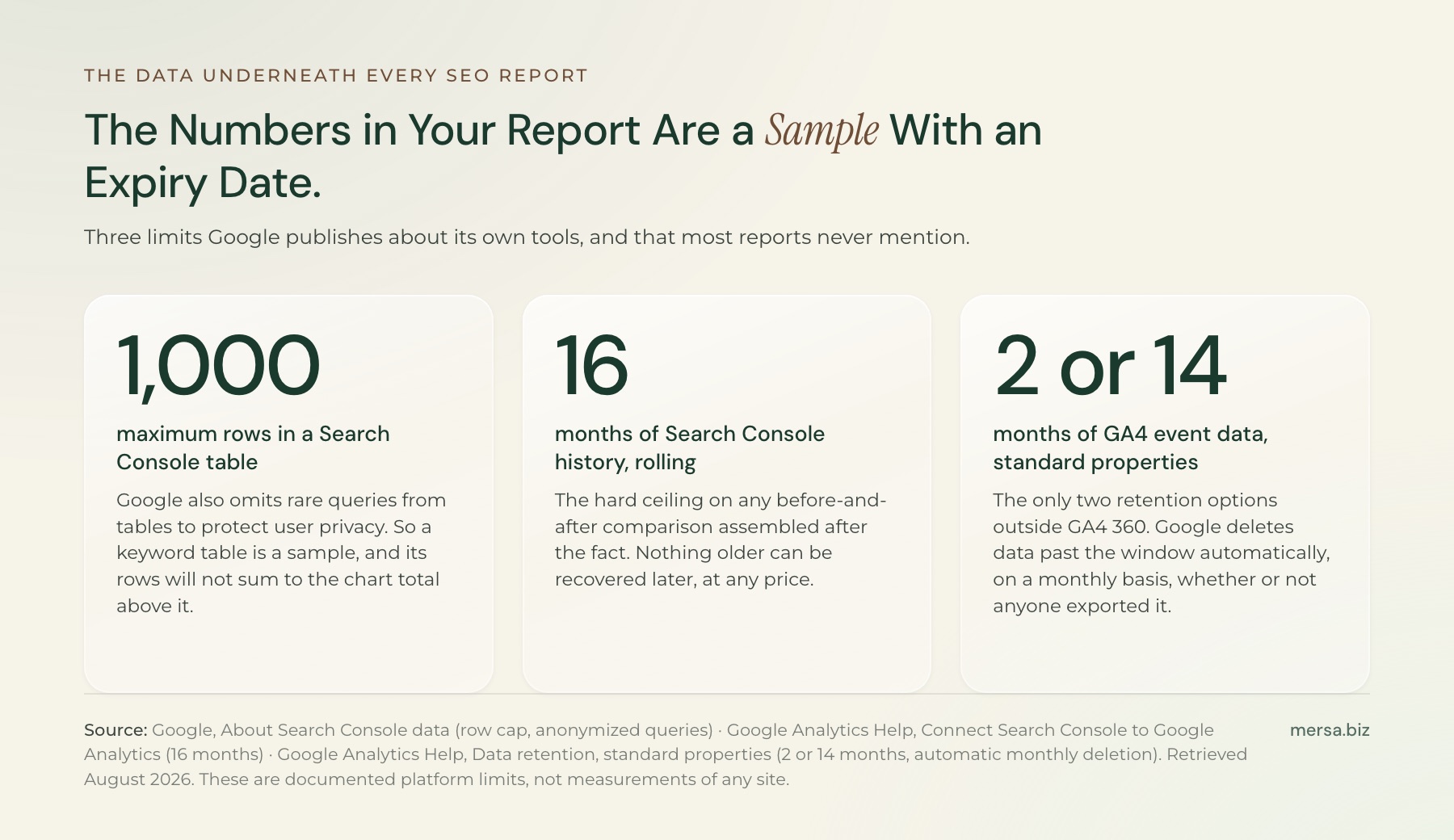
- Search Console performance tables are capped at 1,000 rows and omit rare queries, so a keyword table is a sample and the rows will never sum to the chart total.
- Search Console retains 16 months. GA4 standard properties retain 2 or 14 and delete automatically, so a baseline exported at the start is the only way the comparison survives.
- Collected data is normally available within two to three days, which means the final days of every reporting period are incomplete.
- Average position is impression-weighted rather than a rank. An average of 8.4 may represent third place for a handful of queries and thirtieth for hundreds.
- Google states that no one can guarantee a number one ranking. A report forecasting specific positions constitutes a warning rather than a service.
Almost every guide to SEO reporting presupposes an agency, a retainer and a monthly meeting. The reader is assumed to be a marketer explaining the previous month to a superior, and the advice concerns which widgets should be placed on a dashboard so that the explanation proceeds smoothly.
The far more common document is a one-off. A fixed price was paid, a report arrived, and it is now being read alone on a Tuesday with no dashboard login, no analyst on a call, and no subsequent month in which clarification might occur. Where that document does not function unaided, it does not function at all.
Mersa publishes two of them in full, so the format is not hypothetical here. The rules below emerged from writing SEO reporting required to survive without its author present in the room.
Who SEO Reporting Advice Is Written For
The intended reader can be reverse-engineered from the top results for SEO reporting. What is wanted there is white-labelled templates, automated scheduling, connectors drawing several platforms into one deck, and a means of displaying month-over-month movement. Every one of those needs is real, and every one belongs to a retained relationship.
None of it assists the person holding a standalone report.
That reader faces a different set of problems: a follow-up question cannot be asked without payment, next month’s chart will not be seen, and which of the twenty findings should be started with remains unknown, with nobody available to say.
A monthly deck may be thin because the conversation surrounding it carries the meaning. A one-off report has no such conversation, so the document must carry everything, including its own limits.
The distinction carries commercial weight as well. Google’s own guidance on hiring an SEO advises asking whether the provider will share every change made and supply detailed information regarding the recommendations and the reasoning behind them. A monthly dashboard rarely answers that, whereas a written report is the format in which your reasoning fits.
What the Data Underneath Will Not Tell You
Any honest discussion of SEO reporting must begin with what the source data does not contain, because most reports quietly present it as complete. It is not, and this is stated in writing by Google in its documentation on Search Console data.
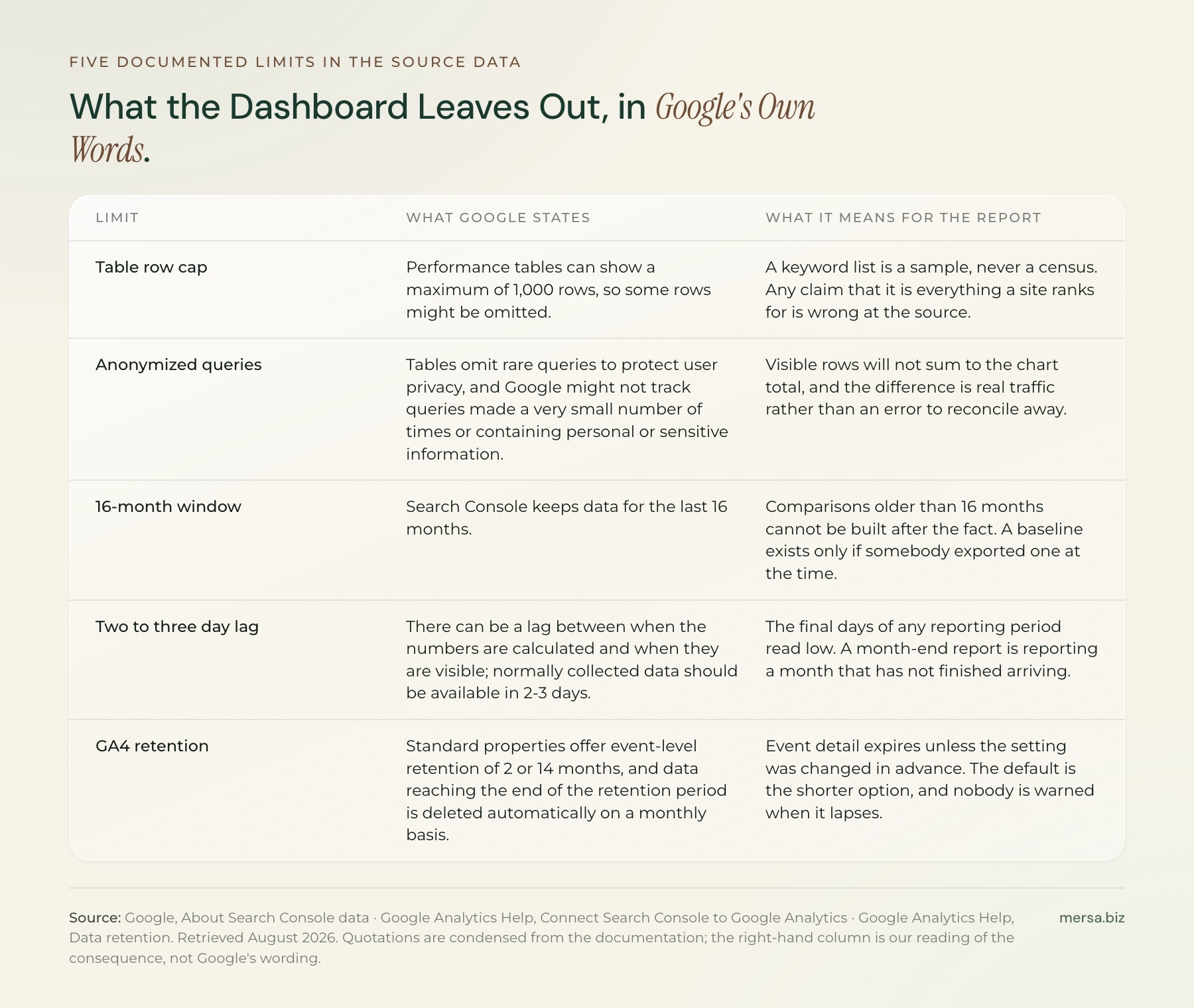
Four consequences follow, and a report omitting them is overselling its own numbers.
A keyword table is a sample. Search Console displays at most 1,000 rows and omits rare queries in order to protect user privacy, which Google terms anonymized queries. The rows will therefore not sum to the chart total, and the tail is genuinely absent rather than empty.
The last few days are always low. Collected data is stated by Google to be normally available within two to three days. A report generated on the first of the month therefore describes a month that has not finished arriving.
History has an expiry date. Search Console keeps the last 16 months. Google Analytics 4 standard properties hold event-level data for two or fourteen months and delete it automatically on a monthly basis. Where that setting was not altered at the property’s creation, the comparison you want a year later does not exist and cannot be recovered.
Two tools will disagree. Sampling, attribution and retention all differ between them. A report reconciling the difference in a single sentence is worth more than one quietly selecting the flattering figure.
Average Position Is Not a Position
The single most-reported metric in SEO reporting is also the most misread. Average position in Search Console is an impression-weighted average of where your result appeared, and Google’s performance report documentation notes that search results are specific to the time, place, device and recent history of the person searching.
An average position of 8.4 therefore does not indicate that you sit eighth. It may describe a page ranking third for a handful of queries and thirtieth for hundreds of others, and it moves when the query mix changes even where no ranking has moved at all. Reported as a rank, month over month, it produces a line rising and falling for reasons nobody in the meeting can name.
The problem compounds where a target is attached to it. Google states plainly that no one can guarantee a number one ranking and warns against providers claiming otherwise. A reporting layer constructed on a metric that is not a position, driving a promise nobody is permitted to make, constitutes two errors stacked.
Position should be reported as a distribution instead, or the specific queries your business actually cares about should be reported individually, with the date and the device stated. Both require more work and neither can be produced by clicking export.
What a Standalone Report Has to Carry
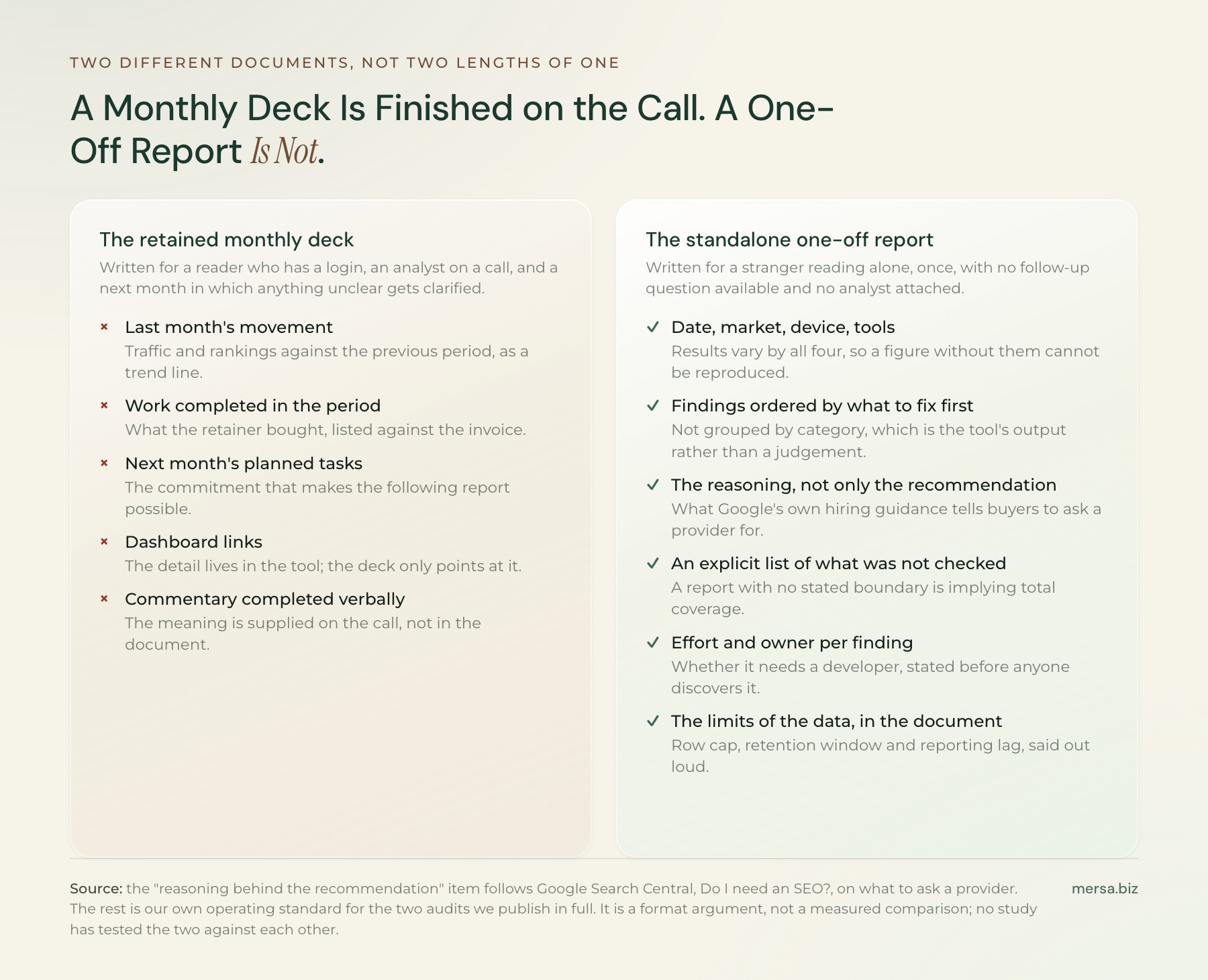
Six rules cover most of it.
1. Date and Scope Everything, on the Page
Which country, which device, which date range, which tool. Search results differ across all four, so a screenshot lacking context cannot be reproduced by the reader or by whoever reads it the following year.
2. Order the Findings by What to Do First
Grouping by category is the default output of every tool and is useless to a reader with limited hours. The determination of what matters most has to be made by somebody, and that judgement constitutes a large part of what was paid for.
3. Publish the Reasoning, Not Only the Recommendation
This is what Google’s hiring guidance requests of providers directly, and it is the part that survives once the specifics go stale.
4. Say What You Did Not Check
A report carrying no stated boundary implies that everything was checked, which is never true. Naming the gaps is the cheapest credibility available in the document.
5. Give Every Finding an Owner and an Effort Estimate
A list a small business cannot action is decoration. Where a fix requires a developer, that should be stated before it is discovered.
6. State the Limits of the Data Inside the Report
The row cap, the retention window, the two to three day lag. A reader subsequently discovering that your numbers do not tie out will trust the entire document less where no explanation was ever offered.
The Numbers Worth Reporting
The honest short list is smaller than most decks: clicks and impressions for the queries mapping to money, and the pages earning them.
Conversions that are genuinely tracked, described honestly where the tracking is partial. Technical defects blocking indexing, which are pass or fail rather than a trend. And a plain statement of what changed since the work commenced, with the commencement date attached.
Everything else is usually filler: a domain authority score invented by a tool vendor, a bounce rate with no target attached, a keyword count, or a chart of a metric moving on its own. Post 03 in this series examined what SEO actually costs, and the pattern there is identical: the impressive-looking number is rarely the one you can act upon.
Mersa’s two published examples are the format in practice. The KYND growth audit and the Villa KaliBali audit are both real client reports written to be read once, alone, and both are online in full with the numbers left in.
What to Do in the First Week After a Report Lands
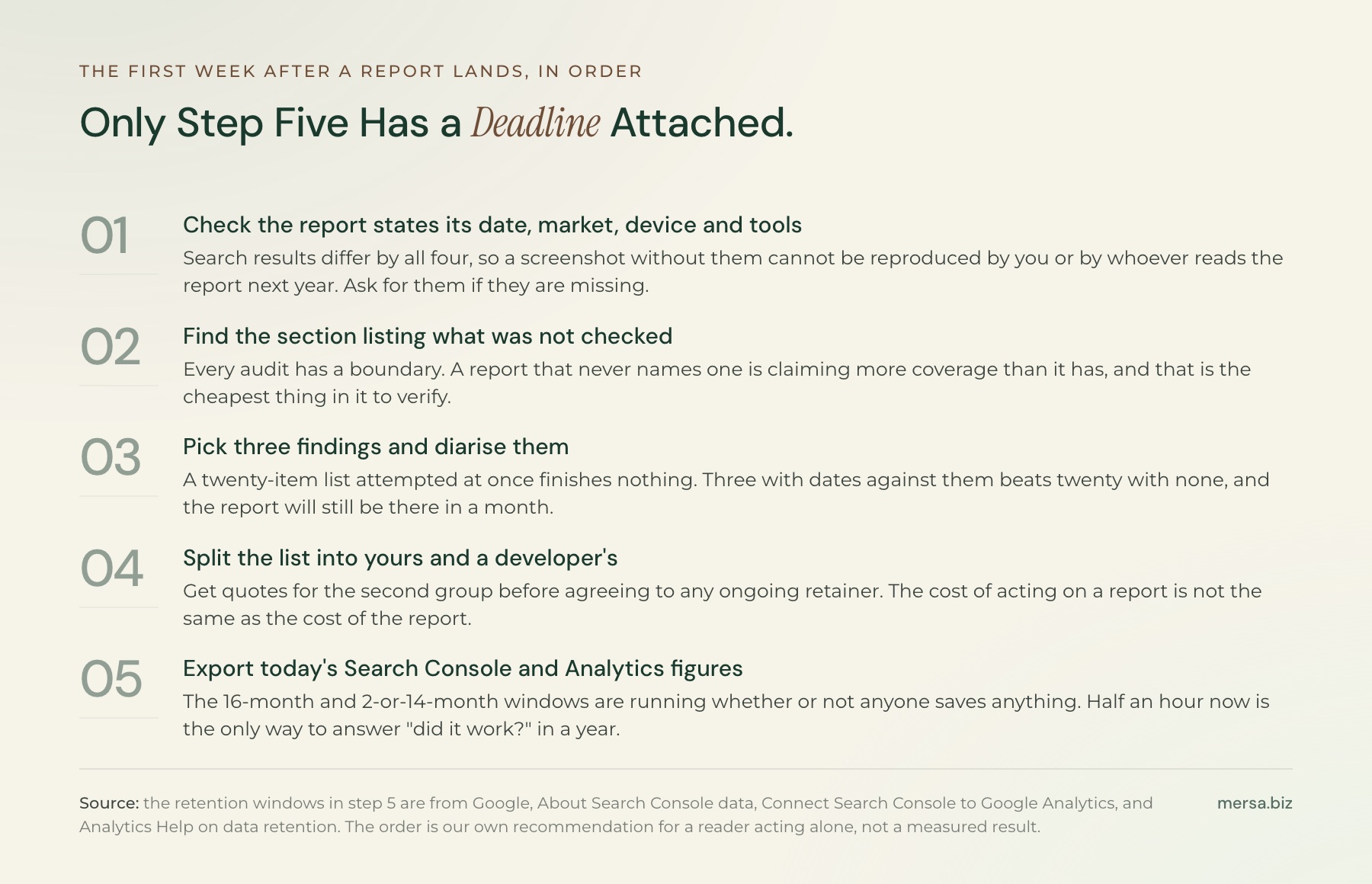
Step five deserves the emphasis. Whatever the report states today, the underlying data expires on a rolling schedule controlled by nobody at your business. A single export of the current position costs half an hour and is the only means of answering the obvious question a year later, which is whether any of it worked.
Common Questions
What should an SEO report include if there is no monthly retainer behind it?
It must be self-contained, because no meeting exists in which to explain it. That means the date, market, device and tools the data was drawn from, findings ordered by what to fix first rather than grouped by category, the reasoning behind each recommendation, an explicit list of what was not checked, an effort estimate and an owner for every action, and a statement of the data’s own limits. A monthly deck may be thin because a conversation completes it. A one-off report has no conversation attached.
Why do the rows in a Search Console keyword table not add up to the total?
Because the table is not the whole data set, and Google states as much. Performance tables display a maximum of 1,000 rows, and rare queries are omitted from them to protect user privacy, which Google refers to as anonymized queries. Those queries still count toward the chart total, so the total is legitimately higher than the sum of the visible rows. Any SEO reporting presenting a keyword table as a complete list of what a site ranks for is misreading the source.
Does average position in Search Console tell me what rank I hold?
No. It is an impression-weighted average across every query producing an impression, and Google notes that results themselves vary by time, place, device and the searcher’s recent history. An average of 8.4 may describe a page ranking third for a few queries and far lower for many others, and it moves when the query mix changes without any ranking changing. The specific queries that matter should be reported, with date and device stated, or the distribution should be reported.
How far back does the data behind an SEO report actually go?
Search Console retains performance data for the last 16 months, which is the ceiling on any before-and-after comparison made after the fact. Google Analytics 4 standard properties retain event-level data for either 2 or 14 months, and data past the retention period is deleted automatically by Google on a monthly basis. Neither is recoverable once it has aged out, so exporting a baseline at the start of any project is the only reliable means of holding one later.
How often should SEO reporting happen for a small business?
Less often than most retainers bill for. Search work does not produce meaningful month-over-month movement in the early stages, so a monthly report on a small site usually documents noise, and the final two or three days of the period are incomplete regardless because collected data normally requires two to three days to appear. A detailed report at the start, a light check at 90 days and a substantial one at six months costs less and is easier to act upon.
Can an SEO report guarantee the rankings it forecasts?
No, and a report forecasting specific positions should be treated as a warning rather than a service. Google states directly that no one can guarantee a number one ranking and advises wariness of providers claiming otherwise, alleging a special relationship with Google, or offering priority submission. Honest SEO reporting commits to work delivered and to measurement of what occurred, never to a position on a page controlled by nobody involved.
For those preferring to see the format rather than read about it, both published audits are online in full, and a new one is a flat-price marketing audit with no retainer attached.
Sources
- Google: About Search Console data, on the 1,000-row table cap, anonymized queries, and the two to three day data lag
- Google Analytics Help: data retention, on the 2 and 14 month event-level retention options for standard properties and automatic monthly deletion
- Google Analytics Help: connect Search Console to Google Analytics, stating that Search Console keeps data for the last 16 months
- Google Search Central: do I need an SEO?, on ranking guarantees and asking a provider for the reasoning behind recommendations
- Google: Performance report, Search results, on average position and on results varying by time, place, device and search history