
Table of Contents
No separate technical layer for AI search exists, and Google has stated so in writing on three occasions. For AI Overviews, organic rank is the dominant predictor: 76.1% of cited pages rank in the top ten. Schema is not a citation lever, llms.txt is not read, and the one supported intervention is citing sources and numbers in visible text.
Key Takeaways
- Google states there are “no additional requirements” to appear in AI Overviews and no special optimisations. That wording is Google’s own, and the emphasis is Google’s also.
- Rank is the lever for AI Overviews. 76.1% of cited pages sit in the top ten; position one is cited in 43% of queries, position seven in 5%.
- Rank barely transfers to AI assistants. Citation overlap with Google’s top ten is about 12%, and 80% of assistant citations do not rank at all.
- Being cited is worth about 120% more organic clicks than not being cited on the same page, but still around 38% fewer than if no AI Overview had appeared.
- Your own website is the largest single source category in every local study that measured it. That is simultaneously the least fashionable finding and the best evidenced.
- 13.6 million Australians used an AI tool in an average four weeks (Roy Morgan, 14,646 respondents). How many used one to choose a dentist has never been measured.
A considerable amount of money is presently being made selling AI search visibility to Australian practice owners. Before any of it is purchased, one sentence from Google’s own documentation, last updated December 2025, is worth reading. The emphasis is Google’s rather than mine.
There are no additional requirements to appear in AI Overviews or AI Mode, nor other special optimizations necessary.
And from Google’s AI optimisation guide, updated 10 July 2026:
From Google Search’s perspective, optimizing for generative AI search is optimizing for the search experience, and thus still SEO.
That does not mean nothing has changed. A great deal has, and some of it matters to a dental practice in a specific and slightly strange way. The gap between what the evidence supports and what is being sold is nonetheless wide enough to warrant careful examination.
Where AI Search Stands in Australia
AI Overviews reached Australia on 28 October 2024, in Google’s rollout to more than 100 additional countries. AI Mode arrived in the October 2025 expansion, and Australia appears in Google’s current supported countries table for both AI Mode and Gemini in AI Mode.
Both surfaces operate by what Google terms query fan-out: “dividing your question into subtopics and searching for each one simultaneously across multiple data sources”. That mechanism turns out to explain the majority of what follows.
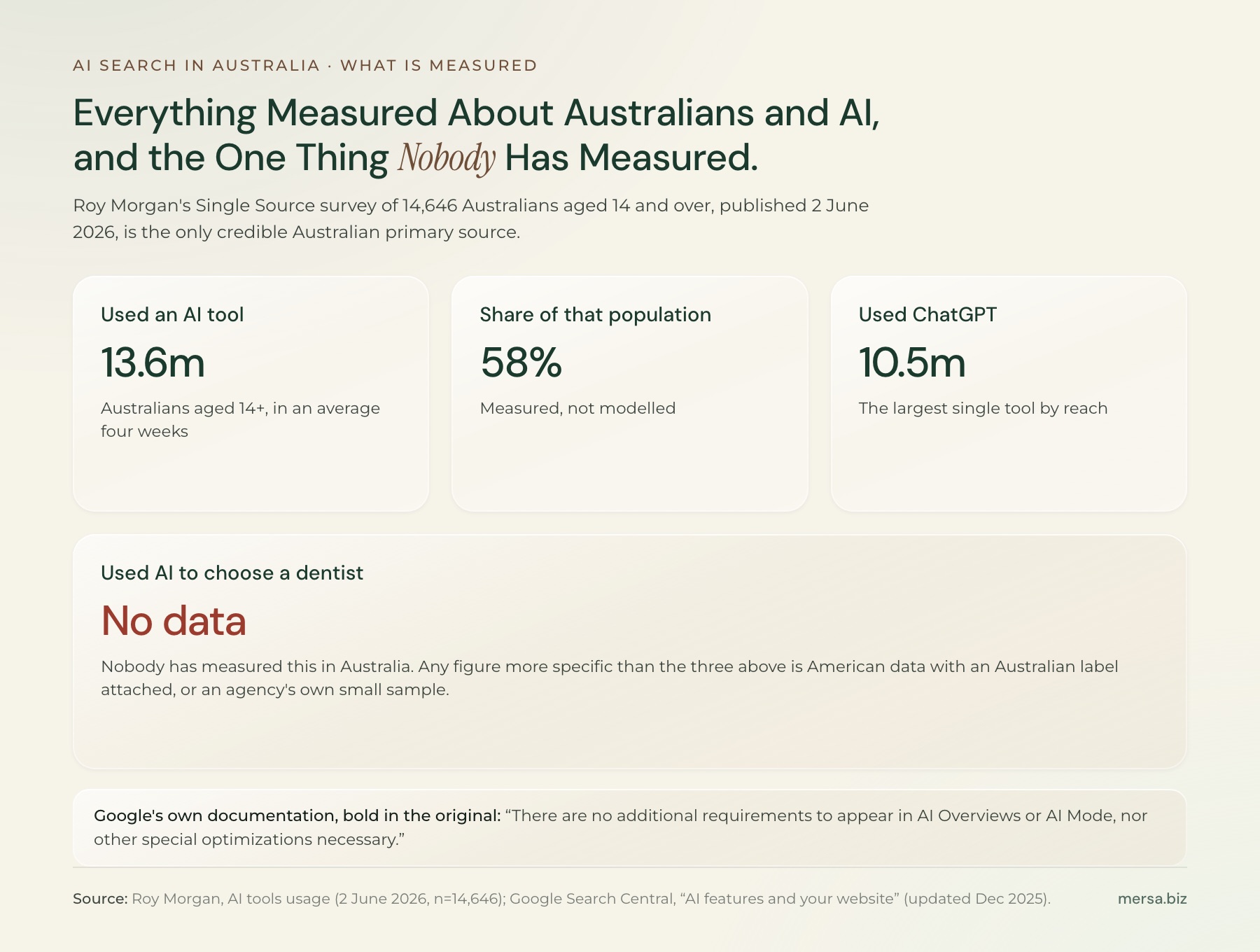
For usage, the only credible Australian primary source is Roy Morgan, published 2 June 2026 from its Single Source survey of 14,646 Australians aged 14 and over. It found 13.6 million Australians, 58% of that population, used an AI tool in an average four weeks. ChatGPT accounted for 10.5 million.
That measures the use of an AI tool. It does not measure the use of AI to choose a dentist, and nobody has measured that in Australia. Every figure quoted about Australian AI search behaviour sounding more specific than this is either American data carrying an Australian label or a marketing agency’s own small sample. I went looking and found several of both.
AI Search Exposure Is Real, and Not Where You Would Guess
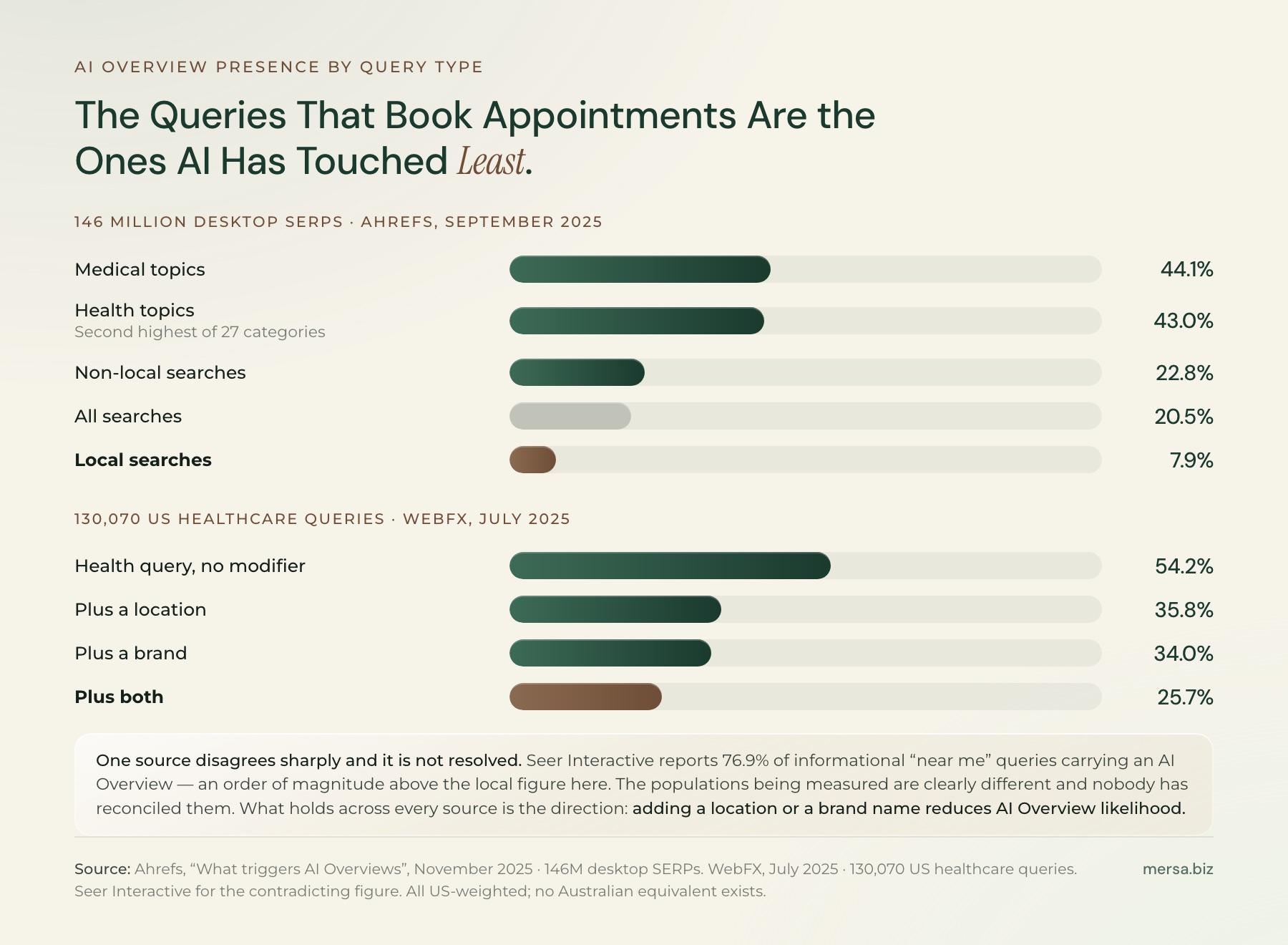
Ahrefs analysed 146 million desktop search results pages in September 2025 and found AI Overviews on 20.5% of them overall. By category, medical topics came in at 44.1% and health at 43.0%, second highest of 27 categories. Health questions rank among the most AI-exposed content on the internet.
Then comes the part that changes the conclusion: within the same dataset, local searches triggered an AI Overview only 7.9% of the time, against 22.8% for non-local.
WebFX found the same gradient inside healthcare specifically, across 130,070 US healthcare queries in July 2025: 54.2% of health searches with no modifier produced an AI Overview, dropping to 35.8% once a location was added, 34.0% with a brand, and 25.7% with both.
So “why does my tooth hurt at night” is heavily AI-mediated while “dentist Coburg” is considerably less so, which means the queries that book appointments are the ones AI has touched least.
One contradiction is worth stating rather than pretending away: Seer Interactive reports 76.9% of informational “near me” queries carrying an AI Overview, an order of magnitude above Ahrefs’ local figure. The populations being measured are clearly different and nobody has reconciled them. The direction that holds across every source is that adding a location or a brand name reduces AI Overview likelihood.
What the AI Search Click Data Says, Including the Bit Nobody Reported
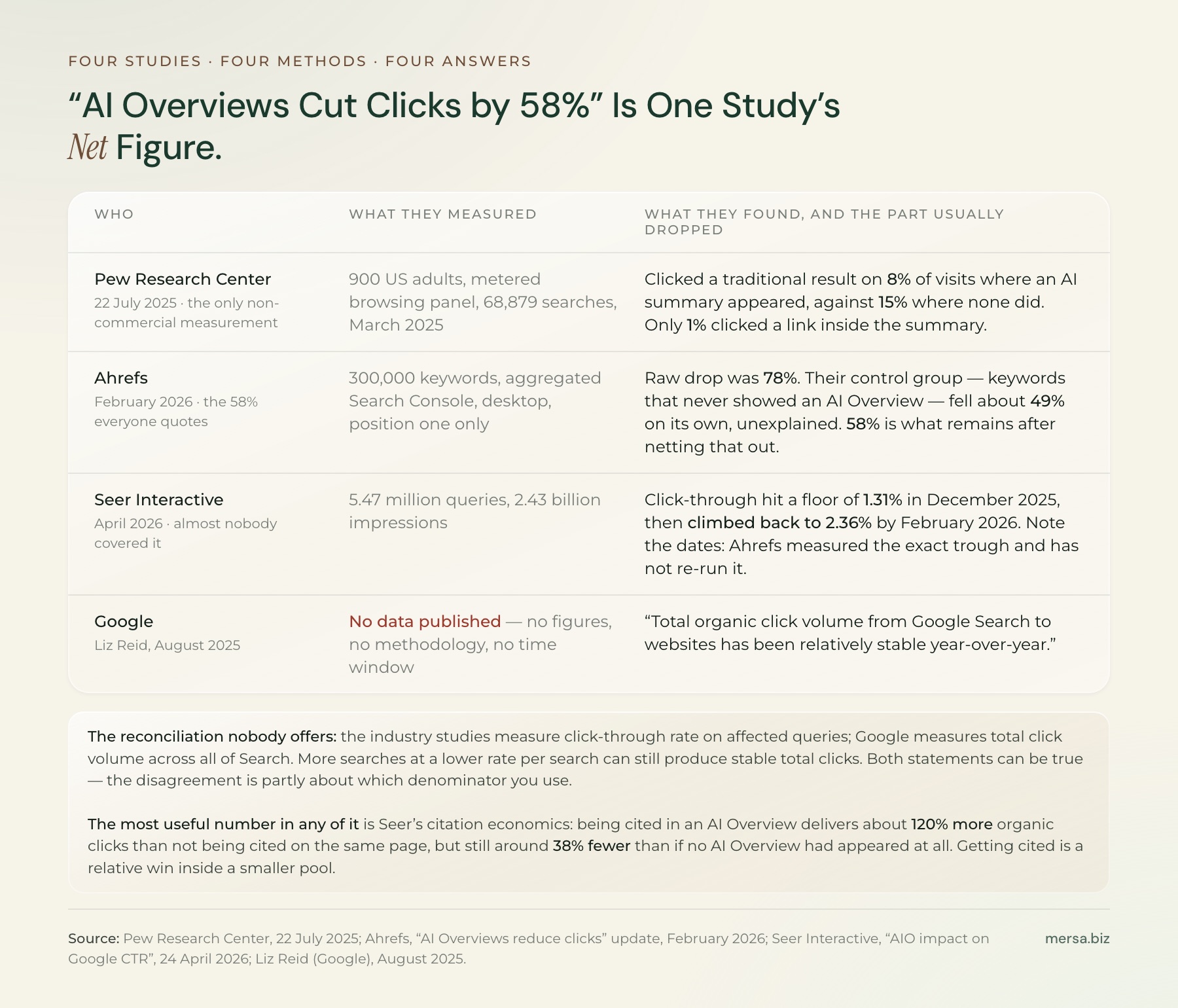
A version of “AI Overviews cut clicks by 58%” has probably been encountered already. The real picture is messier and more interesting.
Pew Research Center: 8% Versus 15%
Pew is the only non-commercial measurement in this field, and the only one carrying no product to sell. In a study published 22 July 2025, it tracked 900 US adults through a metered browsing panel across 68,879 searches in March 2025. Users clicked a traditional result on 8% of visits where an AI summary appeared, against 15% where one did not. Only 1% clicked a link inside the summary itself.
Ahrefs: The 58% Figure, and Its Control Group
Ahrefs produced the 58% figure in February 2026, from 300,000 keywords using aggregated Search Console data, desktop, position one only.
The detail almost every retelling omits is that their control group, informational keywords never showing an AI Overview, fell approximately 49% on its own over the same window. The raw drop on AI Overview keywords was 78%, and 58% is what remains after netting out a control decline Ahrefs cannot explain.
Seer Interactive: The Recovery Nobody Covered
Seer Interactive published the sequel in April 2026 and almost nobody covered it. Across 5.47 million queries and 2.43 billion impressions, organic click-through on AI Overview queries fell to a floor of 1.31% in December 2025 and then climbed back to 2.36% by February 2026.
Seer refuses to name a cause and warns against forecasting from two months. The dates are nonetheless worth noting: Ahrefs measured December 2025, the exact trough, and has not re-run the study.
Google Says the Opposite
Liz Reid, its head of Search, wrote in August 2025 that “total organic click volume from Google Search to websites has been relatively stable year-over-year”. No data was published with that statement, and no figures, methodology or time window accompanied it.
The reconciliation nobody offers, and the one I think fair, is this. The industry studies measure click-through rate on affected queries, whereas Google measures total click volume across all of Search.
More searches at a lower rate per search can still produce stable total clicks. Both statements can be true at once, and the disagreement is partly about which denominator you use.
The most useful number in any of it is Seer’s citation economics: being cited in an AI Overview delivers about 120% more organic clicks than not being cited on the same results page, but still around 38% fewer than if no AI Overview had appeared at all. Citation therefore constitutes a relative win inside a smaller pool.
What Predicts Being Cited in AI Search
Two findings emerge, and they point in different directions depending on which AI is meant.
For AI Overviews, Ranking Is the Whole Game
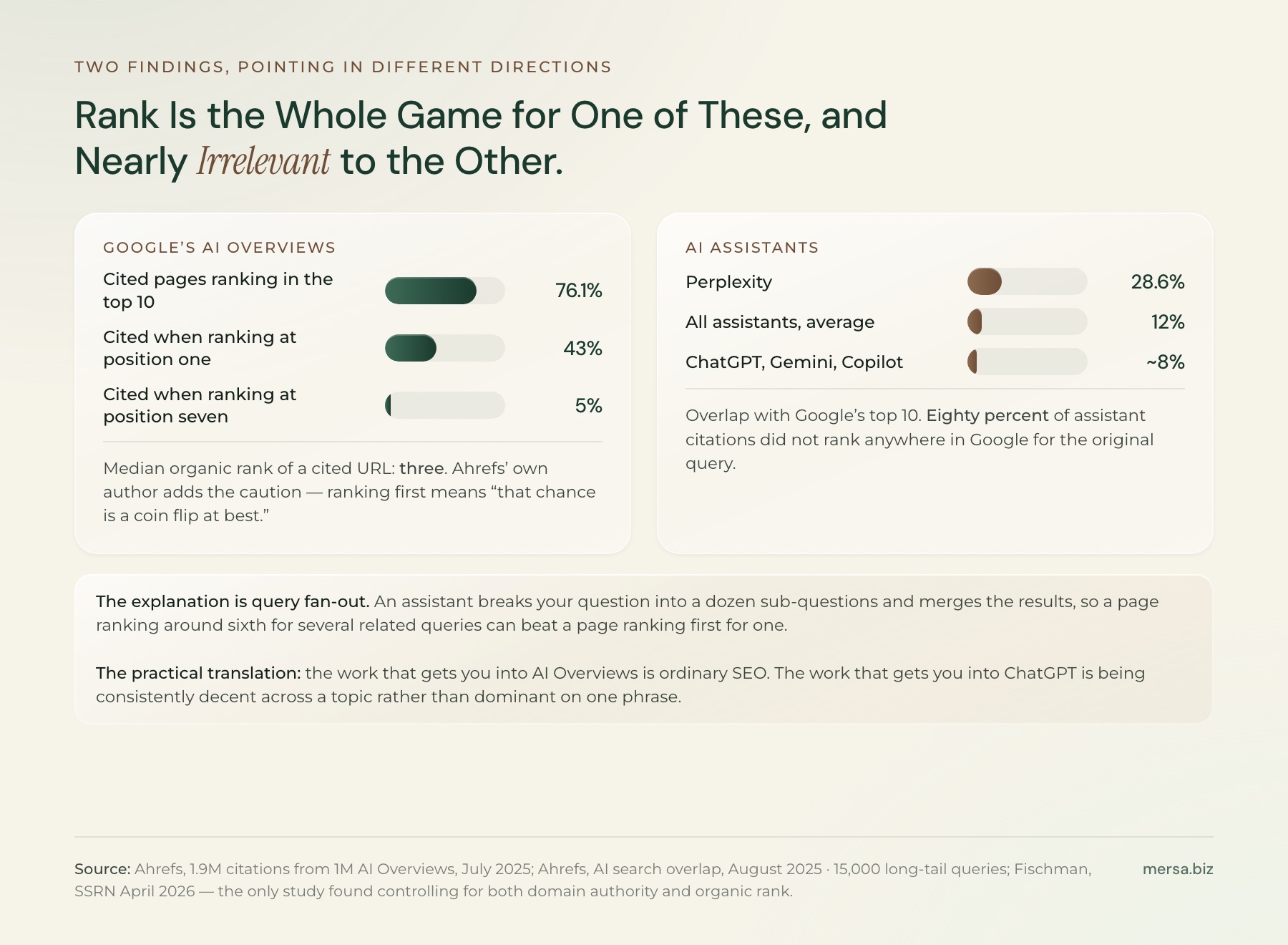
Ahrefs examined 1.9 million citations from a million AI Overviews in July 2025: 76.1% of cited pages ranked in Google’s top 10, and the median organic rank of a cited URL was three.
A separate study by Kurt Fischman, posted to SSRN in April 2026 and the only one I found controlling for both domain authority and organic rank, found rank dominated everything: a page at position one was cited in 43% of queries, a page at position seven in 5%.
Ahrefs’ own author adds the necessary caution: ranking first means “that chance is a coin flip at best.”
For AI Assistants, Ranking Barely Transfers
Ahrefs ran 15,000 long-tail queries in August 2025 and found AI assistant citations overlapped with Google’s top 10 only 12% of the time. Perplexity was the exception at 28.6%; ChatGPT, Gemini and Copilot all sat around 8%. Eighty percent of assistant citations did not rank anywhere in Google for the original query.
The explanation is query fan-out again. An assistant breaks your question into a dozen sub-questions and merges the results, so a page ranking around sixth for several related queries can beat a page ranking first for one.
The practical translation: the work that gets you into AI Overviews is ordinary SEO. The work that gets you into ChatGPT is being consistently decent across a topic rather than dominant on one phrase.
Schema Does Not Do What You Have Been Told About AI Search
This is the single most oversold item in the category, so the whole evidence base follows.
Google, under a heading that literally reads “Mythbusting generative AI search: what you don’t need to do”:
Overfocusing on structured data: Structured data isn’t required for generative AI search, and there’s no special schema.org markup you need to add.
The measured studies agree, repeatedly:
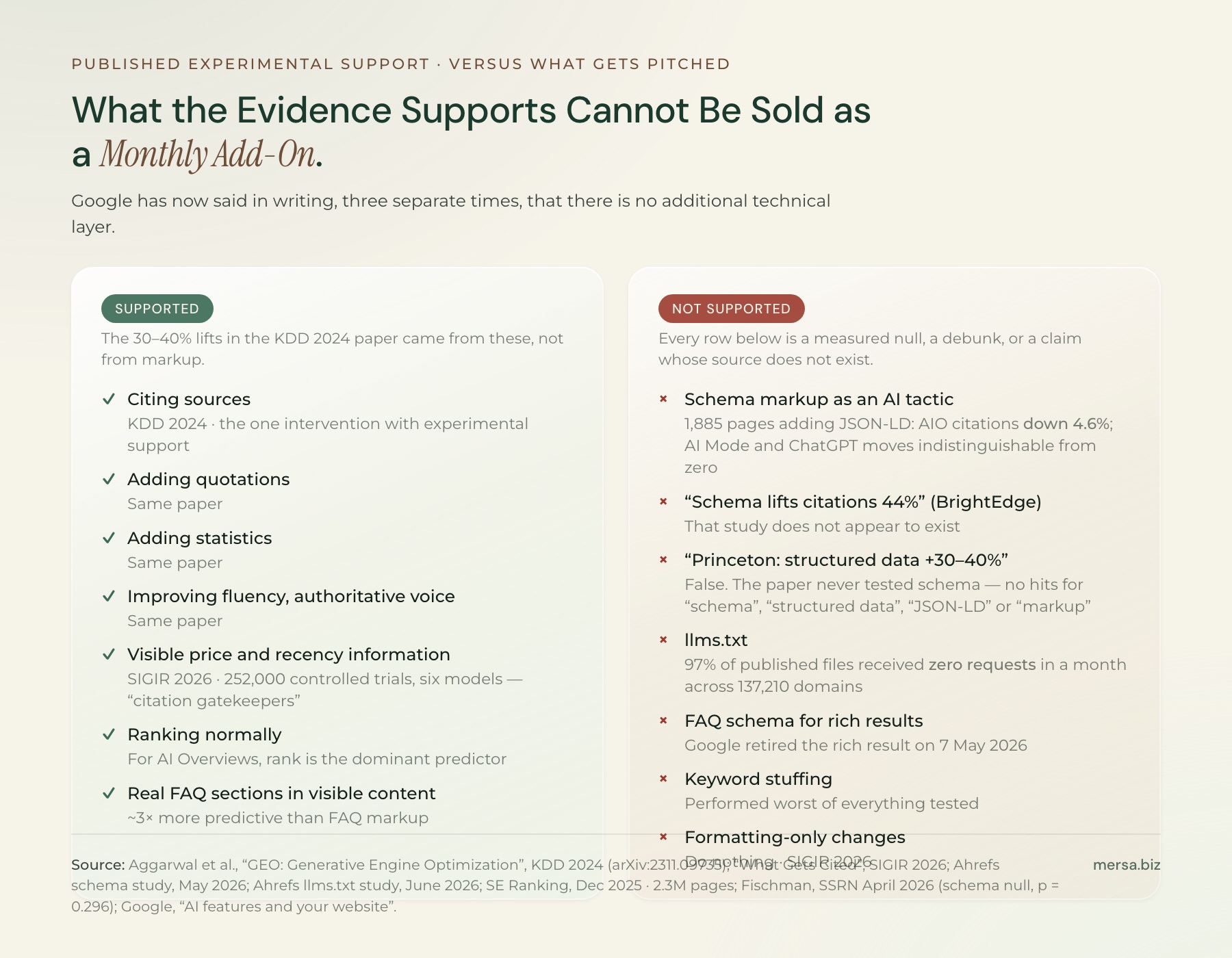
Ahrefs, May 2026, tracked 1,885 pages that added JSON-LD between August 2025 and March 2026 against roughly 4,000 matched control pages. AI Overview citations went down 4.6%. AI Mode and ChatGPT moved up 2.4% and 2.2%, both described as statistically indistinguishable from zero. This is the closest thing to a controlled before-and-after that exists.
Fischman, April 2026, controlling for rank and authority: schema presence was null, p = 0.296. Schema appeared on 43.1% of cited pages and 44.8% of non-cited pages.
SE Ranking, December 2025, 2.3 million pages: FAQ schema had no impact on AI Mode citations, and was about three times weaker than simply having real FAQ sections in the visible content.
searchVIU, December 2025, planted test values in eight conditions across five systems: “JSON-LD Schema Markup is NOT extracted by ANY system during direct fetch.” Every value the systems found was in visible content.
No study exists finding that schema causes citations while controlling for rank. Ahrefs names the confounder itself: schema tends to reside on better-maintained sites, and those sites publish better content and earn more links.
Two claims circulating in the Australian market could not be verified at all. BrightEdge is credited with a study showing a 44% citation lift from schema; that study does not appear to exist, and the real 44% figure from BrightEdge is about something else entirely.
And the Princeton and Georgia Tech generative engine optimisation paper is widely cited as showing structured data improves AI visibility by 30 to 40%. I read it, and it never tested schema: a full-text search returns no hits for “schema”, “structured data”, “JSON-LD” or “markup”.
What that paper, published at KDD 2024, found is more useful anyway. The 30 to 40% lifts came from citing sources, adding quotations, adding statistics, improving fluency, and writing with an authoritative voice. Keyword stuffing performed worst of everything tested. A 2026 follow-up presented at SIGIR, running 252,000 controlled trials across six models, found that visible price and recency information act as citation gatekeepers while formatting-only changes do nothing.
Which is to say that the route to citation is the writing of pages containing specific, current, sourced facts, prices included. That is not a technical trick and cannot be sold as a monthly add-on, which may be why it is not what gets pitched.
Structured data remains worth having for ordinary search, and Google says so in the same breath. It should simply not be purchased as AI visibility. And note that FAQ rich results were retired by Google on 7 May 2026, so anyone selling FAQ schema for rich snippets is selling something Google has switched off.
The One Genuinely New AI Search Thing, Aimed at You
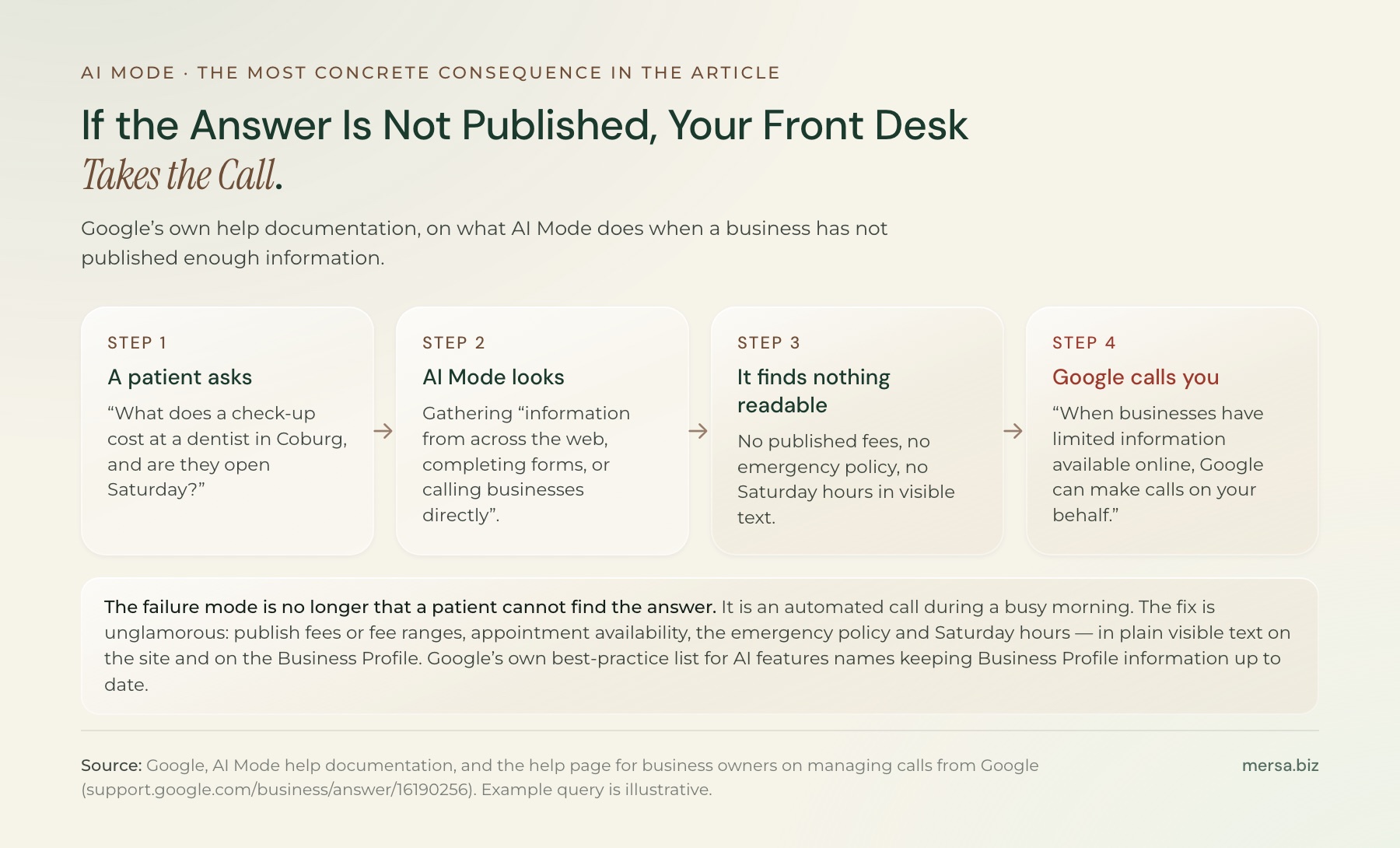
Google’s AI Mode help documentation describes what happens when a business has not published enough information:
AI Mode simplifies your search by gathering information from across the web, completing forms, or calling businesses directly… When businesses have limited information available online, Google can make calls on your behalf.
There is a help page for business owners about managing these calls.
For a dental practice that is the most concrete consequence in this entire article. Where your fees, appointment availability, emergency policy and Saturday hours are not published anywhere a machine can read them, the failure mode is no longer a patient unable to find the answer, but your front desk taking an automated call about it during a busy morning.
The fix is unglamorous: the information should be published, on your website in plain visible text and on your Google Business Profile. Google’s own best-practice list for AI features names the maintenance of current Business Profile information.
Related, and worth watching rather than acting on: Sterling Sky reported in January 2026 that an AI-generated local pack is beginning to displace the traditional three-pack on around 8% of keywords, often showing one or two businesses instead of three, surfacing 32% fewer unique businesses, and in many versions dropping the click-to-call button while paid ads keep theirs.
llms.txt Is a File Nobody Reads
This will be offered, so it is worth covering. llms.txt is a markdown file at your site root, proposed in September 2024, and its own specification makes no claim regarding AI search visibility. That framing was added afterwards by the SEO industry.
Google, in writing:
You don’t need to create new machine readable files, AI text files, markup, or Markdown to appear in Google Search (including its generative AI capabilities), as Google Search itself doesn’t use them… Doing so will neither harm nor help your site’s visibility or rankings in Google Search, as Google Search ignores them.
John Mueller of Google compared it to the keywords meta tag, adding that “none of the AI services have said they’re using LLMs.TXT (and you can tell when you look at your server logs that they don’t even check for it)”.
Ahrefs tested that in June 2026 across all 137,210 domains in its analytics product. Approximately 28% published a valid llms.txt, and ninety-seven percent of those files received zero requests in May 2026. No AI bot ever requested an llms.txt URL returning a 404 either, which means no getting-on-the-radar effect exists.
Where a CMS generates one automatically the cost is nothing and it may stay. Where somebody is charging for it as an AI visibility service, the charge is for a file the companies it is named after have never agreed to read. The full server-log breakdown, including who does fetch these files, is in the llms.txt piece.
Two AI Search Crawler Facts Usually Stated Backwards
These are worth knowing because they are commonly reversed, including by the people configuring your site.
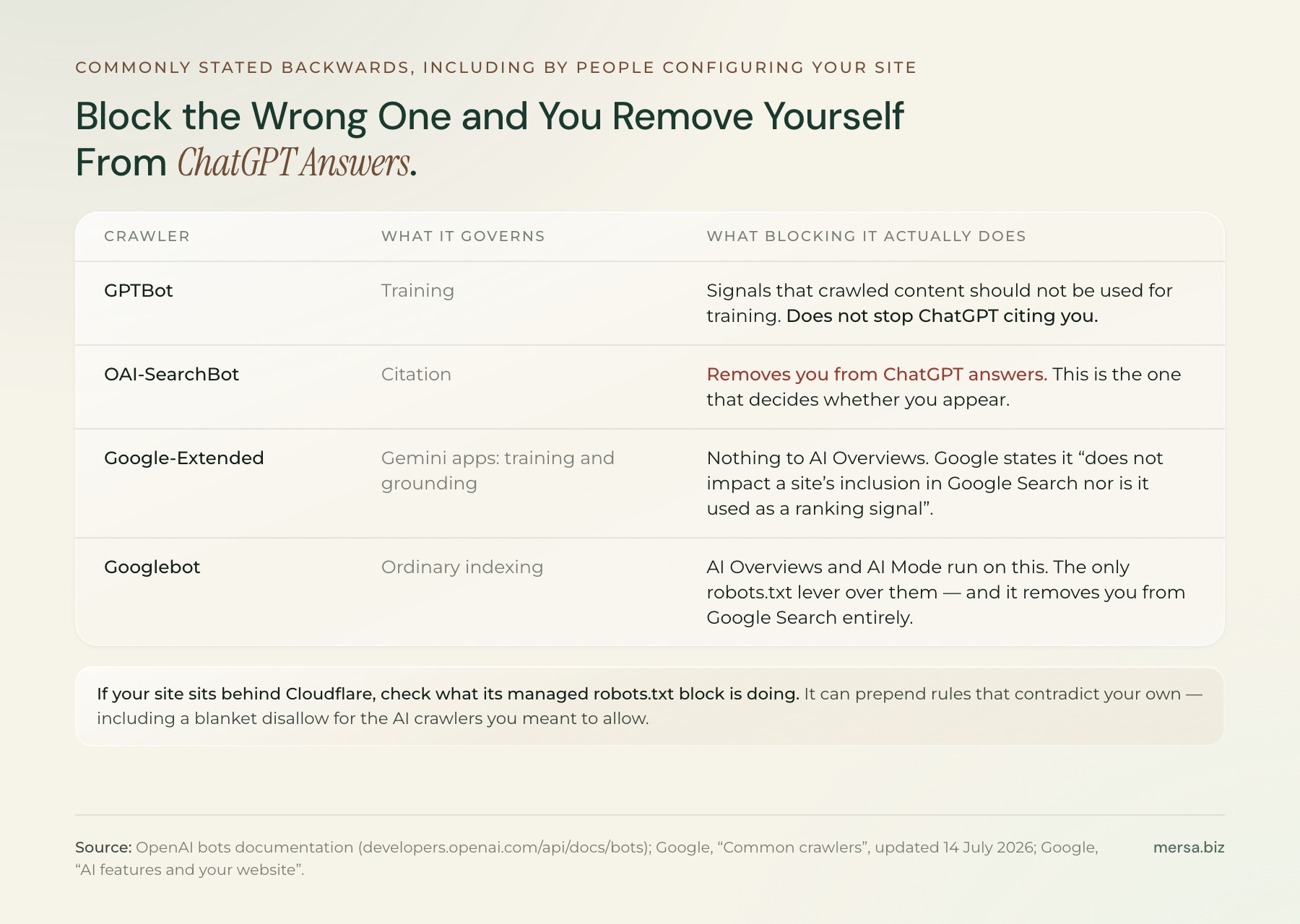
Blocking GPTBot does not stop ChatGPT citing you. OpenAI documents that its crawlers are independent: “a webmaster can allow OAI-SearchBot in order to appear in search results while disallowing GPTBot to indicate that crawled content should not be used for training.” GPTBot governs training and OAI-SearchBot governs citation, so blocking the wrong one removes you from ChatGPT answers.
Google-Extended does not control AI Overviews. Google states it governs training and grounding for Gemini apps, and that it “does not impact a site’s inclusion in Google Search nor is it used as a ranking signal”. AI Overviews and AI Mode run on ordinary Googlebot indexing. The only robots.txt lever over them is blocking Googlebot, which removes you from Google Search entirely.
Where your site sits behind Cloudflare, its managed robots.txt block is worth checking, because rules contradicting your own can be prepended to it.
What Australian Patients Are Doing in AI Search
The honest answer is that nobody knows, and the American data is worth reading with that stated in advance.
BrightLocal’s March 2026 survey of 1,002 US adults found 45% had used AI tools for local business recommendations, with ChatGPT at 31% and Google AI Mode at 23%. The widely quoted jump from 6% the previous year should be treated with suspicion, as the question wording appears to have changed between waves.
More on point, and more concerning: in a 2026 survey of nearly 1,000 US patients by the healthcare vendor rater8, with no Australian sample, AI Overviews were the most trusted section of a search results page for healthcare queries at 37%, against 20% for organic links and 13% for the local map pack.
In that same US sample, 66% had encountered incorrect provider information from an AI tool, and 60% still trusted the AI summary without verifying it.
Then comes the counterweight, which rarely appears in the same article. SparkToro’s clickstream analysis found more than 95% of Americans remain regular users of traditional search engines, with no meaningful decline over two and a half years, and Google still running roughly 210 times the query volume of ChatGPT. Similarweb put AI Mode at 0.34% of all Google searches between January and April 2026.
Both things are true: AI answers are trusted disproportionately where they appear, and they still appear on a small fraction of the searches bringing patients to a dental practice.
One more is worth including, because it is dental-specific and the only one I found. BrightLocal ran 20 local searches across four AI engines in July 2025 and noted: “In our dentistry searches, ChatGPT exclusively sourced information from ten different dental directories.” That is a sample of twenty, produced by a company selling citation building, so it should be held loosely.
It also contradicts BrightLocal’s own December 2024 study, which found Yelp, Facebook and Google Maps absent from ChatGPT’s local sources entirely while business websites accounted for 58%. Directory source mixes shift over months, so anything built on whichever directory is currently favoured carries a short shelf life.
What to Do About AI Search, Which Is Boring
The best-supported finding across every local study that measured it is that the business’s own website is the largest single source category. Least fashionable, best evidenced.
So your real information should be published in visible text: fees or fee ranges, treatment explanations, hours including holidays, emergency policy, what a first visit involves, and which health funds you accept. It should be written as prose a person would read, because the systems extracting it are reading the visible page rather than the markup.
Sources should be cited and specific numbers included wherever you hold them, that being the one intervention carrying published experimental support.
Rank normally, since for AI Overviews rank is the dominant predictor and no separate lever exists.
Keep your Business Profile current, which Google names directly within its own AI guidance.
Publish prices and recency signals, which the SIGIR work identified as citation gatekeepers.
Then stop. No additional technical layer exists, and Google has now stated so in writing on three separate occasions.
Where a proposal contains a monthly line item for AI visibility, the questions worth asking are which of the above it is and what it costs. Pricing questions in general are covered here, and the AI-citation layer is covered as part of a fixed-price audit.
Common Questions
Do we need to do anything special to appear in AI Overviews?
Google says no, in bold, within its own documentation. A page requires indexing and eligibility to show with a snippet. No additional technical requirements exist.
Does schema markup get us cited by AI?
The controlled studies say no. Ahrefs found a small decline for AI Overviews and no significant effect for AI Mode or ChatGPT. Structured data should be retained for ordinary search rather than deployed as an AI tactic.
Is llms.txt worth adding?
Google states that the file is ignored. Of the sites publishing one, 97% had it fetched by nothing whatsoever within a month. Harmless where free, and not worth paying for.
Are AI Overviews killing our traffic?
On informational health questions exposure is high, while on location-based searches, which are what bring patients, AI Overview presence is far lower. Measured click effects range widely by study, the most recent data shows a partial rebound in early 2026, and Google disputes the entire framing without publishing data.
Should we block AI crawlers?
Which crawler is being blocked should be established first. GPTBot governs training, OAI-SearchBot governs appearance in ChatGPT answers, and Google-Extended has no effect on AI Overviews whatsoever.
How do we get ChatGPT to recommend our practice?
Nobody can promise this, and anyone doing so is guessing. What the research supports is consistent ranking across a topic rather than dominance on one phrase, publication of specific and current facts in visible text, and mention on third-party sites. That is a description of ordinary good marketing.
Are Australian patients really using AI to pick a dentist?
No one has measured it in Australia. Roy Morgan found that 58% of Australians use an AI tool in an average month, but that constitutes tool use rather than provider selection. Everything more specific is US data or an agency’s own small sample.
Why is Google phoning our practice to ask about our prices and availability?
Because that information is not published anywhere a machine can read it. Google’s AI Mode documentation states that where businesses have limited information available online, calls may be placed by Google on a searcher’s behalf. A help page for business owners covers the management of those calls, though the actual fix is upstream: fees, appointment availability, emergency policy and Saturday hours should be published in plain visible text on the site and on the Google Business Profile.
Should we be paying an agency for AI visibility or GEO services?
The question worth asking is what specifically will be done that ordinary search work does not already cover, together with a request that the evidence be identified. Google’s own documentation states that no additional requirements and no special optimisations exist for appearance in AI Overviews or AI Mode. Where a proposal consists of llms.txt, AI-specific schema and “AI-optimised content”, the work being sold carries published evidence against it.
Does adding FAQ or dental schema get our practice quoted in AI answers?
Not on the evidence available. Ahrefs tracked 1,885 pages adding schema and found no citation effect. Structured data performs useful functions for search features, though citation by a generative answer is not among the functions it has been shown to perform.
Is llms.txt worth adding to our website?
Only where a CMS generates it at no cost. Ahrefs tested every domain in its analytics product in June 2026: approximately 28% published a valid llms.txt, and 97% of those files received zero requests in the month measured. Google states that the file is ignored. Nobody should be charging for one.
Will blocking AI crawlers protect our practice, and which one do we block?
The two levers most often reversed are worth getting right. Blocking GPTBot prevents content being used for training but does not remove a practice from ChatGPT answers, OAI-SearchBot being the crawler governing citation. Google-Extended covers Gemini apps and has no effect on AI Overviews whatsoever, because those run on ordinary Googlebot. The only robots.txt lever over AI Overviews is blocking Googlebot, which removes a site from Google Search entirely.
Are AI Overviews going to stop patients clicking through to our website?
For some queries, yes, and the click studies disagree about how much. The detail that matters for a dental practice is where AI Overviews actually appear: they are far more common on medical and health topics than on searches carrying a location, and local intent is what most patients search with.
How do we get ChatGPT or Gemini to recommend our practice?
No submission process and no setting exists. What the citation research supports is that generative answers draw heavily on pages already ranking well, so the work is the ordinary work: being findable, being accurate, and publishing the specific things a patient asks about. Anyone promising placement in an AI answer is promising something they cannot control.
Sources
- Google: AI features and your website, updated 10 December 2025
- Google: Optimizing your website for generative AI features, updated 10 July 2026
- Google: AI Mode help and managing calls from Google
- Pew Research Center, 22 July 2025, 900 US adults, 68,879 searches
- Ahrefs: AI Overviews reduce clicks, update, February 2026, 300,000 keywords
- Seer Interactive: AIO impact on CTR, 2026 update, 24 April 2026, 5.47M queries
- Ahrefs: What triggers AI Overviews, November 2025, 146M SERPs
- Ahrefs: 76% of AI Overview citations pull from the top 10, July 2025
- Ahrefs: AI search overlap, August 2025, 15,000 queries
- Ahrefs: We tracked 1,885 pages adding schema, May 2026
- Ahrefs: llms.txt study, June 2026, 137,210 domains
- Aggarwal et al., “GEO: Generative Engine Optimization”, KDD 2024, arXiv:2311.09735
- “What Gets Cited: Competitive GEO in AI Answer Engines”, SIGIR 2026
- Roy Morgan: AI tools usage, 2 June 2026, 14,646 Australians
- BrightLocal: Consumers asking AI for business recommendations, March 2026, 1,002 US adults
- rater8: 2026 Patient Choice Report, June 2026, ~1,000 US patients
- OpenAI: Bots documentation
- Google: Common crawlers, updated 14 July 2026