
Table of Contents
You need virtually none of the standard international SEO toolkit to sell into one country from another in one language. Hreflang is unnecessary, because you have no alternate pages to distinguish, and a country-code domain is equally unnecessary.
What you do need is the component addressed by no available guide. Nearly all search surfaces are reachable from abroad, with the exception of the local map pack, which no level of expenditure will alter.
Key Takeaways
- A single-language site directed at one country requires zero hreflang tags. Across a crawl of 18,786 sites carrying hreflang, 31.02% were found by Dan Taylor of SALT.agency to contain conflicting directives, introducing a risk previously absent.
- The local map pack represents a structural barrier rather than a budgetary one. Local results are ranked by Google on relevance, distance and prominence, with distance measured from the position of the searcher.
- Search Console country targeting was retired by Google in August 2022 and removed in September of that year. Any checklist still opening with that step describes a function that ceased to exist four years ago.
- Server location is described in Google’s own documentation as “not a definitive signal”. Hosting abroad therefore is no meaningful obstacle.
- Trust remains the operative constraint. State the city you work from, the hours your day overlaps the buyer’s, the currency you invoice in, and publish work with verifiable figures in it.
Every guide to international SEO addresses a different company entirely. That company has a home market and is expanding outward, and its difficulty consists of a single site being required to serve several countries in several languages. For that reason the guide opens with hreflang, advocates ccTLDs over subdirectories, and concludes with translation quality.
The reverse situation is considerably more common and receives almost no attention. You are located physically in one country and sell into one other country, operating in a single language, with no office there, no local telephone number and no intention of establishing either.
Mersa is such a business: a two-person marketing studio based in Bali, providing search and content services to dental practices in Australia. None of what follows is therefore hypothetical, and every figure presented is verifiable against the citations at the end of this article.
What Every International SEO Guide Assumes About You
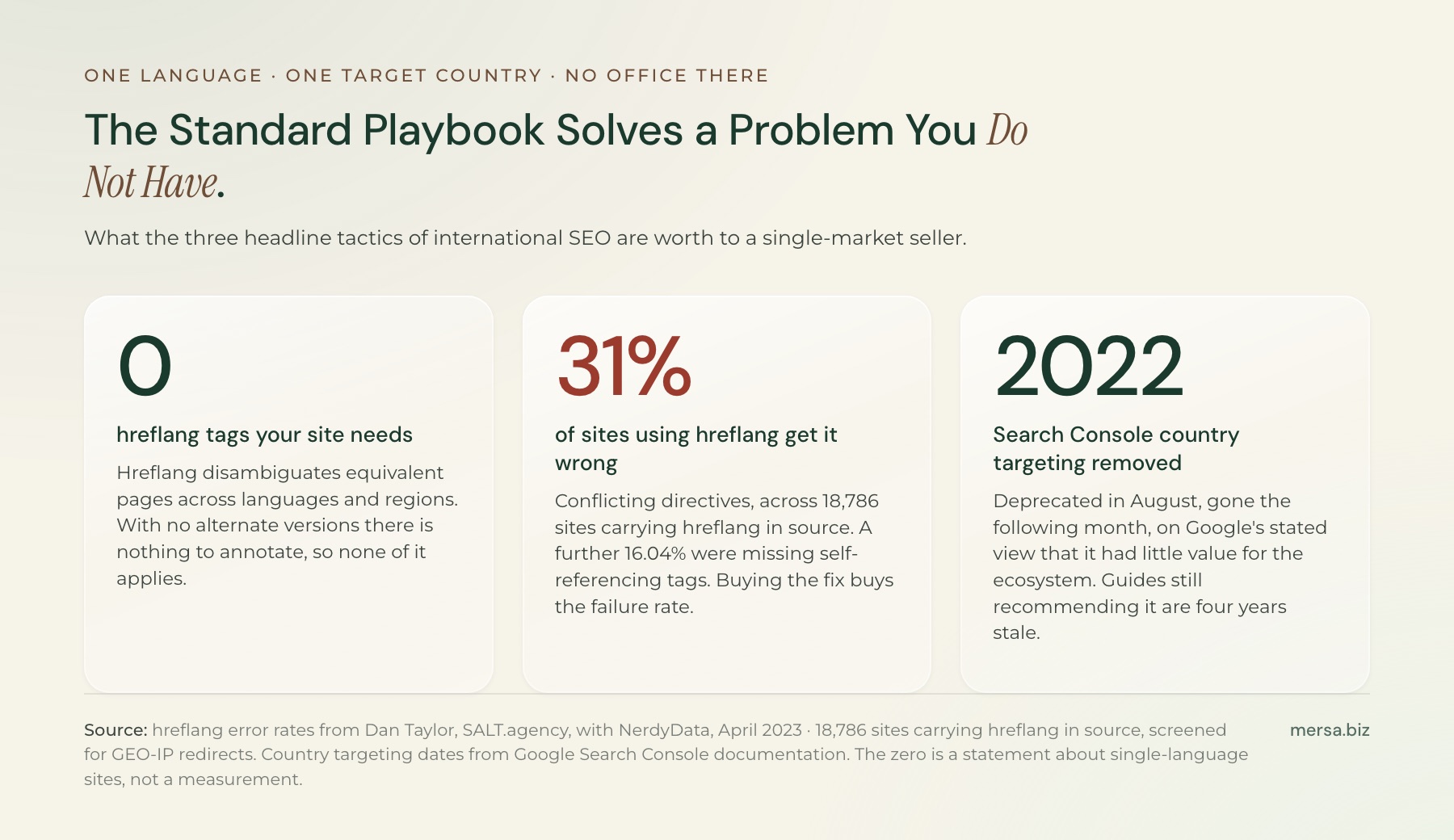
The standard checklist resolves a single problem: the communication to a search engine of which near-duplicate page belongs to which country and language. That is the function of hreflang, and it’s a function difficult to implement correctly.
When 18,786 sites carrying hreflang in their source were crawled by Dan Taylor of SALT.agency together with NerdyData, 31.02% were found to contain conflicting directives, 16.04% were missing self-referencing tags, and 47.95% contained no x-default whatsoever.
How Many Hreflang Tags a Single-Market Site Needs
The number of such tags you need on a single English site directed at a single country is zero, and not a reduced or simplified set.
You have nothing to distinguish. No alternative language versions are present, and consequently no return tag can be absent and no directive can conflict with another. A substantial portion of the international SEO industry is therefore engaged in selling a remedy for a condition that does not exist, and its purchase introduces a category of error already committed by about a third of the sites using it.
Whether You Need a Country-Code Domain
The domain question receives an identical answer. Neither a .com.au nor a .de is required for sales into Australia or Germany respectively, regardless of the recommendations presented by domain registrars. ccTLDs are listed in Google’s own documentation as one signal among several, alongside hreflang, server location, and what is described there as other signals: local addresses and telephone numbers appearing on the pages, together with local language and currency.
It is the strongest member of that set. It is also expensive, restricted to a single country, and frequently not legally registrable from outside that jurisdiction.
Where You Can Rank From Abroad, and Where You Cannot
This portion is omitted by the guides, and it’s the sole portion determining whether the project is worth starting.
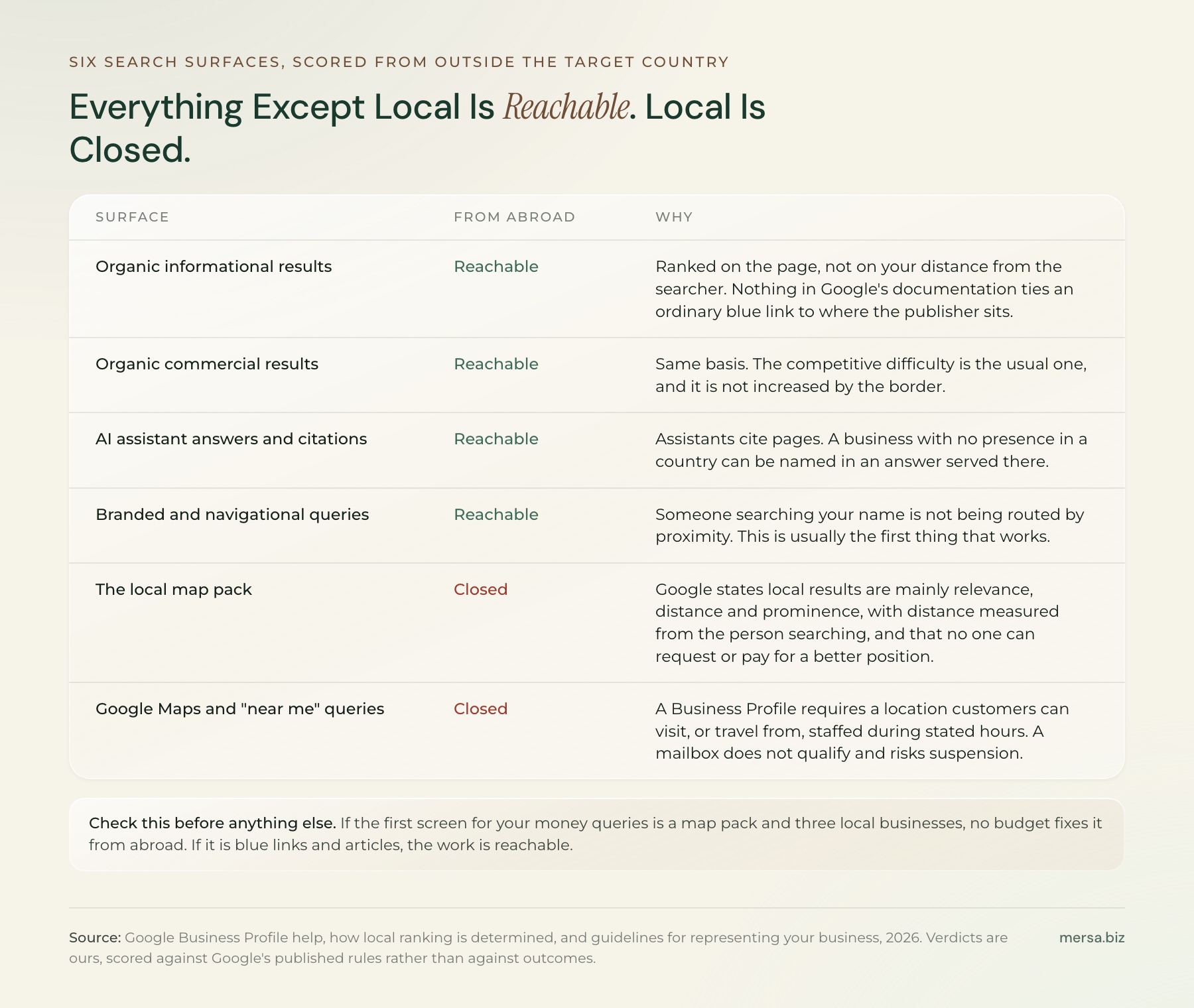
The barrier is constituted by the map pack, and expenditure of effort isn’t a relevant factor. Local results are stated by Google to rest principally on relevance, distance and prominence, with distance defined as the physical separation between each business and the customer conducting the search. It is further stated explicitly that no mechanism exists by which a superior local position may be requested or purchased.
Beneath that consideration lies Business Profile eligibility. A physical location accessible to customers is required, or alternatively a service area to which travel occurs, and contactability at the verified address during published hours is mandatory.
A serviced mailbox in Sydney doesn’t satisfy that requirement. Renting such a mailbox to obtain a listing incurs a suspension risk, and is a misrepresentation delivered at precisely the moment when a prospective client is evaluating trustworthiness.
The honest scope of international SEO conducted from outside the market therefore comprises everything with the exception of local surfaces. Ordinary organic results, both informational and commercial, remain reachable, as ranking is determined by the page rather than by physical proximity to the searcher. Answers produced by AI assistants operate on an identical basis, which explains why a business possessing no local presence may nonetheless be cited within one.
Where the queries of commercial value are dominated by the map pack, no remedy exists from abroad, and an agency that accepts payment without disclosing this in advance has thereby disclosed its own character.
The Signals Google Says It Uses, and the One It Retired
A persistent belief holds that hosting a site abroad damages its rankings within the target country. Server location is positioned by Google’s own documentation at the weaker end of the scale.
The server is described there as often near the users and as capable of indicating the intended audience, followed immediately by the qualification that because content delivery networks are used and hosting is selected wherever infrastructure is better, it does not constitute a definitive signal.
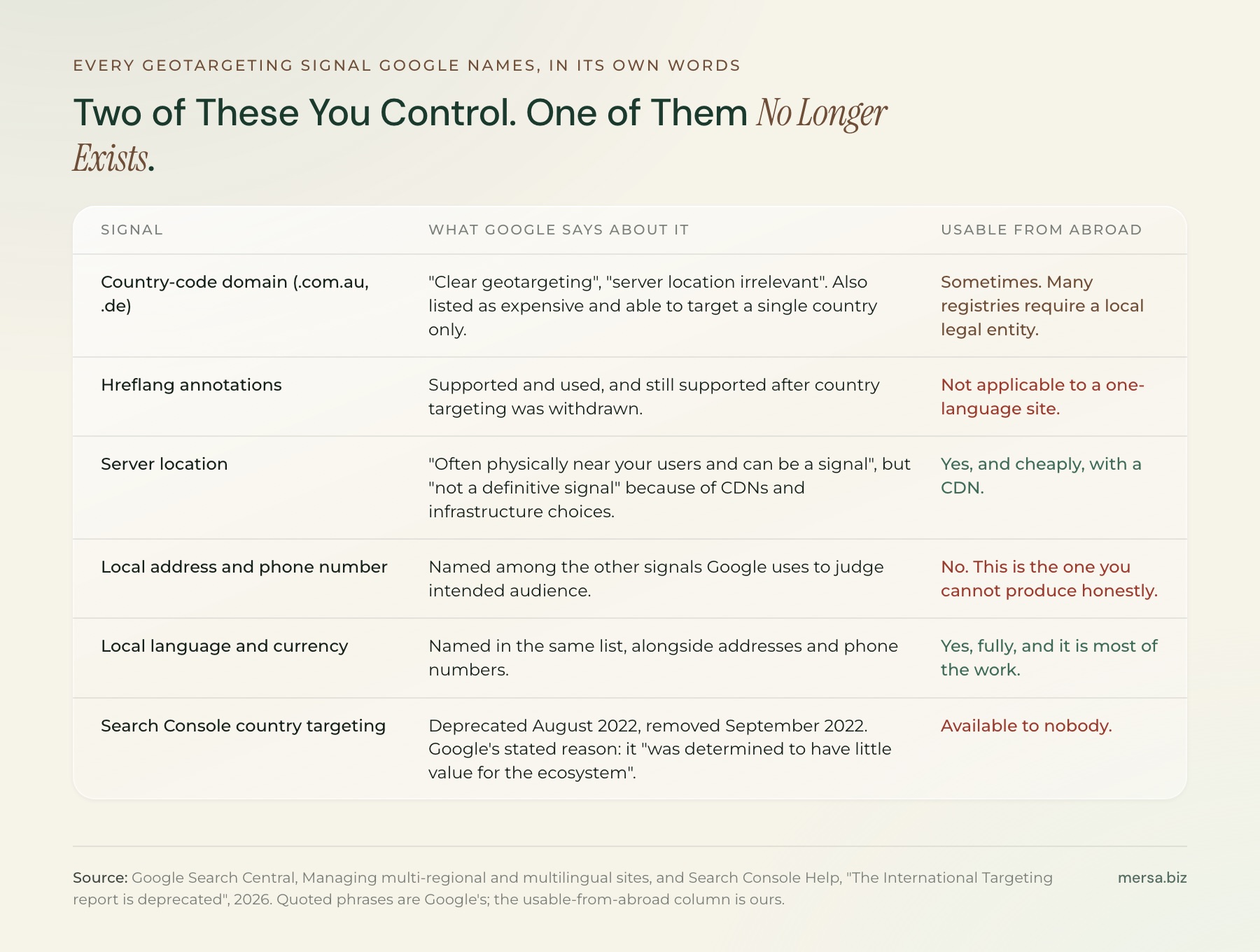
The signal formerly occupying the opening position of every international SEO checklist has meanwhile been absent for four years. The country targeting setting within Search Console, by which a site could be declared as directed at a given country, was deprecated by Google in August 2022 and removed the month after.
The reason stated was that the capability had been determined to hold little value for the ecosystem. Any guidance still recommending its configuration is old enough that its remaining recommendations are worth checking.
What remains available is the page itself, and you control every part of it. Write in the English of the target market.
Quote your pricing in the currency your buyer is familiar with, or state openly which currency you invoice in. Name that country’s regulator, its platforms and its standards, and answer the questions that market actually poses. The work is unglamorous and is most of the undertaking.
Trust Is the Real International SEO Problem
Once the closure of the local surfaces is accepted, the remaining difficulty isn’t technical in nature. A stranger in another country has to decide whether to send you money, and they can’t visit your office or consult a neighbour about you.
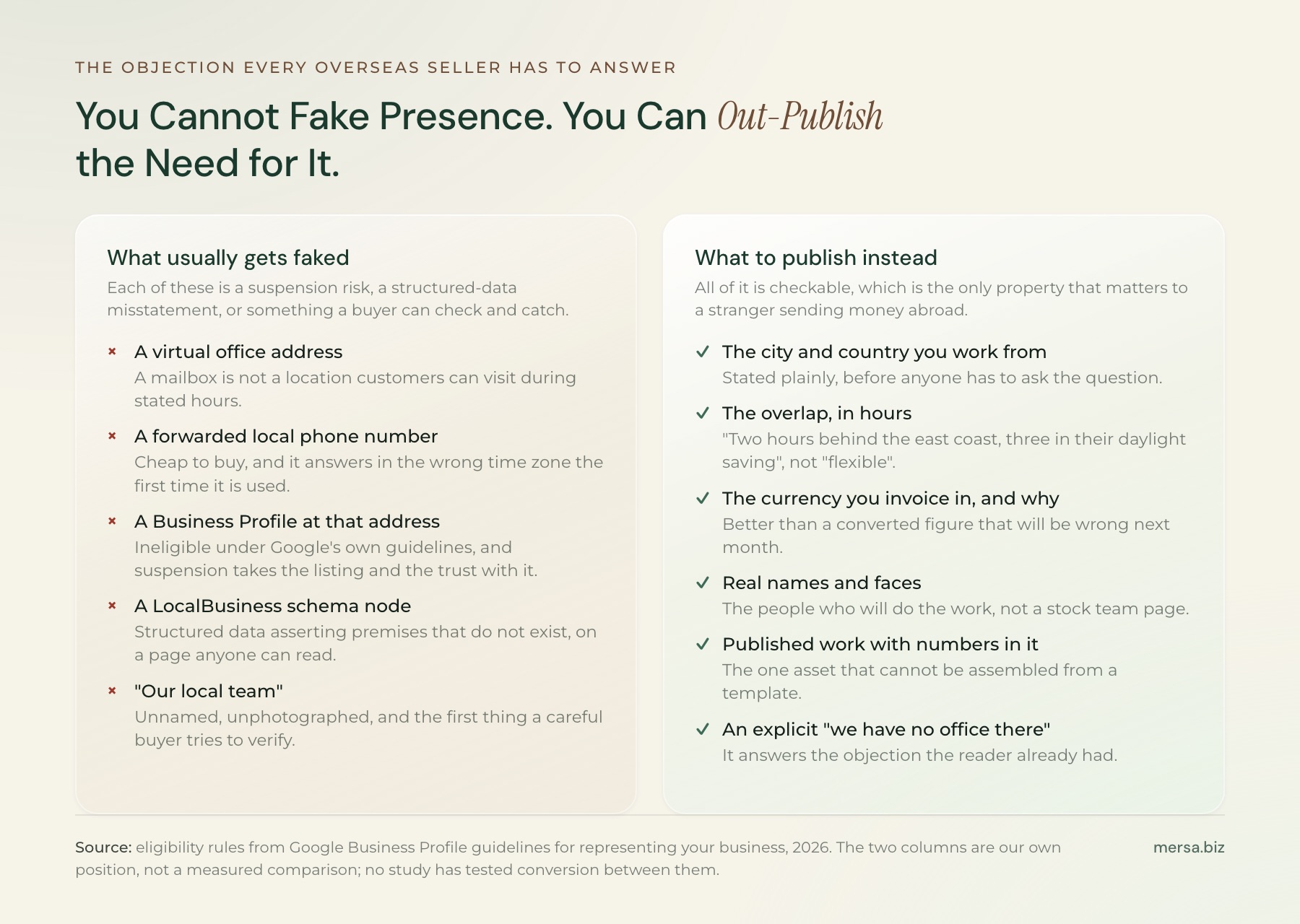
The response employed on our own dentist page consists of a comparison table concluding with a row stating that no Australian office is maintained and that no pretence to the contrary will be offered. That single row performs more effectively than every signal described in the preceding section, as it addresses the objection already held by the reader before it is raised.
Three matters warrant explicit statement rather than implication, and each costs you a single sentence on a page you already control.
The Overlap, in Hours
Bali operates on UTC+8, positioning the studio two hours behind the eastern coast of Australia, and three hours behind during the period of daylight saving observed there. The specific figure is what your buyer requires, and a description such as “flexible” conveys nothing of substance.
The Currency, and Why
We publish in US dollars, because that is the currency in which every client is invoiced. Stating the currency you invoice in is preferable to quoting your reader a converted figure that will have become inaccurate within the month.
Work With Numbers in It
A published audit of a real client exceeds in value any assertion regarding market experience, because your reader is able to examine the working directly. It is also the single asset that cannot be assembled from a template. The qualification is that the document must survive being read in isolation by a reader who has no context, which represents a separate discipline from monthly reporting.
What to Do, in Order
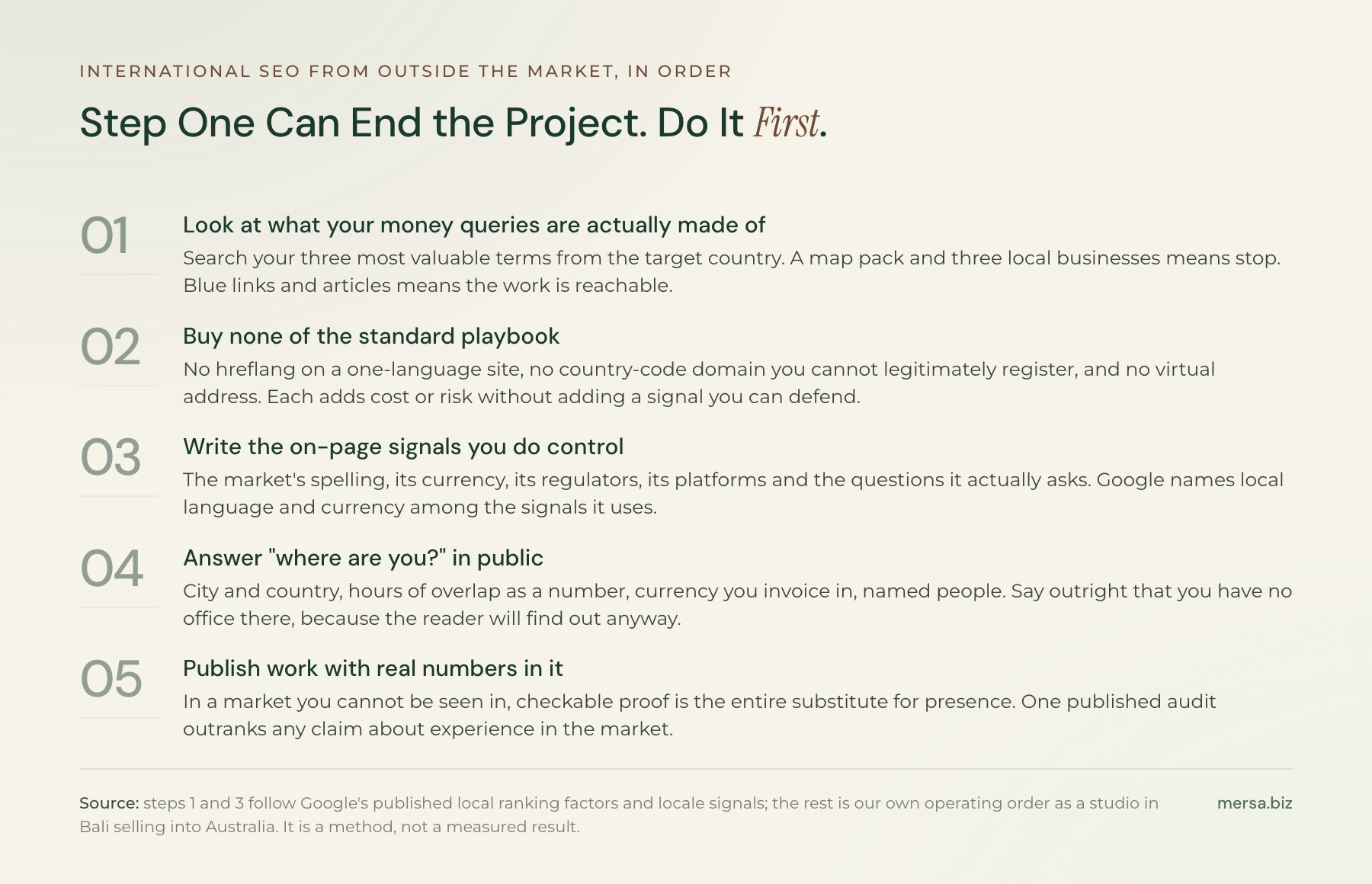
The first step is the one commonly omitted, and it compresses the whole of international SEO from abroad into a single afternoon of review.
Search your three most valuable queries from within the target country and observe the composition of the first screen. Where a map pack and three local businesses fill that screen, you should drop the project. Where ordinary blue links and articles fill it, the work is reachable, and the remainder of that list is your work.
Common Questions
Do I need hreflang tags if my whole website is in one language for one country?
No. Hreflang communicates to a search engine which of several equivalent pages serves which language or region, and a site with no alternate versions therefore has nothing requiring annotation. Its addition creates risk rather than removing it: across a crawl of 18,786 sites employing hreflang, 31.02% carried conflicting directives and 16.04% were missing self-referencing tags. The single exception is genuine duplication, such as separate British and American English pages.
Can a business ranked outside a country appear in that country’s Google map pack?
No, and the limitation is structural rather than a matter of effort. Local results are stated by Google to rest principally on relevance, distance and prominence, with distance measured from the person conducting the search, and it is further stated that no superior local position may be requested or purchased. A Business Profile additionally requires a genuine location accessible to customers or from which travel occurs, staffed during the hours published. The rental of a mailbox for qualification purposes incurs a suspension risk.
Does hosting my website in another country hurt my rankings in the market I sell to?
Barely, according to Google’s own account. Its documentation states that the server is often near the users and may indicate the intended audience, then adds that because content delivery networks are used and hosting is selected wherever infrastructure is better, it doesn’t constitute a definitive signal. The stronger signals reside on the page itself: the language of composition, the currency quoted, and the local entities named. The question of speed is addressed separately by a CDN.
Should I register a country-code domain like .com.au or .de to sell into that market?
Only where legitimate registration is possible and serving that single country is planned. ccTLDs are listed by Google as providing clear geotargeting and rendering server location irrelevant, followed by the associated costs: they are expensive and capable of targeting a single country only. Numerous registries additionally restrict them to entities holding a local legal presence, which an overseas seller does not possess. A subdirectory on the existing domain is the ordinary alternative.
Is Search Console country targeting still a part of international SEO in 2026?
No, it no longer exists in any form. The International Targeting report was deprecated by Google in August 2022 and removed the month after, the stated reason being that the ability to target results to specific countries through Search Console had been determined to hold little value for the ecosystem. Hreflang annotations remain supported and in use. Any checklist opening with the configuration of a target country there has not been revised in four years.
How should a business admit it has no office in the country it sells to?
Plainly, on the page itself, in advance of any enquiry. The city and country of operation should be named, together with the hours of overlap with the buyer’s working day, the currency invoiced in, and the individuals who will perform the work. Mersa publishes a comparison table concluding with a statement that no Australian office is maintained and no pretence to the contrary offered. It outperforms a virtual address, principally because the reader was going to establish the fact regardless.
Working out which queries within a target market are genuinely reachable from the seller’s actual location is the first question addressed by our audit.
Sources
- Google: Managing multi-regional and multilingual sites, Search Central, on ccTLDs, server location and locale signals
- Google Business Profile: guidelines for representing your business, on physical location and in-person contact requirements
- Google: how local ranking is determined, on relevance, distance and prominence
- Google Search Console: the International Targeting report is deprecated, deprecated August 2022, removed September 2022
- Study: 31% of international websites contain hreflang errors, Search Engine Land, 4 April 2023, reporting research by Dan Taylor of SALT.agency with NerdyData across 18,786 sites