
Table of Contents
Three things decide a Google Business Profile’s map pack position, and Google names them: relevance, distance and prominence. Google Posts, Q&A and citation packages are not among them and have been tested to no measurable effect. The item carrying a deadline is different: a departing associate can walk out with a practitioner listing whose existence may be unknown to you.
Key Takeaways
- Google names three ranking factors: relevance, distance and prominence. Distance is measured from the searcher, so it is not something open to optimisation.
- A practitioner listing belongs to the practitioner. While they still work there it cannot be removed or merged, and where they control it, it may be repointed at their next employer.
- Keywords in the business name are prohibited, and Sterling Sky’s test showed the tactic works, which is exactly why it is a suspension risk rather than a tip.
- Google Posts had no measurable ranking impact across 441 keywords per location over nine weeks, at roughly 0.5% click-through.
- Products is not available to Australian practices at all, so a proposal offering to optimise it was written without checking.
A dental practice’s Google Business Profile is usually set up once, by whoever built the website, and then touched only when the phone number changes. The practitioner listing is where to begin, because it is the item here carrying a deadline.
The Practitioner Listing Nobody Told You About
Google allows individual practitioners to have their own Business Profile, separate from the practice. From Google’s guidelines for representing your business:
An individual practitioner is a public-facing professional, typically with their own customer base. Doctors, dentists, lawyers, financial planners, and insurance or real estate agents are all individual practitioners.
Two configurations exist and they carry different rules.
Several Dentists at One Location
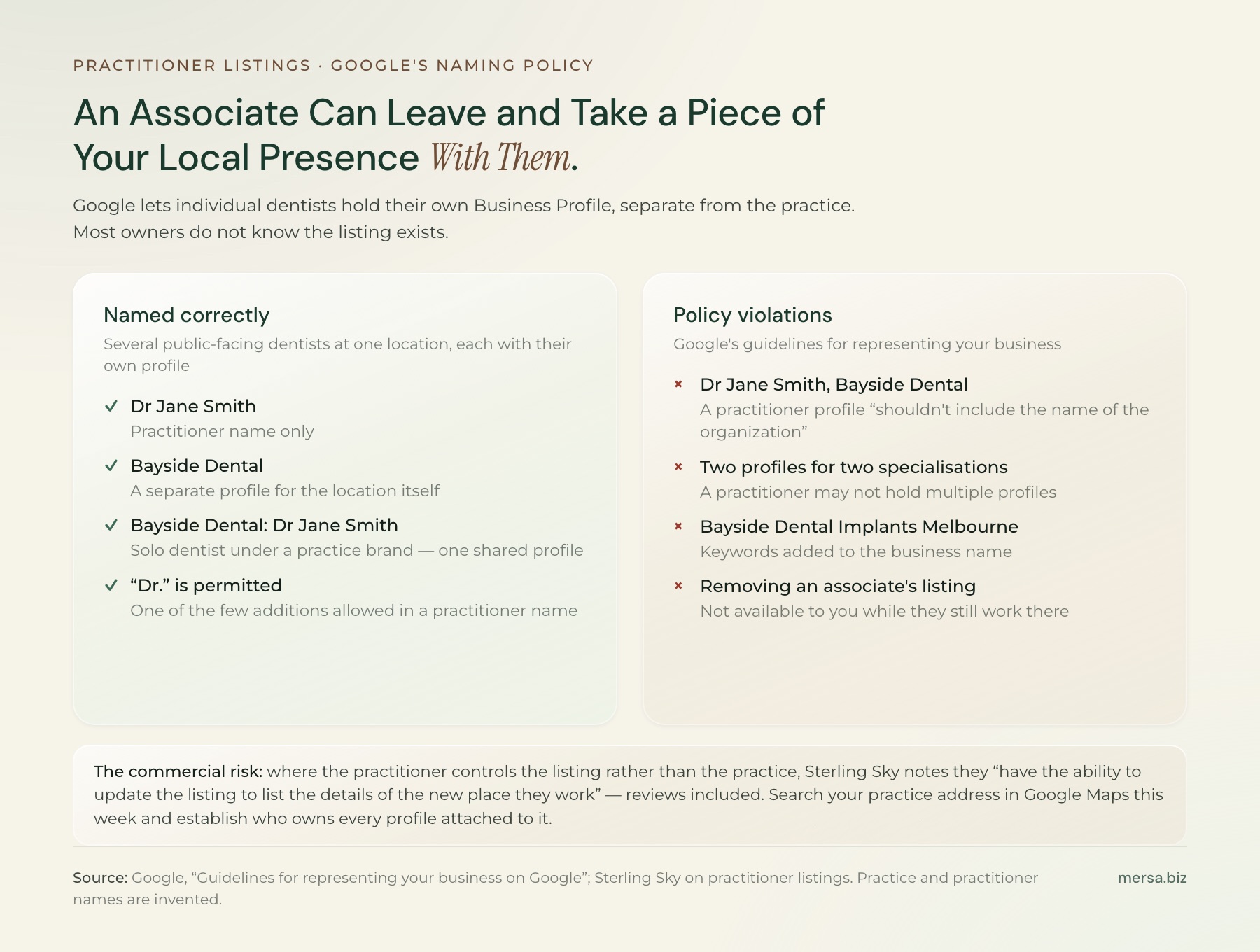
Google says the organisation should create a profile for the location, separate from each practitioner’s, and that the practitioner’s profile “should include only the name of the practitioner, and shouldn’t include the name of the organization”. So “Dr Jane Smith” is correct, while “Dr Jane Smith, Bayside Dental” constitutes a policy violation.
A Solo Dentist Under a Practice Brand
Google says to share a single profile named in the format “[brand/company]: [practitioner name]”. Their example is “Allstate: Joe Miller”, which for a practice would be rendered “Bayside Dental: Dr Jane Smith”.
Also worth knowing is that “Dr.” is permitted on a practitioner profile, being one of the few additions allowed to a name, and that a practitioner may not hold multiple profiles for different specialisations.
The part that matters commercially follows. Sterling Sky, who audit these professionally, note that where a practice has multiple practitioners, “you are not able to get these listings removed or merged provided the practitioner still works there”. And if the practitioner controls the listing rather than the practice, “they have the ability to update the listing to list the details of the new place they work”.
So an associate who claimed their own listing three years ago, accumulated reviews on it, and subsequently leaves for a practice two suburbs over may repoint that listing, reviews included, at their new employer. Joy Hawkins of Sterling Sky puts it bluntly: “Often when we do audits for SMBs we find practitioner listings they had no clue existed.”
Three things are worth doing this week. Your practice address should be searched on Google Maps so that every profile attached to it becomes visible, ownership of each should be established, and a practice policy should be decided on whether associates hold their own listings and what becomes of them on departure.
That is a conversation for your practice agreement rather than your marketing plan.
One caveat applies on the upside: reviews do not pool. Where a patient reviews Dr Smith’s profile, that review does not assist the practice profile, so running practitioner listings means asking patients to review two things rather than one. For most practices that is a reason to keep listings minimal rather than to create more.
What Google Says Decides Google Business Profile Rankings
Verbatim, from Tips to improve your local ranking:
Local results are mainly based on relevance, distance, and popularity.
Relevance is “how well a Business Profile matches what someone is searching for”, improved by providing “complete and detailed business info”. Distance is how far you are from the searcher. Prominence is “how well-known a business is”, based partly on “how many websites link to your business and how many reviews you have”.
Two things are worth noting about that page. First, the summary sentence says “popularity” while the subheading immediately below says “Prominence”, so Google’s own documentation is not internally consistent here, which serves as a useful reminder of how much precision to expect from it.
Second, and more importantly, citations and NAP consistency are never mentioned anywhere on that page. The only external signals named are links and reviews, which is worth retaining for later.
The page also says, plainly: “There’s no way to request or pay for a better local ranking on Google.”
What Practitioners Think Decides Google Business Profile Rankings
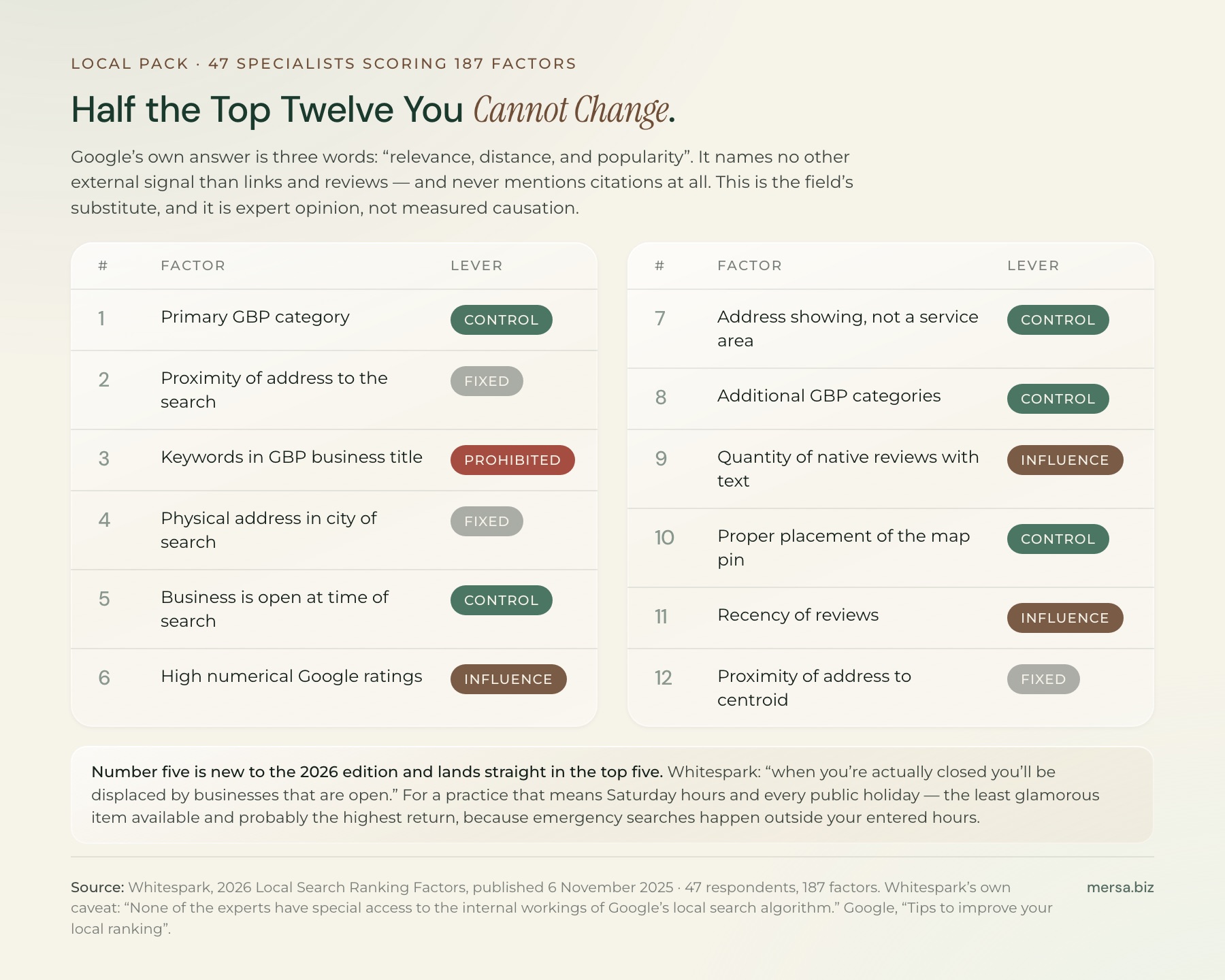
Google’s three-word answer is insufficient to act upon, so the field’s substitute is Whitespark’s Local Search Ranking Factors, published 6 November 2025. Forty-seven local search specialists scored 187 factors across a two-hour survey.
It should be read in the knowledge of what it is. Whitespark says so themselves: “None of the experts have special access to the internal workings of Google’s local search algorithm.” It is aggregated expert opinion, not measured causation. It is also the only longitudinal series in the field, now in its sixth edition.
The top of the 2026 local pack list:
- Primary GBP category
- Proximity of address to the point of search
- Keywords in GBP business title
- Physical address in city of search
- Business is open at time of search
- High numerical Google ratings
- Address showing on GBP, not a service area business
- Additional GBP categories
- Quantity of native Google reviews with text
- Proper placement of the map pin
- Recency of reviews
- Proximity of address to centroid
Several of those cannot be changed, an address being an address. What remains is category selection, hours, reviews, and the map pin, the last being a five-minute fix that a surprising number of practices have wrong.
Number five is new to the 2026 edition and lands straight in the top five. Whitespark’s comment: “when you’re actually closed you’ll be displaced by businesses that are open.”
For a dental practice that carries direct consequences. Where Saturday hours are not entered, you do not appear in Saturday searches, and where public holidays are not set, the profile shows as open while the practice is closed, which is worse than either.
And “emergency dentist” searches, which are the highest-intent queries in dentistry, happen disproportionately outside your entered hours. Special hours are the least glamorous item in this article and probably carry the highest return.
The Uncomfortable One: Keywords in the Business Name
Whitespark’s panel ranks keywords in the GBP business title as the third most influential local pack factor.
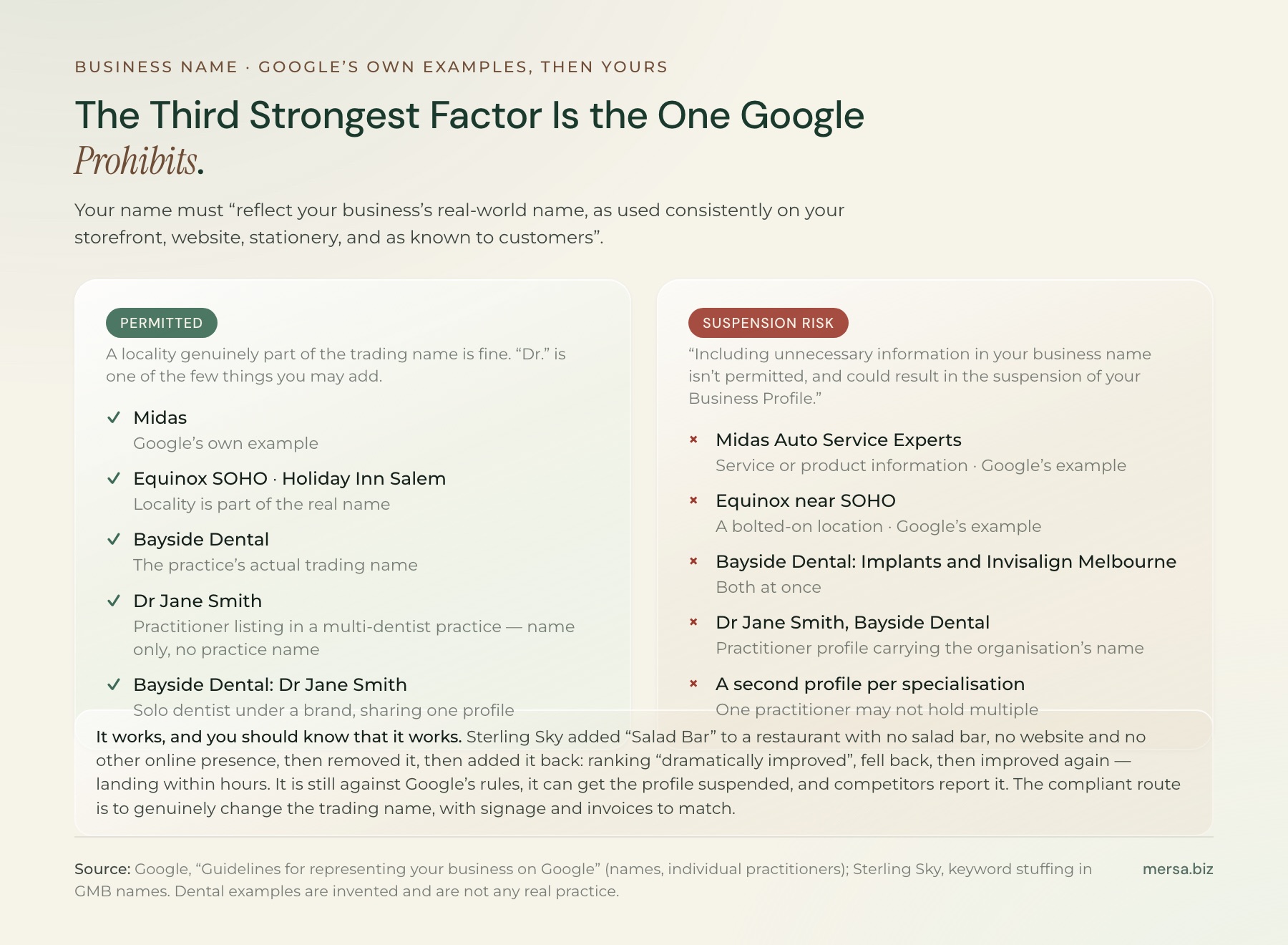
Google’s guidelines prohibit it. Verbatim: “Your name should reflect your business’s real-world name, as used consistently on your storefront, website, stationery, and as known to customers.” And: “Including unnecessary information in your business name isn’t permitted, and could result in the suspension of your Business Profile.”
Google’s own examples make the line clear. Service or product information is out: “Midas Auto Service Experts” not allowed, “Midas” allowed. Bolted-on locations are out: “Equinox near SOHO” not allowed. But a locality genuinely part of the trading name is fine, which is why “Equinox SOHO” and “Holiday Inn Salem” are both permitted.
So “Bayside Dental” is fine, while “Bayside Dental: Implants and Invisalign Melbourne” constitutes a suspension risk.
Whether breaking the rule works has been tested. Sterling Sky ran a controlled test, documented here: they added “Salad Bar” to a restaurant that had no salad bar, no website and no other online presence, removed it, then added it back.
Their result: “adding a keyword to the Google Business name dramatically improved ranking. Removing the keyword decreased rankings back to where they originally were. Adding the keyword back increased rankings dramatically again.” The effect was also observed landing within hours.
This is stated here because it will be discovered anyway, probably by noticing that the practice outranking you is called “Emergency Dentist Brisbane Northside”. It is worth knowing that the tactic works, that it is against Google’s rules, that it can result in the profile being suspended, and that competitors can and do report it.
The legitimate route is the one Hawkins recommends, which is changing the actual trading name. Where the practice genuinely rebrands, with signage, invoices and a website to match, the keyword becomes the name and the guideline is satisfied. That is a real business decision carrying real costs, and for some practices it is worth making deliberately rather than as a growth hack.
For a health practice a second layer applies. A Google Business Profile name and description constitute advertising of a regulated health service, so a name asserting superiority, or a description promising outcomes, sits under the same National Law rules as your website copy. Covered in the AHPRA advertising piece, and worth a look at your profile description specifically, because it is usually written once and never reviewed.
Google Business Profile Categories and Services
Google’s rule on categories: “Use as few categories as possible to describe your overall core business” and “Do not use categories solely as keywords or to describe attributes of your business”. The test they give is whether the category completes “this business is a” rather than “this business has a”.
Primary category is the number one factor on Whitespark’s list, so it warrants ten minutes of care rather than a guess. “Dentist” and “Dental clinic” are different categories. Adding “Cosmetic dentist”, “Emergency dental service”, “Orthodontist” or “Dental implants periodontist” is appropriate only where you genuinely are that thing.
Services is the more interesting story. “Presence of GBP predefined services” moved from 81st in Whitespark’s 2023 edition to 22nd in 2026, and “keywords in GBP services” rose 75 places, the largest single move in the study. Sterling Sky’s testing separately found both predefined and custom services affect ranking, with predefined services doing considerably more.
So the services section, which most practices leave empty, is one of the few genuinely rising levers available. It should be completed using Google’s predefined options first, followed by custom entries for whatever remains.
Google Business Profile Features That Do Not Work
Knowing what to stop paying for is useful.
Google Posts
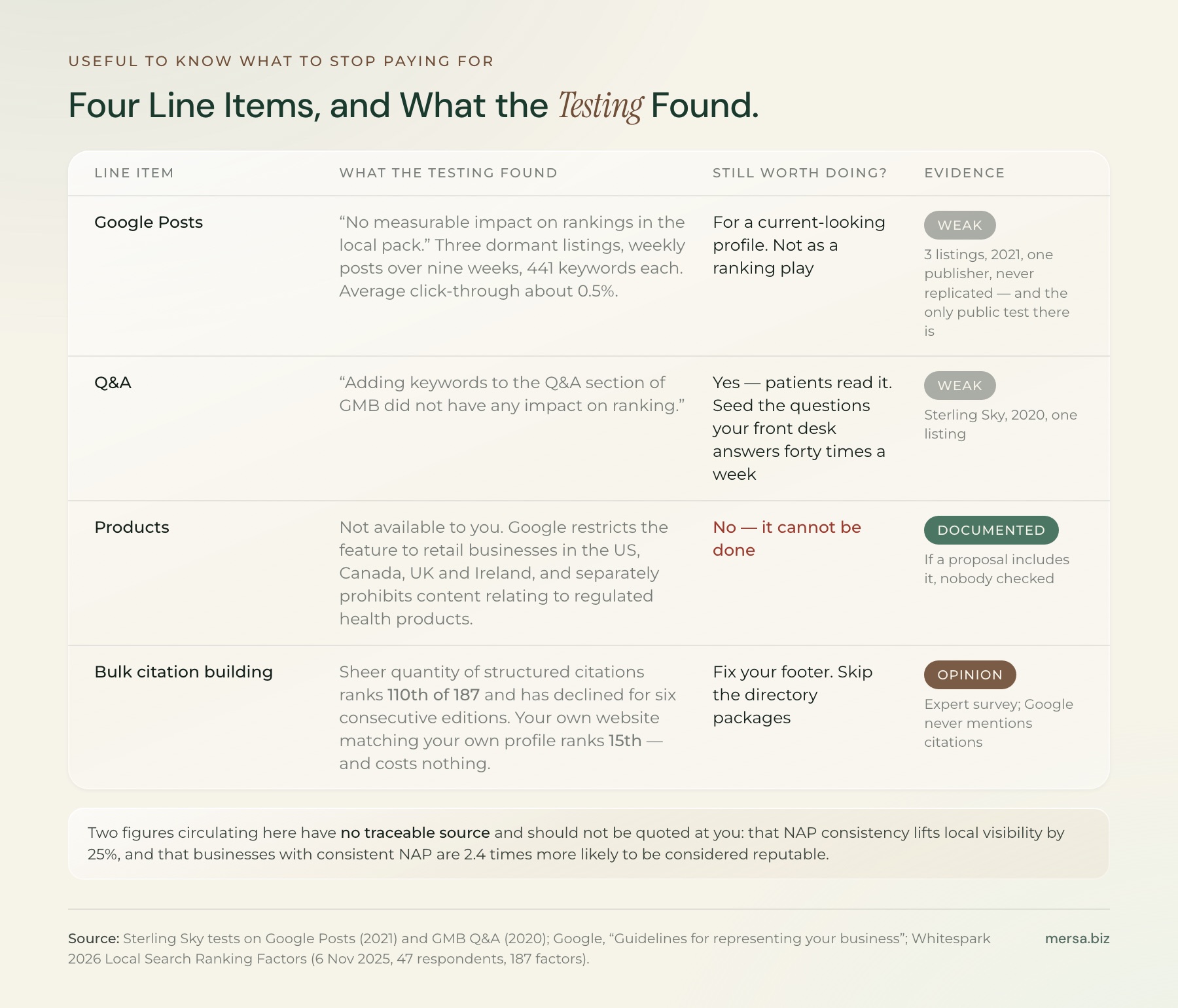
Sterling Sky tested this on three dormant listings with weekly posts over nine weeks, tracking 441 keywords per location. Their conclusion: posts “had no measurable impact on rankings in the local pack”. Hawkins adds that average click-through on a post is about 0.5%, and when asked in 2024 whether any contrary evidence had emerged, said “not that I have ever seen.”
The evidence is weak and should be labelled as such: three listings, 2021, one publisher, never replicated. It is also the only public test in existence, which is its own comment on the field. Posting for a current-looking profile is reasonable; purchasing a package built on it is not.
Google Q&A
Sterling Sky again, 2020, on a listing with no website: “Adding keywords to the Q&A section of GMB did not have any impact on ranking.” It remains worth populating, because patients read it and the questions your front desk answers forty times a week can be seeded there. It is simply not a ranking play.
Products
It is not available. Google restricts the Products feature to retail businesses in the US, Canada, UK and Ireland, so Australian practices cannot use it, and content relating to regulated health products is separately prohibited. Where a proposal includes “GBP products optimisation”, the person writing it has not checked.
Citations and NAP: The Honest Read
This is where a considerable number of Australian SEO packages still put their hours.
Whitespark’s 2026 data, with citation factors placed among 187:
- 15th: your website’s NAP matching your GBP NAP
- 28th: citation consistency on primary search engines
- 63rd: consistency on key sites like Yellow Pages
- 85th: consistency on data aggregators
- 110th: sheer quantity of structured citations
Shaw’s own comment: “I was surprised to see that citations lost about half a percentage point, continuing the downward trend from previous editions.”
So the highest-placed NAP factor is your own website matching your own profile, which costs nothing and which a considerable number of practices fail because the footer still lists a suite number that has since changed. Bulk directory submission sits at 110th and has been declining for six consecutive editions. Google does not mention citations at all.
There is a counter-argument in the same report, under a heading reading “Citations are back!”: three of the top five AI search visibility factors are citation factors, and Shaw writes that “in AI SEO, mentions (citations) are the new link”. That is one publisher, one edition, and expert opinion rather than measurement. It is an interesting hypothesis rather than a fact, and not something to restructure a budget around.
Two figures circulating in this area have no traceable source and should not be quoted at you: that NAP consistency lifts local visibility by 25%, and that businesses with consistent NAP are 2.4 times more likely to be considered reputable. No primary source could be found for either.
Keeping a Google Business Profile Out of Suspension
Sterling Sky’s suspension playbook, updated March 2026, is the most current serious writeup available. Their top five causes: too many edits to important parts of the profile at once, no genuine physical presence at the address, a manager or owner whose Google account was suspended, duplicate listings, and being in a spam-heavy industry.
Dentistry does not appear on their high-risk list, which names locksmiths, rehab, garage doors and injury law, so the realistic risk for a practice is the first cause, and it is entirely self-inflicted.
Their advice, which is worth following: “Don’t make multiple edits at the same time. For example, if you’re optimizing a profile, don’t change the categories, rewrite the business description and fill out the attributes all at the same time. Instead, make one change a day over several days.”
The website field should also not point at a URL that redirects, and a domain-based email rather than Gmail should be used for the primary owner.
Where a profile is suspended, Google’s process runs on an appeals tool and requests evidence such as business registration, a licence, tax certificates or utility bills. Two warnings appear on Google’s own page: a new profile for the same business must not be created while an appeal is under review, and once the evidence form is opened there are 60 minutes in which to submit it.
Sterling Sky put typical wait times at one to six weeks and note that rebuilding is the wrong instinct, because “a new profile has no history and no ranking power” and “only a Google employee can transfer the reviews”.
A Short Google Business Profile List, in Order
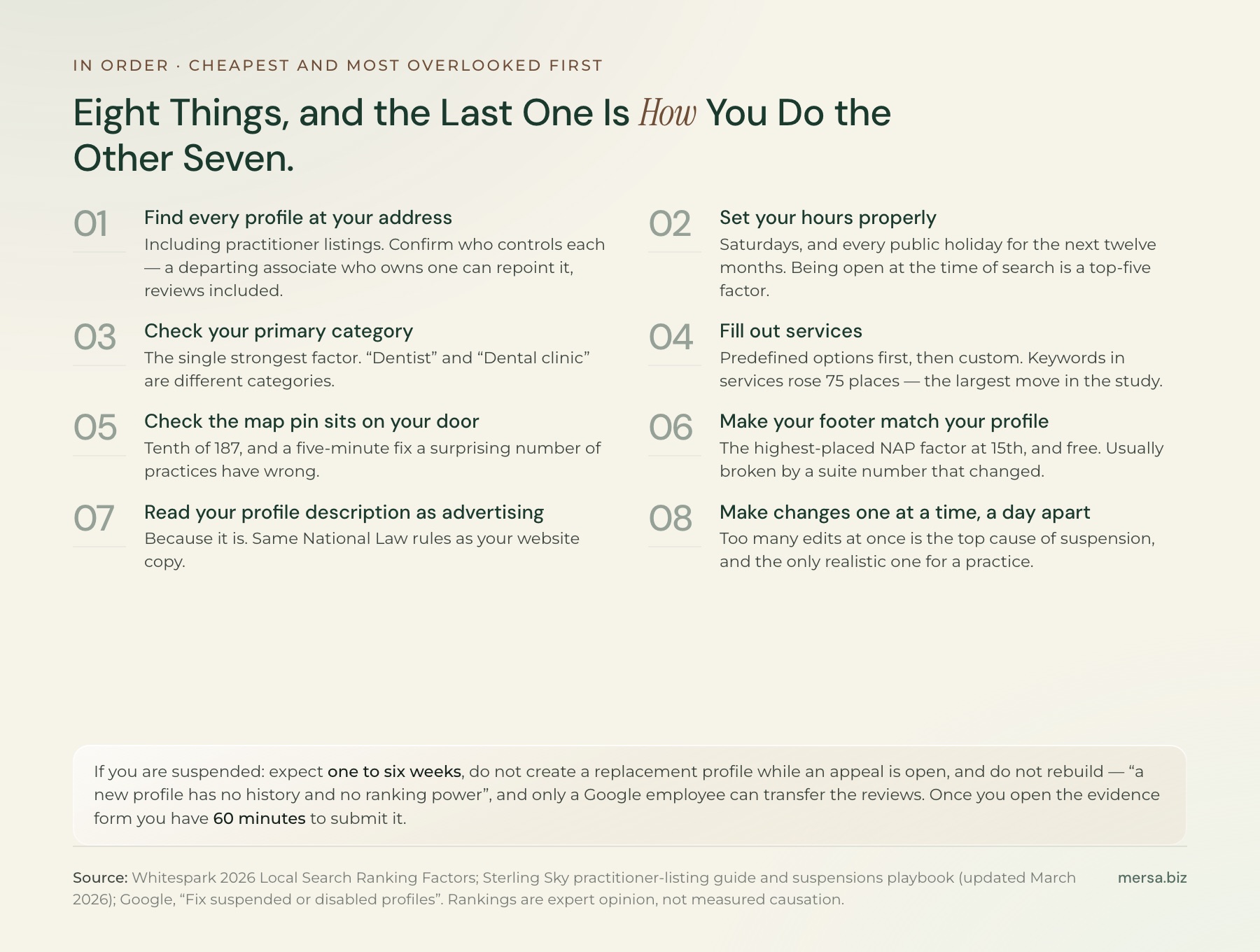
Find every profile at your address, including practitioner listings, and confirm who controls each.
Set your hours properly, including Saturdays and every public holiday for the next twelve months.
Check your primary category, then fill out services using Google’s predefined options.
Check the map pin sits on your door.
Make your website footer match your profile exactly.
Read your profile description as advertising, because it is.
Reviews follow, which is a larger topic covered here.
Make changes one at a time, a day apart.
All of this is checked as part of a fixed-price audit, and further material on how the local layer fits into search for practices appears on the SEO for dentists page.
Common Questions
Can our dentists have their own Google listings?
Yes. Individual practitioner profiles for dentists are explicitly permitted by Google. In a multi-dentist practice the practitioner’s profile carries only their name rather than the practice name, while a solo dentist under a brand shares one profile named “Practice: Dr Name”.
What happens to a practitioner listing when the dentist leaves?
Where they control it, it may be updated to point at their new workplace, and the reviews travel with it. It cannot be removed while they still work for the practice, so ownership should be decided in advance.
Can we add keywords to our business name?
Google prohibits it and states that it can lead to suspension. Independent testing shows the tactic works, which is why competitors employ it. The compliant route is a genuine change of trading name.
Do Google Posts help rankings?
The only public controlled test found no measurable effect, and average click-through on a post sits at around 0.5%. Posting serves freshness rather than rankings.
Are citations still worth building?
A website matching its own profile matters most and costs nothing. Bulk directory building ranks 110th of 187 factors and has declined across six consecutive editions. An emerging argument holds that mentions matter for AI visibility, which is worth watching rather than budgeting for.
How long does a suspension take to fix?
Typically one to six weeks. A replacement profile should not be created while the appeal is open, and rebuilding should be avoided, because a new profile carries no history and only Google can move reviews.
Does any of this guarantee a map pack position?
No. Google states that no way exists to request or pay for better local ranking, and distance from the searcher, which cannot be changed, is the second strongest factor on Whitespark’s list.
How do I find out whether one of our dentists has their own Google listing?
The practice address should be searched in Google Maps and every profile attached to it examined, followed by a search for each dentist by name. A practitioner listing nobody at the practice claimed will usually still be present, sometimes carrying reviews. This should be done before the conversation about ownership rather than after it.
What should we do when a dentist with their own Google listing leaves the practice?
While they still work there the listing cannot be removed or merged. Once they leave, it travels with them where they control it, reviews included. The only real remedy is upstream: a practice policy should decide whether associates hold their own listings, and the answer should be written into the practice agreement rather than the marketing plan.
Can we call our listing “Bayside Dental Implants and Cosmetic Dentistry Melbourne”?
Only where that is genuinely the business name as used in the real world, on the signage, the website and the paperwork. Adding services or a suburb that do not appear on the door constitutes keyword stuffing, is reportable by any competitor, and ranks among the more common reasons a profile is suspended.
Why did our Google Business Profile get suspended and how long does reinstatement take?
Suspensions usually follow an edit, whether a name change, a category change or an address change, that trips a policy check. The underlying violation should be fixed before appealing, because an appeal on an unfixed profile fails and consumes time. The process should be planned for in weeks rather than days.
Do Google Posts and Google Q&A help our rankings?
The evidence available says no, at least not directly. Both remain worth doing for the patients who read them, a post announcing extended hours or an answered question about parking performing real work, but neither should be sold as a ranking lever.
Should we be paying for citation building in 2026?
Citations still matter for consistency of your name, address and phone number across the places that already list you, which is a data-hygiene job with a finish line. A monthly fee to keep adding low-quality directory listings is a different thing, and it is the part of this worth questioning.
How many categories should a dental practice choose?
One primary category that describes what the practice principally is, then secondary categories only for services you genuinely provide. The primary category carries the most weight, and padding the secondaries with everything on your treatment menu dilutes the signal rather than broadening it.
Sources
- Google: Guidelines for representing your business on Google (business names, categories, individual practitioners)
- Google: Tips to improve your local ranking
- Google: Fix suspended or disabled profiles
- Whitespark: 2026 Local Search Ranking Factors, 6 November 2025, 47 respondents, 187 factors
- Sterling Sky: The ultimate guide to practitioner listings
- Sterling Sky: Keyword stuffing in GMB names
- Sterling Sky: Do Google Posts impact ranking?
- Sterling Sky: Does Google Q&A impact ranking?
- Sterling Sky: GBP suspensions playbook, March 2026