
Table of Contents
No independent survey of SEO cost exists for Australia. Every AUD figure quoted traces back to an agency’s own rate card. The measured data is global and in US dollars: local SEO averages US$1,557 a month, and US$1,001 to US$2,500 buys 20 to 40 hours of work.
Key Takeaways
- No independent Australian survey of SEO cost exists. Every AUD number in the market, including the ones below, originates from an agency rate card.
- Local SEO averages US$1,557 a month, against US$2,917 across all work. A practice competing over three suburbs is buying local work, not national.
- Hours are the number to ask for. US$1,001 to US$2,500 buys 20 to 40 hours a month, on Backlinko’s survey of 300-plus providers.
- Under US$500 a month buys 5 to 10 hours, and 2019 client-satisfaction data found those clients 75% more likely to be dissatisfied.
- Google’s own timeline is four months to a year, from a 2017 video that has since left the live documentation. Anyone quoting faster is inventing it.
- Three widely quoted figures do not exist, including the “532% healthcare ROI” attributed to a report that has no healthcare row.
That absence is not a reason to ignore the numbers. It is a reason to establish which were measured and which were asserted, because the two are constantly mixed and the mixing usually favours whoever is quoting. What follows is the honest version, sorted by how much weight each figure can carry.
What the Surveyed SEO Cost Data Says
Two surveys carry any weight, and both are denominated in US dollars.
Ahrefs: US$2,917 Overall, US$1,557 for Local Work
Ahrefs polled SEO providers and published the results at ahrefs.com/blog/seo-pricing. The headline says 439 respondents, though the page’s own meta description says 350, an inconsistency Ahrefs has never reconciled. The charts date from 2023, so it should be treated as 2023 data regardless of the update stamp.
The averages: US$2,917 a month across all respondents, and US$1,557 a month for providers serving local markets specifically. Agencies doing local work averaged US$1,819, freelancers US$1,150. The most common single band was US$501 to US$1,000, at 20.4% of respondents, and 68.8% of everyone surveyed charged US$2,000 a month or less. Average hourly rate was US$111.
The gap between the headline average and the local average is worth noting. Local SEO is cheaper than national or ecommerce work by roughly half, and a dental practice competing across three suburbs constitutes local work.
Backlinko: US$1,000 to US$2,500 Is Typical
Backlinko surveyed over 300 SEO professionals at backlinko.com/seo-pricing, last updated December 2025. It lands on US$1,000 to US$2,500 a month as typical, with a regional split worth knowing: retainers under US$500 a month are held by only 7% of providers in the US, UK and Australia, against 42% in India and Latin America. Where AU$400 a month is being quoted, an offshore team has been quoted, whether or not the invoice says so.
The Number That Decides Your SEO Cost
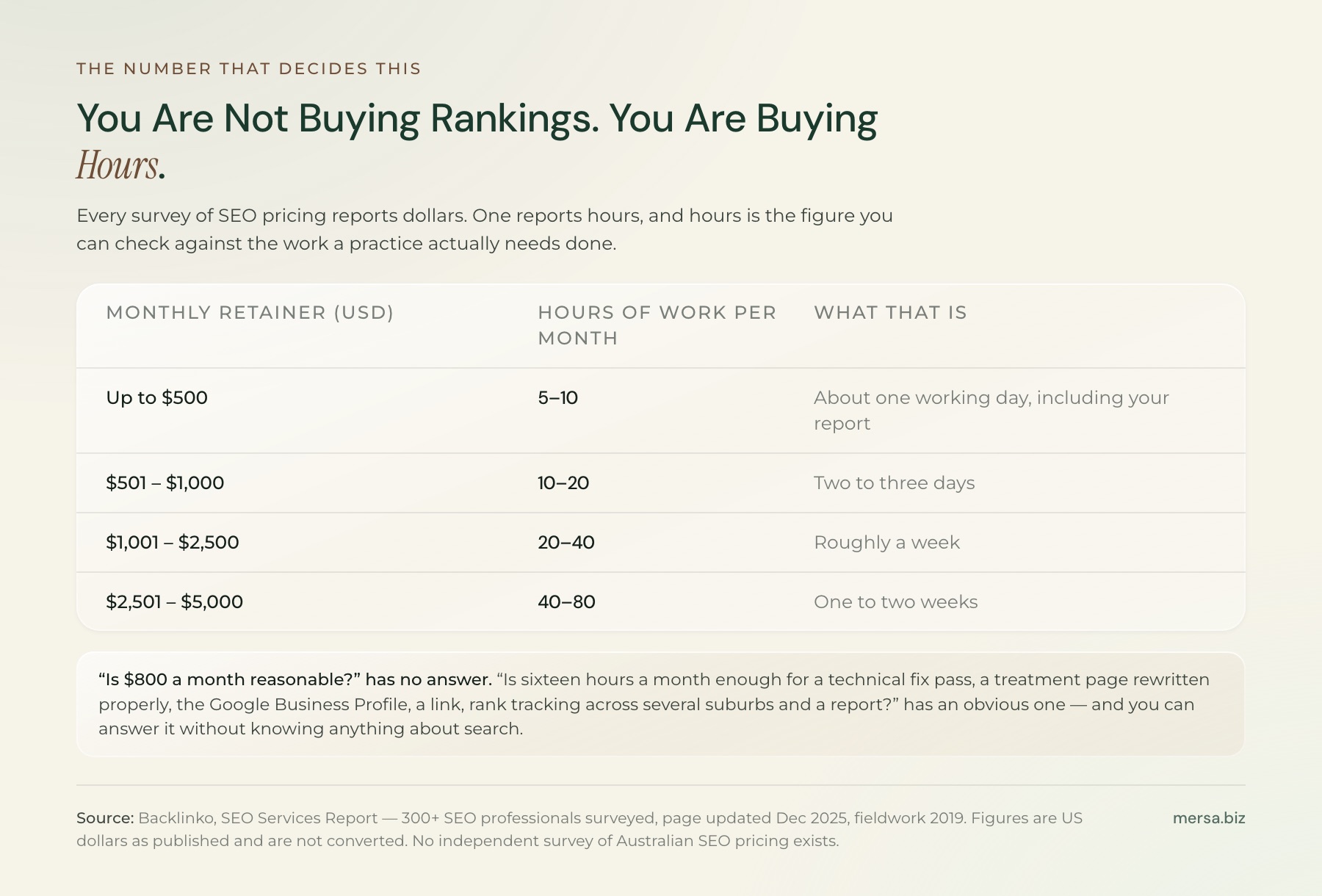
Every survey above reports dollars. Only one reports hours, and hours is the figure indicating what is actually being bought.
From the same Backlinko survey, monthly retainers converted into work delivered:
| Monthly retainer (USD) | Hours of work per month |
|---|---|
| Up to $500 | 5 to 10 |
| $501 to $1,000 | 10 to 20 |
| $1,001 to $2,500 | 20 to 40 |
| $2,501 to $5,000 | 40 to 80 |
The top row rewards attention. A $500 retainer buys somewhere between five and ten hours a month, which amounts to one working day spread across strategy, execution and the reporting you receive.
What a dental practice requires within that time is worth setting out:
- A technical crawl and fix pass.
- Writing or rewriting a treatment page properly.
- Managing the Google Business Profile.
- Building or earning a link.
- Watching rankings across several suburbs.
- Producing a report a practice owner can read.
Across one day a month, most of that day is consumed by the report.
This reframes the whole question. “Is $800 a month reasonable for SEO?” has no answer, whereas “Is sixteen hours a month enough to do the things on this list?” has an obvious one, answerable without any knowledge of search.
Any provider quoting should be asked how many hours the retainer represents and who performs them. The answers, or the reluctance to give them, will reveal more than the proposal deck.
The same test applies to what arrives afterwards: a report that does not say what was done, by whom, is the reporting-side version of an SEO cost nobody can account for, and what a standalone report has to carry is its own subject.
The SEO Cost Australian Agencies Publish
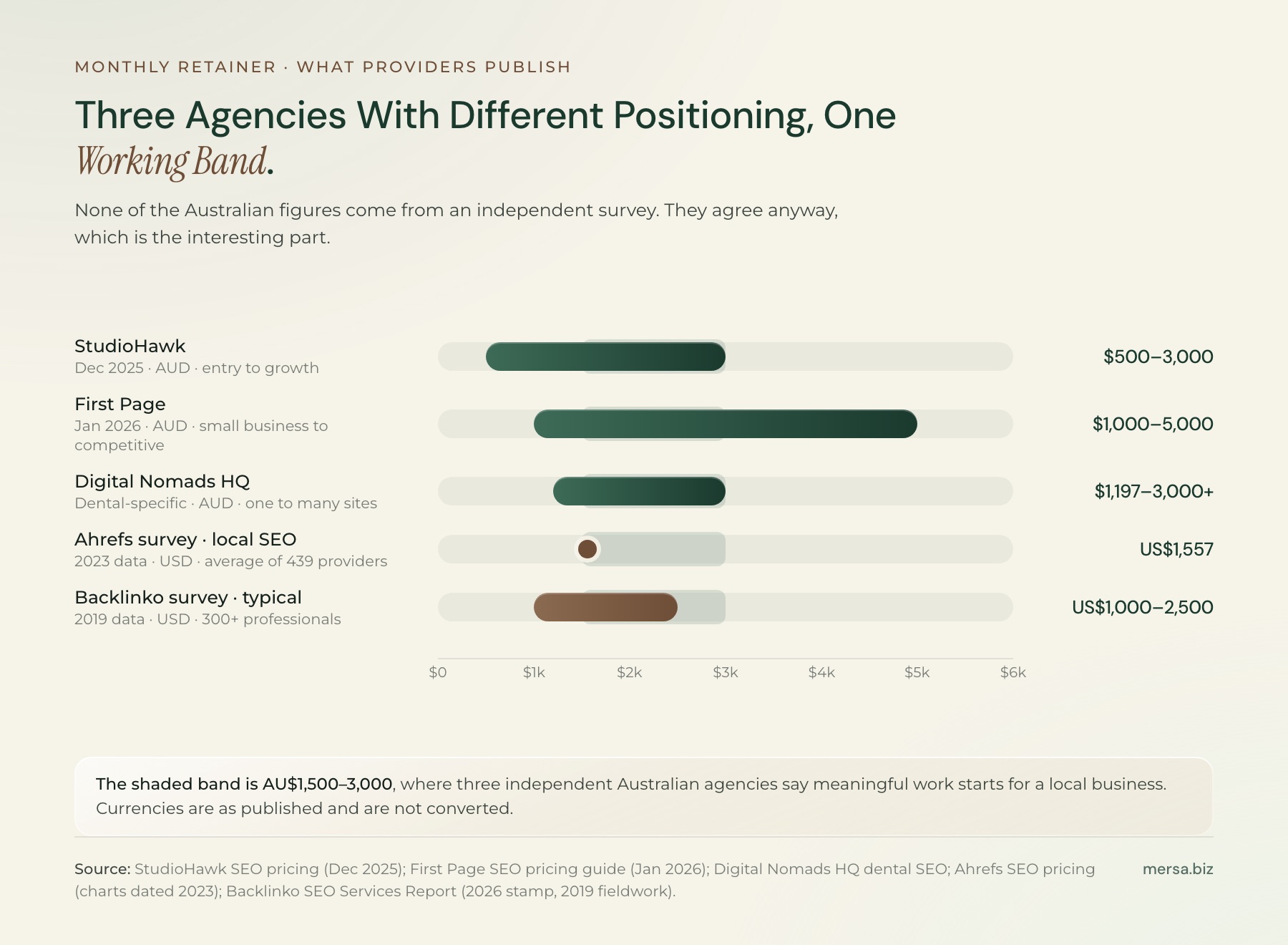
These are self-declared and unaudited, and worth knowing regardless because the convergence is interesting.
StudioHawk, December 2025, in AUD: entry-level retainers $500 to $1,000 a month, a growth band of $1,500 to $3,000 described as where most small and medium businesses see traction, and $5,000 or more for competitive work. Consulting at $150 to $300 an hour. A full site audit at $2,000 to $5,000.
First Page, January 2026, in AUD: $1,000 to $2,500 a month for small business and local, $2,500 to $5,000 for more competitive work, $5,000 to $15,000 and up for enterprise. Consulting at $100 to $250 an hour.
Dental-specific, and closer to what a practice would be quoted: Digital Nomads HQ publishes dental SEO from $1,197 a month for a single-location clinic, and $3,000 or more for multi-location groups.
Three independent agencies with different positioning land on roughly the same place: AU$1,500 to $3,000 a month is where meaningful work starts for a local business, and $100 to $300 an hour for consulting. That agreement carries meaning even though none of it is surveyed, and it is consistent with the Backlinko hours table once converted.
The SEO Cost Number to Hold It Against
Where a retainer feels expensive, the comparison worth making is against the alternative rather than against zero.
First Page puts an in-house SEO specialist’s salary at AU$70,000 to $120,000, and the fully loaded cost at AU$100,000 to $150,000 a year once on-costs are included. That is AU$8,000 to $12,500 a month for one person who takes annual leave, needs tools, and will not be equally strong at technical work, content and links.
Most practices are not choosing between an agency and a hire. The comparison nonetheless sets a ceiling on what “expensive” can reasonably mean, and it explains why a $3,000 retainer covering several specialists is not obviously worse value than it appears.
What a Cheap SEO Cost Correlates With
Backlinko’s SEO Services Report carries a 2026 date, though the fine print matters: the survey was designed and run with Northstar Research Partners and the underlying data dates from 2019. It should be cited as 2019 data. It is still the only real client-satisfaction dataset in the field.
In that 2019 data, clients spending under US$500 a month were 75% more likely to be dissatisfied, and clients spending over US$500 a month were 53.3% more likely to be extremely satisfied.
The rest of that survey is bleak reading for the industry, and practice owners are entitled to see it. Only 30% of respondents would recommend their current SEO provider. The industry’s net promoter score came out at zero.
Sixty-five percent had worked with more than one provider, 25% with three or more. Of those who left, 82% cited dissatisfaction with results and 81% cited cost.
One finding cuts against the agencies-are-the-problem reading, however. Among dissatisfied clients, 50% said they needed more training to benefit from SEO, 28% did not have the staff resources, 27% found it confusing, and 25% were not sure what they were paying for.
That last one is a briefing failure as much as a delivery failure, and it is fixable from the client’s side. Where you cannot explain what your provider did last month, the question should be asked before cancelling. Where they cannot explain it either, cancelling is warranted.
How Long Before Anything Happens
What Google Says About Timelines
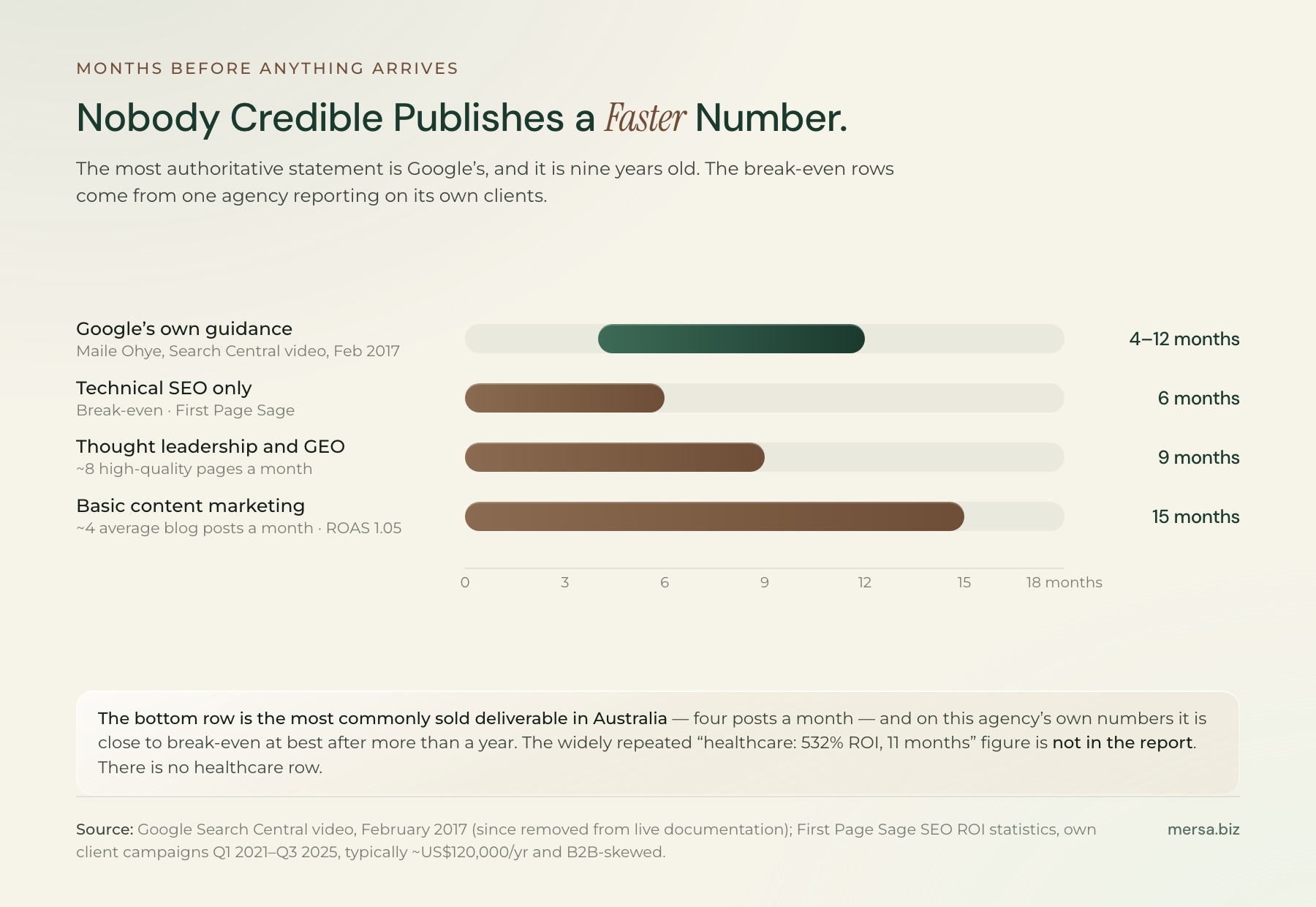
The most authoritative statement on this comes from Google, and it is nine years old.
Maile Ohye, then a Developer Programs Tech Lead at Google, said in a February 2017 Search Central video on hiring an SEO: “In most cases, the SEO will need four months to a year to help your business first implement improvements and then see the potential benefit.”
That figure has since disappeared from Google’s live documentation, which I checked. It remains the closest thing to an authoritative timeline in existence, so it should be cited as a 2017 video rather than current guidance, and anyone quoting a faster number should be treated as inventing it.
Break-Even by Service Type
One dataset on break-even is worth mentioning, carrying heavy caveats. First Page Sage publishes break-even times by industry and by service type from its own client campaigns, Q1 2021 to Q3 2025. The service-type table is the useful part:
- Technical SEO only: break-even at 6 months
- Basic content marketing, around four average blog posts a month: break-even at 15 months, with a return on ad spend of 1.05
- Thought leadership and generative engine optimisation, around eight high-quality pages a month: break-even at 9 months
That middle row deserves attention from anyone being sold a content package. Four mediocre posts a month is the most commonly sold SEO deliverable in Australia, and on this agency’s own numbers it is close to break-even at best across more than a year.
Two caveats matter. First, this is an agency reporting on its own clients, whose campaigns it states typically cost around US$120,000 a year and skew heavily B2B.
Second, and worth stating plainly because it is repeated everywhere: the widely circulated “healthcare: 532% ROI, 11 months to break even” figure attributed to this report is not in it. There is no healthcare row in the current table. Somebody invented it and everybody copied it.
The Comparison Worth Making: Paid Versus Organic
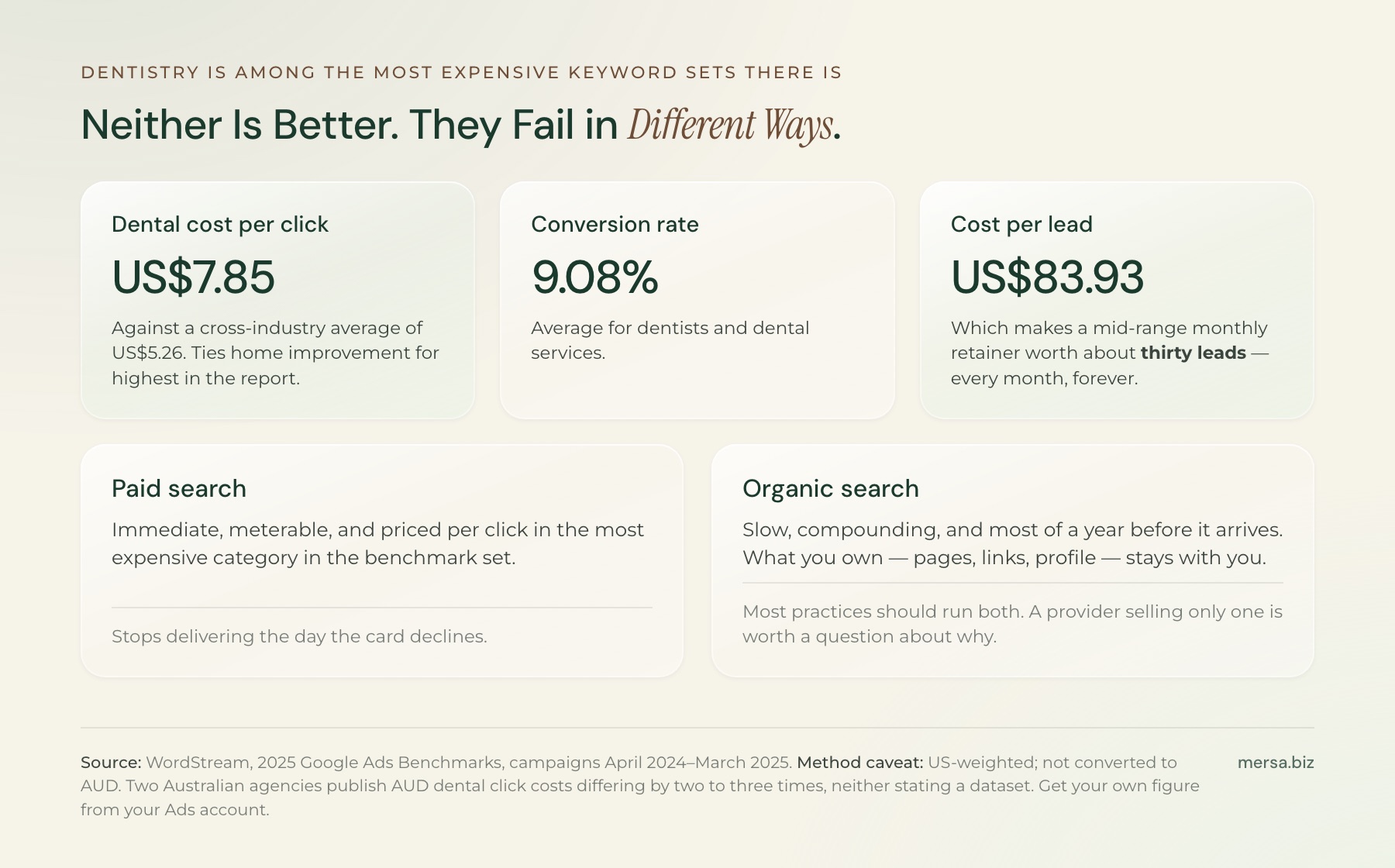
Dentistry constitutes one of the most expensive keyword sets in advertising, which changes the maths on organic work.
WordStream’s 2025 Google Ads Benchmarks, drawn from campaigns running April 2024 to March 2025, puts dentists and dental services at an average cost per click of US$7.85 against a cross-industry average of US$5.26. Average conversion rate 9.08%, giving an average cost per lead of US$83.93. Dentistry ties home improvement for the highest cost per click in the report.
That data is US-weighted, and it will not be converted into Australian dollars here on the pretence that it transfers. Two Australian agencies publish AUD dental click costs disagreeing with each other by a factor of two to three, neither states a dataset, and one quotes a US figure from 2024 as though it were an Australian figure from 2026.
The WordStream numbers should be used as a benchmark carrying a US label, with your real number taken from your own Google Ads account.
The structural point survives the currency question. At roughly $84 a lead, a practice running paid search spends the cost of a mid-range monthly retainer on about thirty leads every month, in perpetuity, and stops receiving anything the day the card declines. Organic work compounds and takes most of a year to arrive.
Neither is superior. They fail in different ways, and most practices should run both, which is one reason a provider selling only one warrants a second look.
SEO Cost Figures I Could Not Verify
This list is published because the alternative is repeating them.
“Clutch: average monthly SEO spend is $3,199.” Quoted across dozens of agency blogs. No Clutch publication containing it could be located.
“SEO delivers 22:1 ROI.” Traces to aggregator blogs citing each other. No primary research behind it.
“Healthcare SEO: 532% ROI, 11-month break-even.” Attributed to First Page Sage. Not in their current table.
Australian dental cost-per-click figures. Two AU agencies publish ranges ($8 to $15 and $10 to $30 a click for comparable terms). Neither discloses a dataset.
Where a proposal quotes any of these, it is not a sign of dishonesty but a sign that nobody checked. Which is roughly the same problem the penalty figure in AHPRA advertising guidance has, and it tends to be the same providers.
What to Ask About SEO Cost Before You Sign
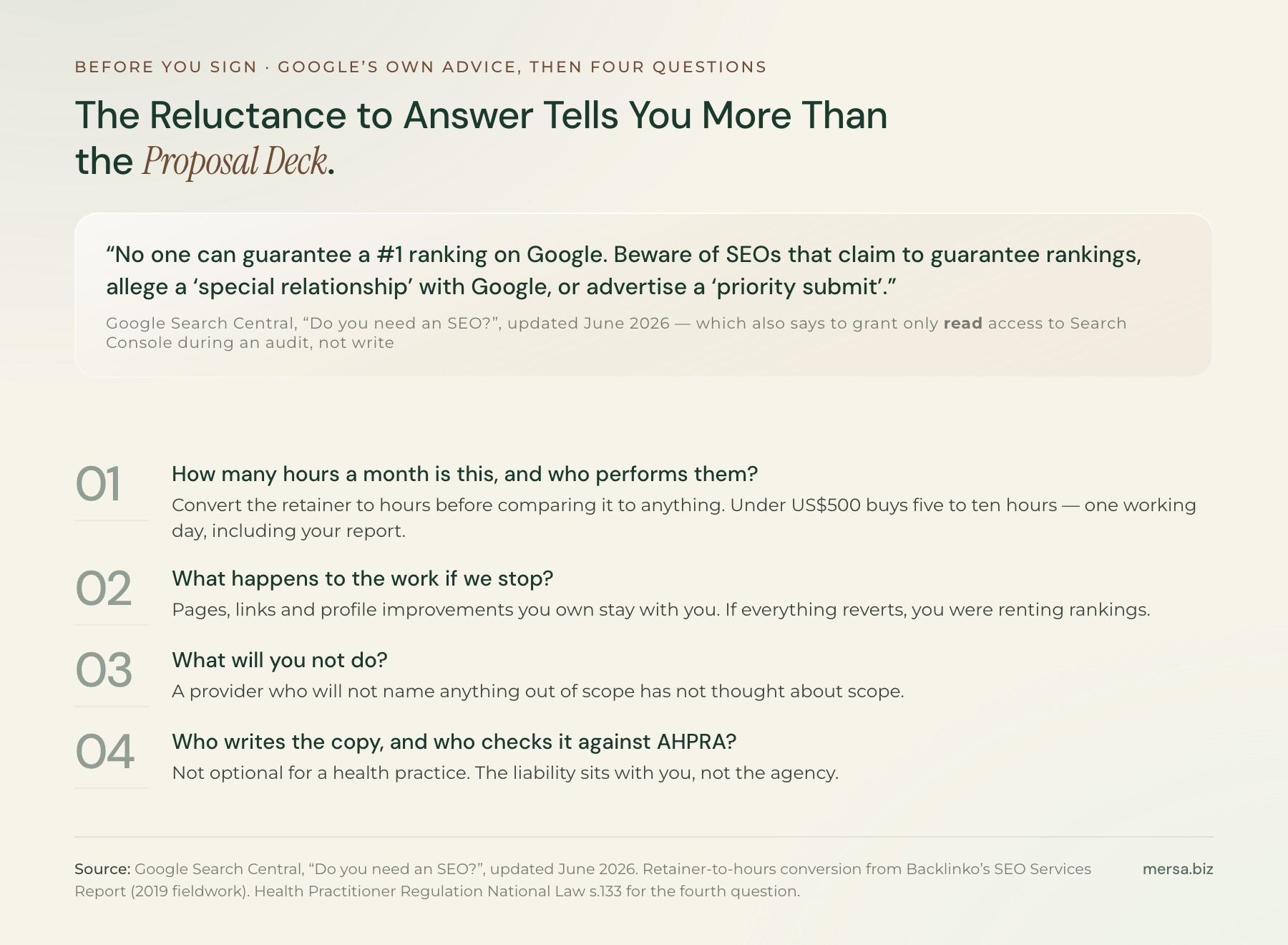
Google publishes its own advice on this at Do you need an SEO?, last updated June 2026, and it is more direct than most agencies would like:
No one can guarantee a #1 ranking on Google. Beware of SEOs that claim to guarantee rankings, allege a ‘special relationship’ with Google, or advertise a ‘priority submit’.
And on audits specifically:
An SEO audit should be about giving you realistic estimates of improvement… If they guarantee you that their changes will give you first place in search results, find someone else.
Google also advises granting only read access to Search Console during an audit rather than write access. That is worth remembering, because the request usually arrives framed as a formality.
Beyond that, four questions produce useful answers:
How Many Hours Does This Retainer Represent?
How many hours a month does this retainer represent, and who performs them? The answer should be compared against the table above.
What Happens to the Work If We Stop?
What happens to the work if we stop? Pages, links and profile improvements under your ownership remain with you. Where the answer is that everything reverts, the rankings were being rented.
What Will You Not Do?
A provider who will not name anything they consider out of scope has not thought about scope.
Who Checks the Copy Against AHPRA?
Who writes the copy, and who checks it against AHPRA? For a health practice this is not optional, and the liability sits with the practice rather than the agency. Covered in more detail in the AHPRA advertising piece.
Where Our SEO Cost Sits
For the sake of not being coy about it, Mersa sells a fixed-price audit at US$350. That sits deliberately below the AU$2,000 to $5,000 band StudioHawk and First Page quote for a full site audit, and below the cheapest project tier in either survey above.
It is priced that way because an audit should constitute a decision rather than a commitment. The findings and the fix list are handed over, and may be passed to an existing provider, actioned in-house, or left.
Where the work is then wanted, it is scoped separately. What will not happen is a monthly figure being quoted before anyone has looked at the site, that being the part of this industry generating most of those Backlinko satisfaction numbers.
Details on the audit page, and how we approach search for practices specifically on SEO for dentists.
Common Questions
How much does SEO cost in Australia per month?
Australian agencies publish entry retainers around AU$500 to $1,000, a working band of AU$1,500 to $3,000 for local businesses, and AU$5,000 or more for competitive markets. None of those figures come from an independent survey. The surveyed global data puts local SEO at an average of US$1,557 a month.
Is cheap SEO worth trying?
A retainer under US$500 buys five to ten hours of work a month, and 2019 survey data found clients at that level were 75% more likely to be dissatisfied. The issue is not that cheap providers are dishonest, but that one day a month does not cover the work.
How much should an SEO audit cost?
Australian agencies quote AU$2,000 to $5,000 for a full audit, while global survey data puts the most common project fee at US$2,501 to $5,000. Cheaper audits exist, Mersa’s among them, and what warrants checking is whether prioritised findings are received or an automated tool export carrying a logo.
How long until SEO works?
Google’s own guidance, drawn from a 2017 video, is four months to a year. No credible party publishes a shorter figure.
Should a dental practice do SEO or Google Ads?
Dentistry carries among the highest cost per click of any industry, so paid search is expensive and immediate while organic is slower and compounds. Most practices benefit from both, and a provider selling only one warrants a question about why.
How do I know if I am being overcharged?
The retainer should be converted to hours and compared against what has been promised, followed by a question about what happens if payment stops.
Why does one agency quote $500 a month and another $5,000 for the same thing?
Because the retainer buys hours, and the two proposals are not for the same number of them. At the surveyed rates $500 represents five to ten hours a month and $5,000 represents forty to eighty. Both providers should be asked for the hours and who performs them, at which point the gap ceases to be mysterious.
Is $500 a month enough for SEO for a dental practice?
It buys roughly one working day a month, including the time consumed producing the report. Set against a technical fix pass, a treatment page rewritten properly, the Google Business Profile, earning a link and tracking rankings across several suburbs, the answer is visible without any knowledge of search.
Is an SEO agency charging AU$400 a month using an offshore team?
Almost certainly. Backlinko’s survey found retainers under US$500 a month held by 7% of providers in the US, UK and Australia against 42% in India and Latin America. The work may still be competent. What is not honest is a local rate card omitting where the work happens.
Should we pay for SEO monthly or buy a one-off audit first?
An audit establishes what is wrong before a retainer is committed to, and it is the cheaper route to discovering whether the retainer is needed at all. It is also the only part of this producing a deliverable retained if you walk away.
How long before we see any return on SEO spend?
Google’s own guidance has long put it at four to twelve months from commencement of work to visible benefit, and that is the figure to plan against. Anyone quoting weeks is either describing paid ads or describing something that will not last.
Is Google Ads cheaper than SEO for a dental practice?
They behave differently rather than one being cheaper. Ads buy visibility that ceases the day payment stops, and the cost per click is set by whoever else is bidding. Search work compounds and survives a pause, though it takes months to start and can be lost to a competitor working harder. Most practices run both at some point.
Do we still own anything if we stop paying our SEO agency?
The question should be asked before signing. Content published on your own site and fixes made to it remain with you, whereas rented links, a landing page hosted on the agency’s domain and a tracking number pointed at their system do not. The answer reveals more about a provider than their pricing does.
Sources
- Ahrefs: SEO Pricing: How Much Does SEO Cost?, survey of 439 providers (page meta says 350), data vintage 2023, USD
- Backlinko: SEO Pricing, over 300 SEO professionals, updated December 2025, USD
- Backlinko: The SEO Services Report, with Northstar Research Partners, underlying data 2019, USD
- Google Search Central: Do you need an SEO?, updated June 2026
- Maile Ohye, Google Search Central, “How to hire an SEO”, February 2017 (four to twelve months)
- StudioHawk: SEO pricing in Australia, December 2025, AUD, self-published
- First Page: How much does SEO cost in Australia?, January 2026, AUD, self-published
- Digital Nomads HQ: SEO for dentists, AUD, self-published
- First Page Sage: SEO ROI statistics, proprietary client data Q1 2021 to Q3 2025, USD
- WordStream: Google Ads Benchmarks 2025, campaigns April 2024 to March 2025, USD, US-weighted