
Table of Contents
Patients may be asked for Google reviews. Nothing in AHPRA’s advertising guidelines, testimonial tool or FAQ prohibits asking, and the word “solicit” appears in none of them. The prohibition attaches to using a testimonial in advertising you control, so the compliance work sits in what is done with a review after it arrives rather than in whether it was requested.
Key Takeaways
- Asking is not prohibited. The National Law bans the use of testimonials in advertising. Across all three AHPRA documents the word “solicit” never appears.
- A testimonial is clinical. Comments on service, reception or communication style are explicitly not testimonials and may be republished.
- Review gating fails twice. Routing unhappy patients to a private form breaches Google’s fake engagement policy and creates a misleading public record.
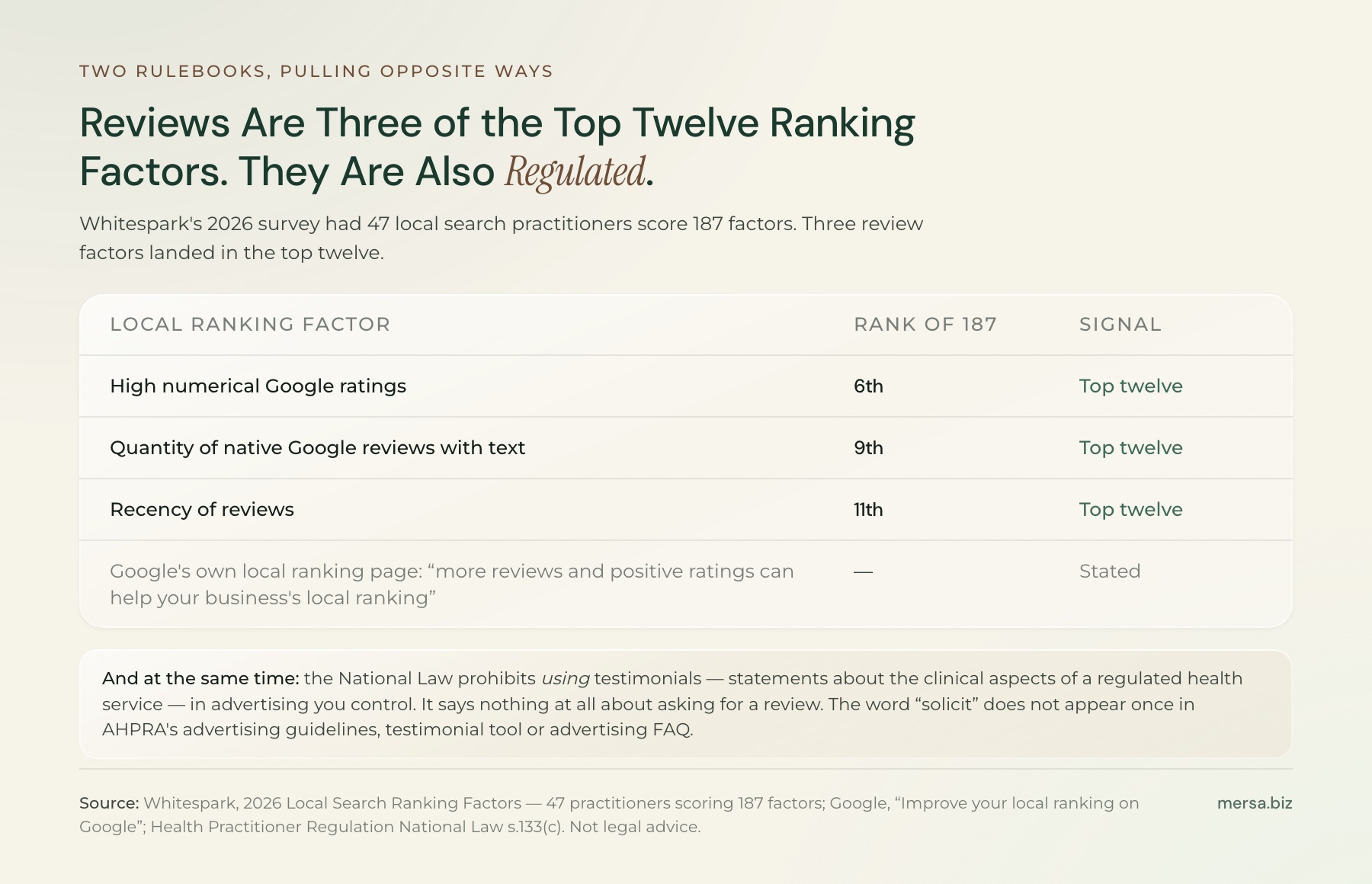
- Three of Whitespark’s top twelve local ranking factors are reviews (ratings 6th, quantity with text 9th, recency 11th, out of 187 scored by 47 practitioners in 2026).
- Star snippets cannot be obtained from reviews of yourself, including through an embedded widget. Google rules the self-serving case out in writing.
Two things about Google reviews are true simultaneously, and they pull in opposite directions.
Google states plainly, on its own local ranking page, that “more reviews and positive ratings can help your business’s local ranking”. In Whitespark’s 2026 Local Search Ranking Factors, a survey of 47 local search practitioners scoring 187 factors, high Google ratings came sixth, the quantity of native Google reviews with text came ninth, and review recency came eleventh.
Meanwhile you remain a registered health practitioner, and the National Law prohibits the use of testimonials to advertise a regulated health service.
So most dental practices land in one of two bad places. Either reviews are ignored entirely because somebody said AHPRA does not allow them, or the same review tactics a plumber runs are deployed and exposure quietly accumulates. Neither outcome is necessary.
The Claim That Is Repeated Everywhere and Is Not in the Guidance
A search for “can dentists ask for Google reviews” returns Australian marketing sites stating that AHPRA says not to encourage patients to leave reviews.
I went looking for that sentence. It is not in the advertising guidelines, it is not in the testimonial tool, and it is not in the advertising FAQ. Across all three documents the word “solicit” does not appear once, and every instance of “encourage” refers to a different limb of section 133, the one about encouraging unnecessary use of health services.
The prohibition in the National Law attaches to using a testimonial in advertising rather than to asking for one.
That matters, because the practical advice following from the two readings is completely different. Under the myth nothing is done and the profile stays thin. Under the actual rule review volume may be built as in any other business, and the compliance work sits in what is done with the reviews afterwards.
One caution applies before anyone over-reads this. AHPRA has not said asking is acceptable either; it has said nothing whatsoever about the act of asking.
Absence of prohibition is not endorsement, and where the asking steers patients toward praising the treatment specifically, testimonials are being collected deliberately, which is a different matter from collecting reviews. Ask about the visit rather than about the dentistry.
Which Google Reviews Count as a Testimonial
Covered in more depth in the companion piece on AHPRA advertising rules, but the definition is short enough to repeat.
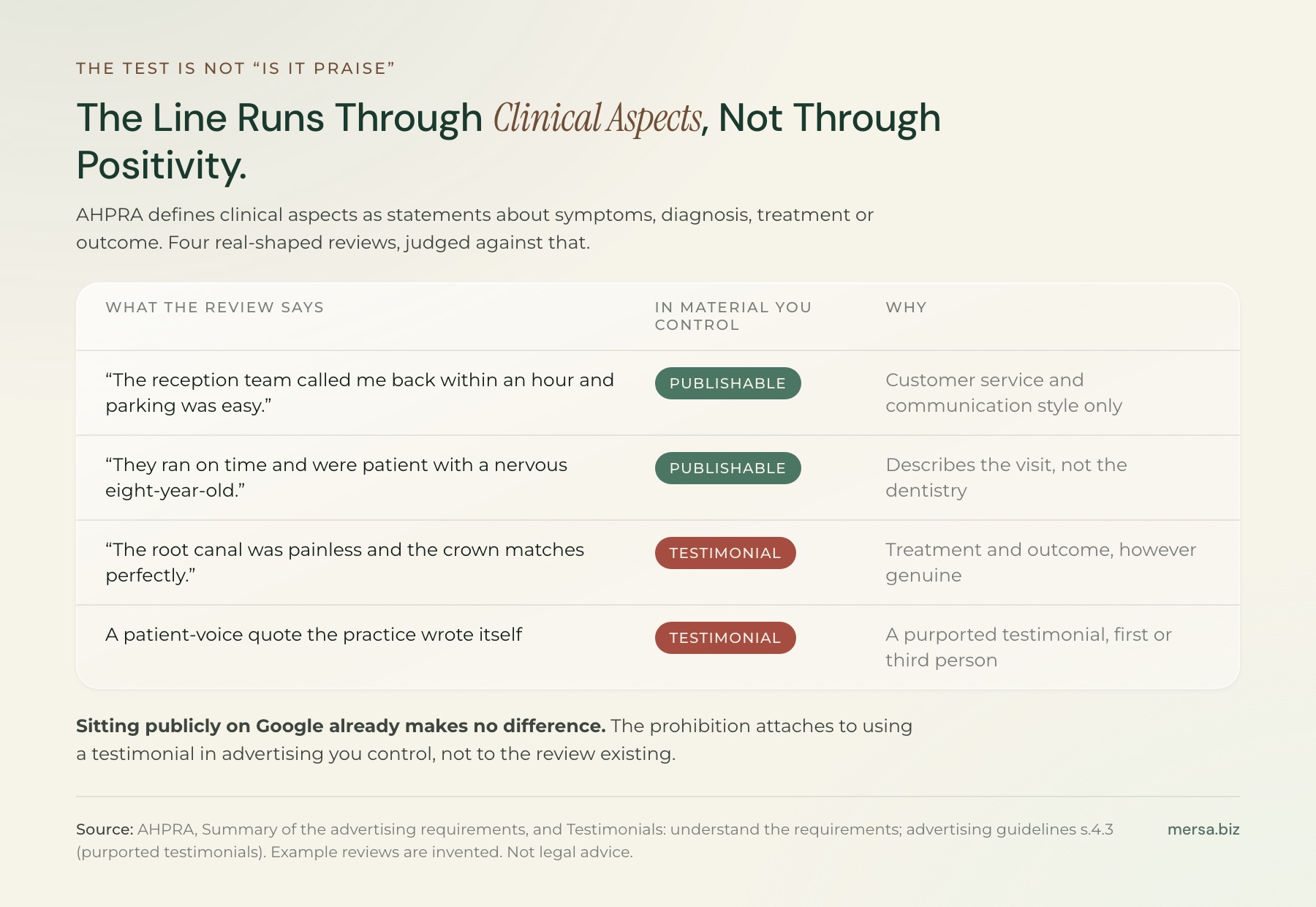
AHPRA: testimonials are “recommendations or positive statements about the clinical aspects of a regulated health service”, where clinical aspects means “statements about symptoms, diagnosis, treatment, outcome”.
And immediately after, the sentence that does most of the work:
Not all reviews or positive comments made about a regulated health service are considered testimonials. For example, comments about customer service or communication style that do not include a reference to clinical aspects are not considered testimonials for the purposes of the National Law.
The testimonial tool puts it even more plainly: “Reviews (i.e. feedback about healthcare experiences that does not refer to clinical aspects of a regulated health service) are allowed in advertising.”
So a review stating that the practice ran on time, that the reception team was patient with a nervous child and that parking was straightforward is publishable. A review stating that the root canal was painless and the crown matches perfectly is not, in anything you control.
A second category is also worth knowing about. A “purported testimonial” is defined in the guidelines as “a statement or representation that appears to be a testimonial, whether provided in the first or third person“. That clause catches a practice writing patient-voice quotes itself, which occurs on dental websites more often than it should.
Where Google Sits, and Why This Is Flagged as Inference
One detail here surprised me: AHPRA never mentions Google. Not Google reviews, not Google Business Profile, not Google Maps. The only platform named anywhere in the three documents is Facebook, once. Everything else is described generically as “a search engine or a review platform”.
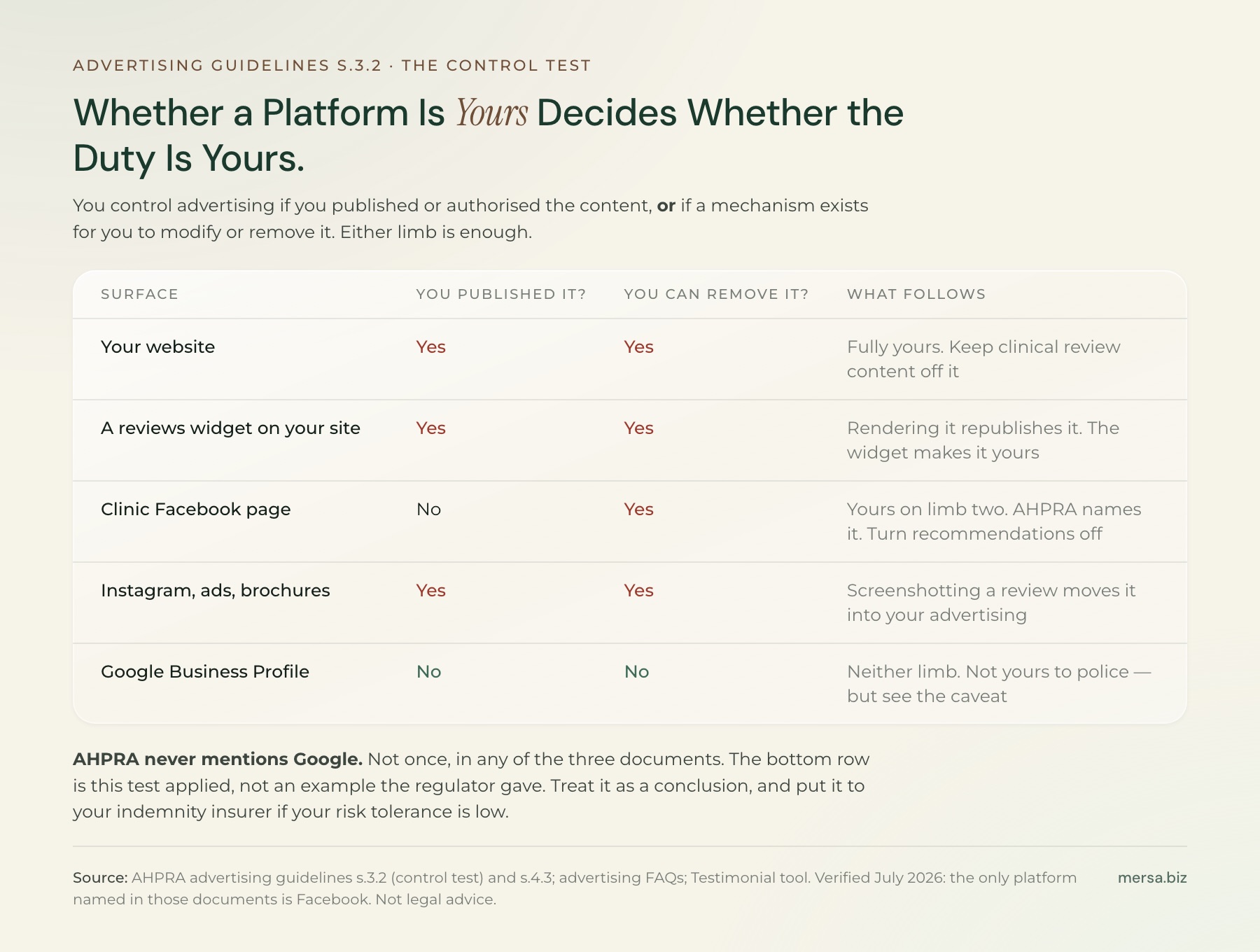
So anyone stating that “AHPRA says Google reviews are fine” is applying a general test rather than quoting an example, and that includes me. The test follows, verbatim from section 3.2 of the guidelines. An advertiser controls advertising where:
they publish or authorise content or direct someone to publish or draft content (including a third party, staff member or marketing agency) or there is a mechanism for the advertiser to modify or remove content published by an unrelated publisher.
Applied to a Google Business Profile: the patient’s review was neither published nor authorised by you, it cannot be edited or deleted, and unlike a Facebook page, Google provides no switch to turn the review function off. On both limbs, control is absent.
The guidelines then say directly: “Advertisers are not responsible for removing (or trying to have removed) testimonials published on platforms they do not control.” And the FAQ adds that boards “do not expect you to monitor the internet or social media for things that may be written about you in forums you do not control”.
The conclusion follows cleanly, though it remains a conclusion drawn from a test rather than a rule written about Google. Where risk tolerance is low, that is the kind of question to put to an indemnity insurer rather than to a marketing agency.
Facebook is different, and AHPRA does address it. If a clinic Facebook page is used to promote the practice, it is advertising, and testimonials posted there are your responsibility. The guidelines note that “not all social media sites allow for editing or removal of testimonials” and that compliance “may be achieved by disabling the reviews/testimonials functions”.
Most dental practices should simply turn Facebook recommendations off. Very little is gained from them and they carry a duty dischargeable no other way.
The Google Reviews Widget Problem
This is where practices get into trouble, and the widget is almost always installed by a web developer with good intentions.
A Google reviews widget on a homepage takes patient text from a platform you do not control and republishes it on one you do. The moment it renders on your site it has been published by you, which is limb one of the control test exactly.
Where any of those reviews mention treatment, symptoms or outcomes, and on a dental practice profile a good number will, testimonials now sit in your own advertising.
The same logic covers screenshotting a five-star review for Instagram, quoting one in a Google Ads sitelink, and printing one in a waiting room brochure. AHPRA’s FAQ is explicit about the social case: it means “not sharing or re-tweeting any comments made by a person about a clinical aspect of a regulated health service you provide on a third-party website”.
A second and unrelated reason for scepticism about review widgets exists. Google’s review snippet documentation, updated 24 July 2026, states that where the entity being reviewed controls the reviews about itself, its pages are ineligible for the star review feature, “including through an embedded third-party widget (for example, Google Business reviews or Facebook reviews widget)”.
So the widget will not produce stars in search results, and was never going to. Where that formed the pitch, the pitch was wrong.
Showing Only the Good Ones Is the Sharpest Trap
Most review widgets carry a setting named something like “minimum rating to display”. Practices set it to four or five stars and think nothing of it.
AHPRA published a media release about this on 13 June 2018, headed Selectively editing reviews or testimonials may break the law. It gives three examples of what is inherently misleading:
edit a review that is negative to make it positive, as this falsely presents the feedback edit a review that has a mix of negative and positive comments so that the published review only has positive comments, as this falsely implies that the reviewer only had positive feedback, or edit a review so that it no longer accurately reflects all the reviewer’s feedback and presents an inaccurate or false impression of the reviewer’s views.
Then AHPRA’s then-CEO Martin Fletcher, quoted directly:
If advertisers edit reviews or testimonials there is a high risk that the edited reviews will become misleading or deceptive. Only publishing complete and unedited reviews that are not testimonials will help advertisers to avoid breaching the National Law.
And the testimonial tool extends it past editing to selection: “if reviews are edited, either by removing part of the review or by selectively including/excluding whole reviews, then publishing reviews has the potential to be misleading and breach the advertising requirements of the National Law.”
A four-star-minimum filter constitutes selective inclusion of whole reviews, which is precisely the thing named.
Fletcher also noted the second regulator in the room: moderation practices “must comply with the National Law and the Australian Consumer Law”. Misleading conduct falls within the ACCC’s territory regardless of what a board thinks, and the ACCC has been active on fake and filtered reviews.
Google Prohibits the Same Behaviour, From a Different Direction
It is worth knowing that the platform agrees, for its own reasons.
Google’s prohibited and restricted content policy covers what it calls fake engagement. Businesses may not discourage or prohibit negative reviews, and may not selectively solicit positive reviews from customers. Offering payment, discounts, or free goods and services in exchange for a review is prohibited. So is instructing staff to solicit a set number of reviews, or to solicit reviews containing particular content.
Enforcement is not just review removal. Google states it may restrict a profile, which can include blocking it from receiving new reviews or ratings for a period, unpublishing existing reviews, or displaying a public warning that fake reviews were removed. A warning label on a profile would be considerably worse than the reviews being suppressed.
So “send the happy patients to Google and the unhappy ones to a private feedback form” fails twice: it constitutes selective solicitation under Google’s policy, and it manufactures a misleading public record under the National Law and the ACL.
Replying to Google Reviews: The Part Nobody Can Answer Cleanly
What Patients Expect From a Reply
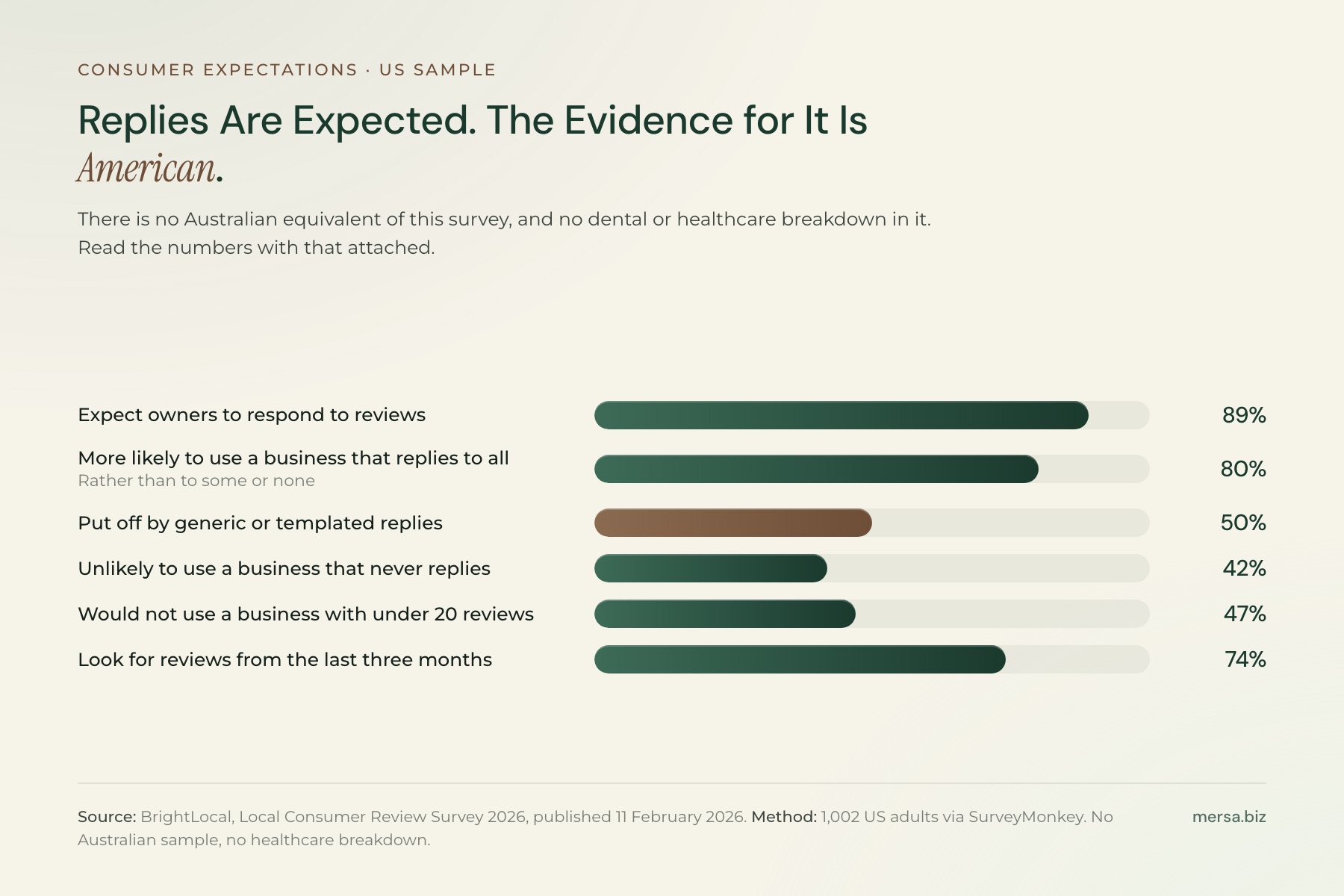
Consumers expect replies. In BrightLocal’s Local Consumer Review Survey 2026, 89% expected business owners to respond to reviews, 80% said they were more likely to use a business that responds to all of them, and 42% said they were unlikely to use one that never replies. Half said generic or templated replies put them off.
The methodology is worth reading before acting on those numbers: 1,002 US adults, surveyed via SurveyMonkey, with no Australian sample and no dental or healthcare breakdown. I have not found an Australian equivalent, and where somebody quotes a percentage of Australian dental patients from this survey, it is not in there.
What AHPRA Says About Engaging With Reviews
Then comes the awkward part. AHPRA’s guidance states:
Advertisers should take care if they choose to engage with reviews on third-party websites as this may be considered using a testimonial to advertise a regulated health service.
“Engage with” is not defined. The FAQ makes clear that it covers sharing and re-tweeting. Whether a short thank-you reply beneath a Google review counts as using that testimonial in advertising is resolved nowhere in AHPRA’s published material, and pretending otherwise would be dishonest.
What I would do, and this constitutes judgement rather than a rule, is reply in a manner adding nothing about clinical care and quoting nothing back. “Thanks for taking the time to write this, we’re glad the visit went smoothly. See you at the next check-up.” A person has been acknowledged without any claim about treatment being repeated or amplified.
Replying to a Negative Review
Negative reviews carry a separate and much older obligation, that being patient confidentiality. Confirmation that somebody was a patient should not be given, their account of their treatment should not be corrected, and what happened clinically should not be explained. Every one of those constitutes a privacy problem before it is an advertising problem. Offer to take it offline and provide a contact.
A Google Reviews Routine That Survives Both Rulebooks
Ask Everyone, and Ask About the Visit
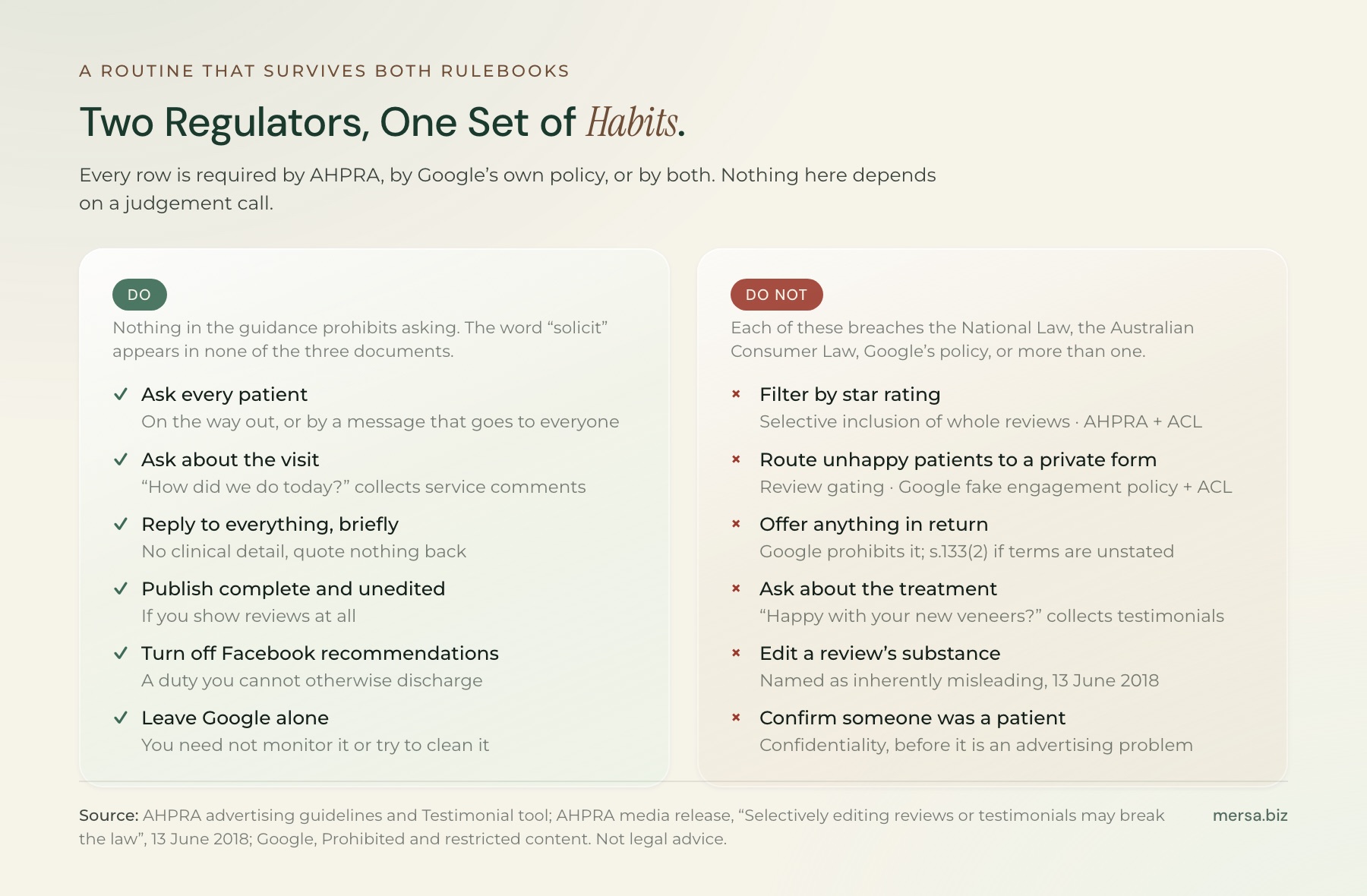
Every patient should be asked rather than selected ones, on the way out or by a message afterwards, in a manner reaching everyone regardless of how the appointment went.
Ask about the visit rather than the treatment. “How did we do today?” collects service comments, whereas “How happy are you with your new veneers?” collects testimonials that you requested.
Nothing should be offered in return. Google prohibits it, and under section 133 an inducement without stated conditions constitutes its own offence.
Keep Your Own Pages Free of Clinical Review Content
Your own site should be kept free of clinical review content. Where reviews are wanted on the page, only comments about service should be used, published complete and unedited and unfiltered by star rating. The safest version is a link to the Google profile and no widget at all.
Turn off Facebook recommendations.
Reply, and Then Leave Google Alone
Reply to everything, briefly and without clinical detail.
Leave Google alone otherwise. Monitoring is not required, removal of testimonials is not required, and attempting to curate it is where the risk begins.
The rest is volume and recency, which is a systems problem rather than a legal one. In the same BrightLocal survey of 1,002 US adults, with no Australian or healthcare breakdown, 47% would not use a business with fewer than 20 reviews and 74% look for reviews written within the last three months.
Whitespark’s panel ranks recency eleventh of 187 factors. A practice with 200 reviews and none since March reads worse than one holding 60 that are current.
Where reviews sit alongside everything else on your listing is a separate question, covered in the Google Business Profile piece.
Common Questions
Are we allowed to ask patients for Google reviews?
Nothing in AHPRA’s advertising guidelines, testimonial tool or advertising FAQ prohibits asking. The prohibition applies to the use of testimonials in advertising you control. Everyone should be asked, about the visit rather than the treatment, with nothing offered in exchange.
Do we have to get clinical reviews removed from Google?
No. AHPRA states that advertisers are not responsible for removing testimonials published on platforms they do not control, and that boards do not expect monitoring of forums outside that control.
Can we put our Google reviews on our website?
Only those carrying no reference to symptoms, diagnosis, treatment or outcome, published complete and unedited, with no filtering by rating. A standard reviews widget fails all three conditions by default.
Is a four-star minimum filter on our widget a problem?
Yes. AHPRA’s testimonial tool names “selectively including/excluding whole reviews” as capable of being misleading, and Google’s own policy separately prohibits the selective solicitation of positive reviews.
Can we send unhappy patients to a private form instead?
That constitutes review gating. It breaches Google’s fake engagement policy and creates a misleading public record. A feedback form should be used for everyone or for nobody.
Should we reply to reviews?
Consumers strongly expect it, though the data on that is US only. AHPRA warns advertisers to “take care” when engaging with reviews on third-party sites without defining the term. Replies should be kept short, carry no clinical detail, quote nothing back, and never confirm that somebody was a patient in a reply to a negative review.
Will review schema get us stars in Google?
Not for reviews of yourself. Google’s documentation rules out self-serving reviews for the star feature, embedded widgets included.
Do reviews affect rankings?
Google states that more reviews and positive ratings can help local ranking, and Whitespark’s 2026 panel places ratings, review quantity with text, and recency within the top twelve of 187 factors. Both are worth taking seriously, and neither constitutes a guarantee.
How do we ask a patient for a Google review without collecting a testimonial?
Ask about the visit rather than the dentistry. A request steering the patient toward praising the treatment constitutes a request for a testimonial whatever it is called, whereas a request asking how the appointment went, covering booking, reception, waiting time and whether things were explained clearly, collects the kind of comment permitted for reuse.
Is it legal to offer a discount or a prize draw for leaving a review?
Google’s own prohibited and restricted content policy rules out incentivised reviews regardless of what AHPRA says, so this fails on the platform rules before the National Law is reached. Section 133 then adds its own constraint on advertising an inducement without stating its terms.
Can we ask unhappy patients to contact us privately instead of leaving a review?
Inviting any patient to raise a problem with the practice directly is ordinary practice management. Routing dissatisfied patients to a private form while routing satisfied ones to Google constitutes review gating, which Google prohibits, and AHPRA’s 2018 media release warns that selectively editing reviews or testimonials may break the law.
Should we turn off reviews on our Facebook page to stay compliant?
It removes a surface you control, and with it any clinical comment posted there, along with the review volume. The alternative is monitoring the page and removing comments referring to symptoms, diagnosis, treatment or outcome, which is the same work the rest of your advertising already requires.
Why can our competitors show star ratings in Google and we cannot?
Star review snippets are a separate mechanism from a Google Business Profile rating, and Google’s documentation rules out the self-serving case: where the entity being reviewed controls the reviews about itself, embedded third-party widgets included, the page is ineligible. Anyone selling review schema for stars on your own site is selling something Google has ruled out in writing.
What do we do about a review that names a treatment and praises the outcome?
On Google, nothing, since it is not advertising you control and AHPRA does not expect it to be policed. It should not be screenshotted, quoted in a newsletter, or pulled onto the website through a widget. Reproduction is what moves it into material you control.
How many Google reviews does a dental practice actually need?
No threshold exists, and any number quoted is invented. What the survey evidence supports is that quantity of reviews with text, high ratings and recency all carry weight, which makes the useful goal a steady flow rather than a target.
Reviews are one layer of a practice’s search presence and rarely the one holding it back on its own. Our fixed-price marketing audit reads the review setup alongside the listing, the site and the advertising-compliance layer, and the SEO for dentists page explains how the search work is scoped for Australian practices.
This article describes publicly available regulatory requirements and platform policies. It is not legal advice. Verify against ahpra.gov.au before acting, particularly on the question of whether a given platform is advertising within your control, which depends on facts specific to your practice.
Sources
- AHPRA: Guidelines for advertising a regulated health service, issued 14 December 2020 (control test s3.2, testimonials s4.3)
- AHPRA: Testimonials: understand the requirements
- AHPRA: Advertising FAQs
- AHPRA: Selectively editing reviews or testimonials may break the law, 13 June 2018
- Google: Prohibited and restricted content
- Google: Tips to improve your local ranking
- Google: Review snippet structured data, updated 24 July 2026
- Whitespark: 2026 Local Search Ranking Factors, published 6 November 2025, 47 respondents scoring 187 factors
- BrightLocal: Local Consumer Review Survey 2026, published 11 February 2026, 1,002 US adults