
Table of Contents
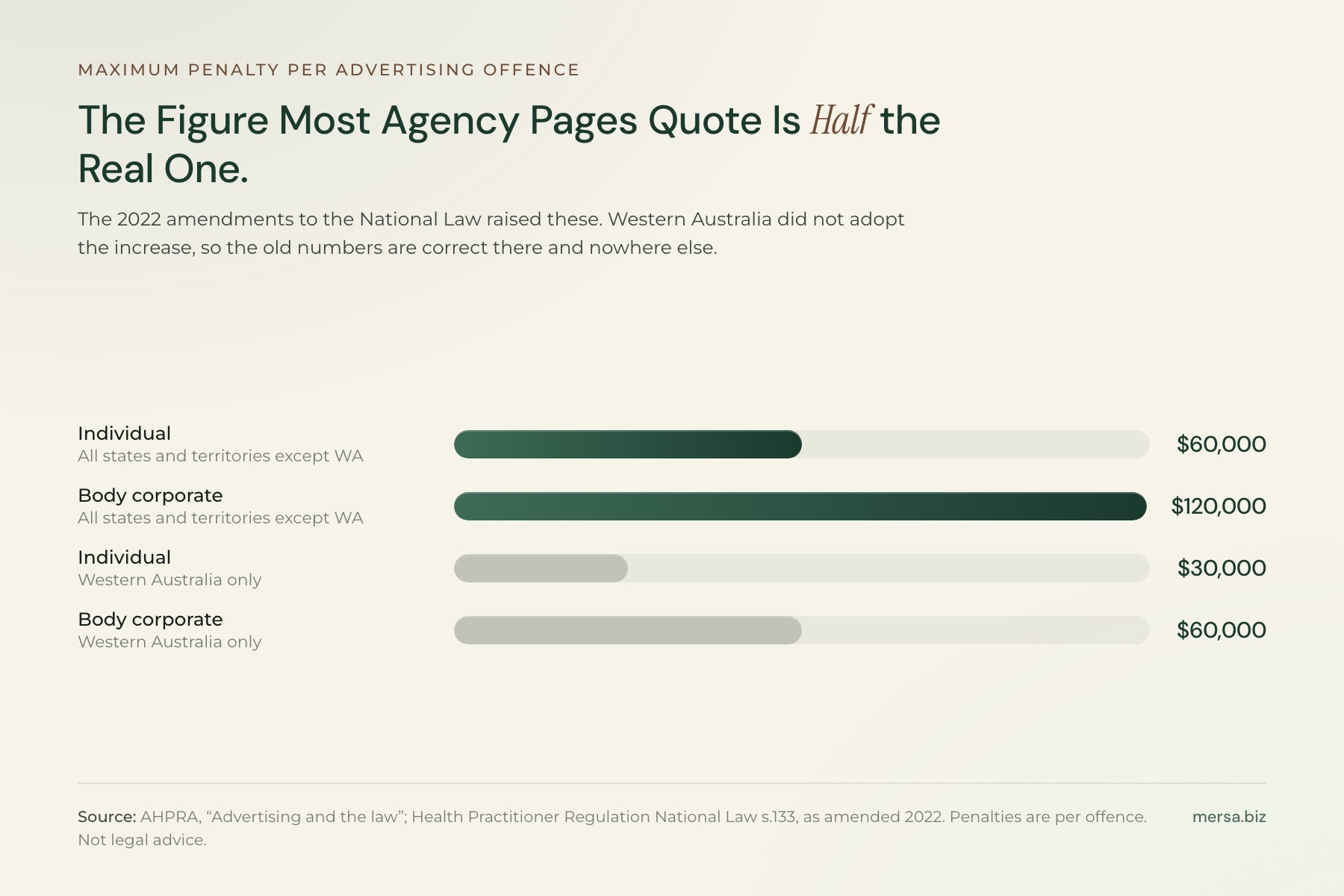
The AHPRA advertising rules prohibit five things, testimonials being only the third of them. A testimonial means a positive statement about the clinical aspects of care, so a comment about reception or parking does not qualify. The maximum penalty is $60,000 per offence for an individual and $120,000 for a body corporate, everywhere except Western Australia.
Key Takeaways
- Section 133 lists five prohibitions. Most articles cover only testimonials, while the other four catch more practices.
- A testimonial is about clinical aspects, meaning symptoms, diagnosis, treatment or outcome. AHPRA states in writing that comments on customer service or communication style are not testimonials.
- The penalty has been $60,000 and $120,000 since the 2022 amendment. The $30,000 and $60,000 figures repeated across agency sites are correct in Western Australia and nowhere else.
- AHPRA publishes no banned-words list. Section 4.1 targets claims of a superior service, not particular words, which is broader and harder to game.
- Title tags, meta descriptions, alt text and the Business Profile description all constitute advertising of a regulated health service, and that is where non-compliant language usually survives.
Most dental marketing agencies in Australia maintain a page about the AHPRA advertising rules, and reading a few is instructive. A striking number quote the maximum penalty as $30,000 for an individual and $60,000 for a company.
That figure was correct in Western Australia. It has not been correct anywhere else in Australia since 2022. When the National Law was amended that year, the maximum financial penalty per advertising offence went from $5,000 to $60,000 for an individual, and from $10,000 to $120,000 for a body corporate.
Western Australia did not adopt the increase. AHPRA publishes both figures on its own Advertising and the law page.
Doubling a number is a small mistake. Copying a number from another agency’s blog without checking the regulator is a larger one, and it indicates something about how this topic is usually written. What follows is the version with the sources attached.
What the AHPRA Advertising Rules Prohibit
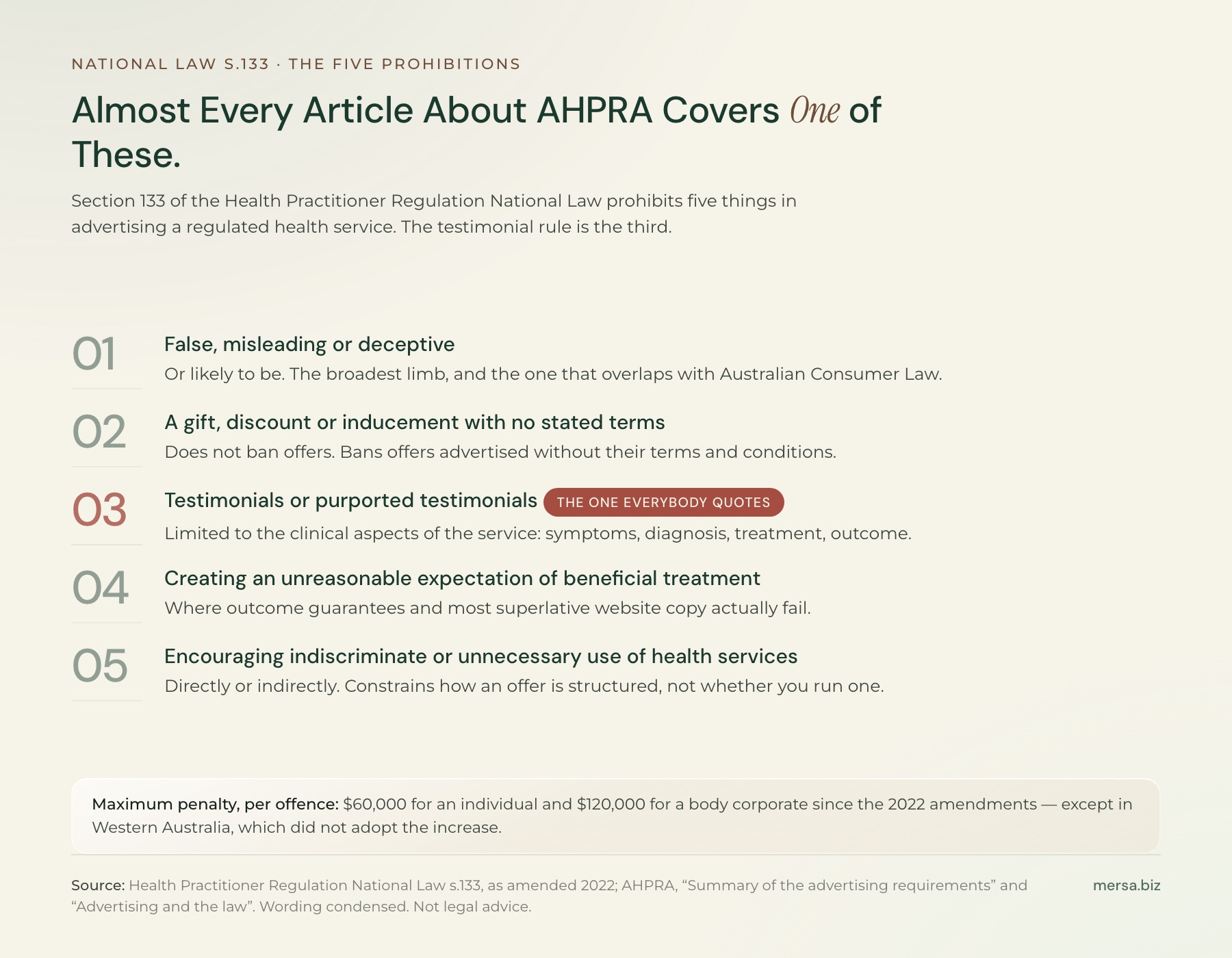
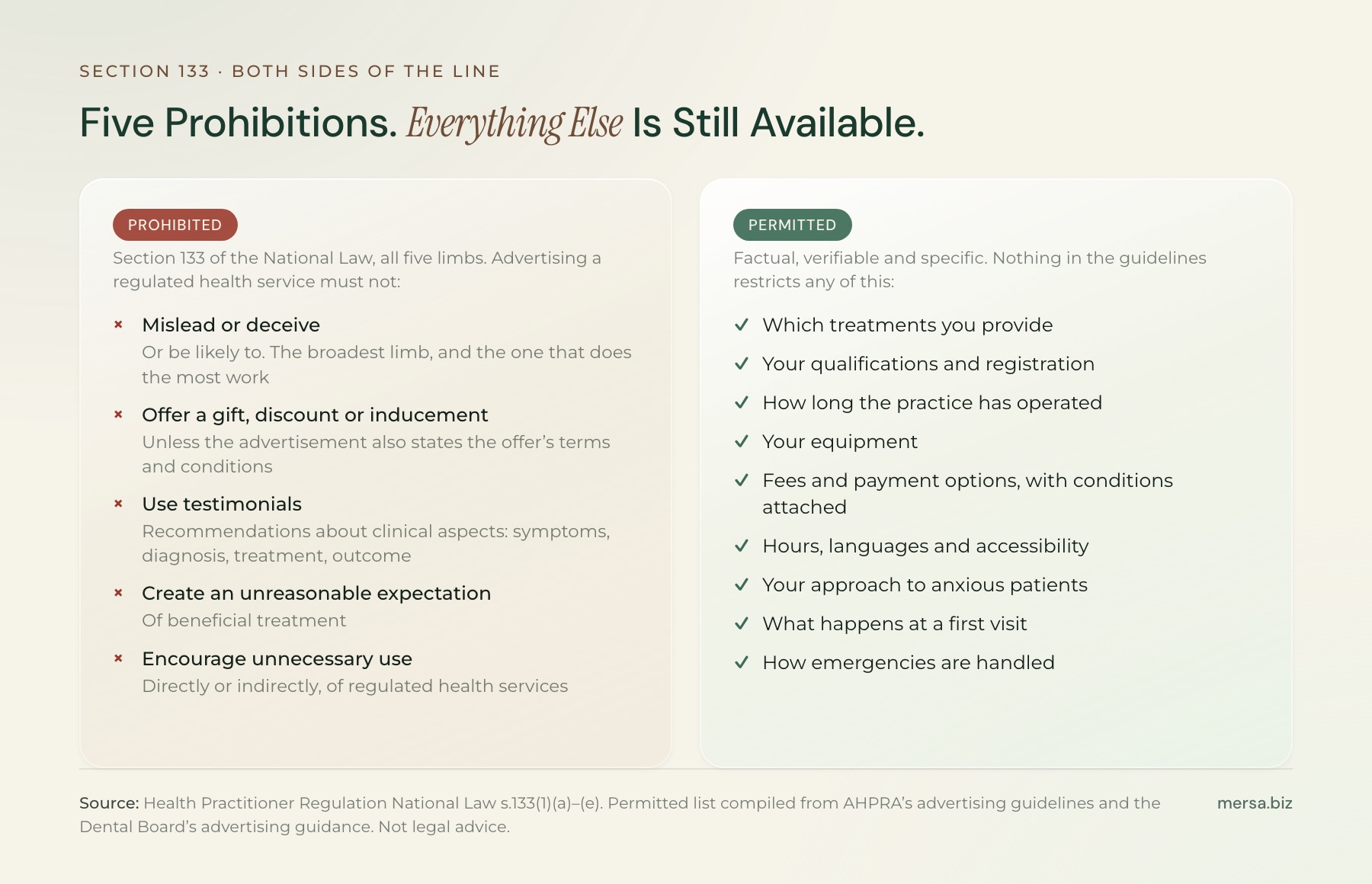
Almost every conversation about AHPRA collapses into a single word: testimonials. That is one of five prohibitions, and the other four catch more practices than the testimonial rule does.
Section 133 of the Health Practitioner Regulation National Law says a person must not advertise a regulated health service, or a business providing one, in a way that:
- is false, misleading or deceptive, or is likely to be misleading or deceptive
- offers a gift, discount or other inducement to attract someone to the service, unless the advertisement also states the terms and conditions of that offer
- uses testimonials or purported testimonials about the service or business
- creates an unreasonable expectation of beneficial treatment
- directly or indirectly encourages the indiscriminate or unnecessary use of regulated health services
Limb 2 rewards a second reading. It does not ban discounts; it bans discounts advertised without their terms and conditions.
A practice running “$99 new patient check-up and clean” is compliant where the page states what is included, what is excluded, and when the offer ends. The same words carrying no conditions constitute an offence. That distinction is constantly lost, usually in the direction of practices believing offers are unavailable to them entirely.
Limb 1 is the broadest and performs the most work in practice. It is also the limb overlapping with Australian Consumer Law, which applies regardless of what AHPRA does.
The Testimonial Rule Is Narrower Than You Have Been Told
AHPRA’s own definition, from its summary of the advertising requirements:
Advertising must not use testimonials or purported testimonials, that is, recommendations or positive statements about the clinical aspects of a regulated health service. ‘Clinical aspects’ refers to statements about symptoms, diagnosis, treatment, outcome.
And then, in the same document, the sentence almost nobody quotes:
Not all reviews or positive comments made about a regulated health service are considered testimonials. For example, comments about customer service or communication style that do not include a reference to clinical aspects are not considered testimonials for the purposes of the National Law.
So the test is not whether the comment constitutes praise, but whether the praise concerns clinical care.
“The reception team called me back within an hour and parking was easy” is a comment about service. “Dr Chen fixed my chipped front tooth and it looks better than the original” is about treatment and outcome. The first may appear in material you control. The second may not, however genuine it is, however unprompted the patient’s offering of it, and however publicly it already sits on Google.
The other half of the rule is about scope. AHPRA:
Advertisers are responsible for removing testimonials from the advertising they control, including social media platforms advertising their regulated health service (e.g. clinic Facebook page).
Your website, Facebook page, Instagram, ads and printed material are all yours. What patients write on Google, on a forum, or on a review site you do not run is not your responsibility to police. That distinction is worth its own article, and it has one: Google reviews and AHPRA covers what you may and may not do with reviews you did not write.
The Trap Sitting Inside Your Website Copy
This is the point at which the topic stops being a legal one and becomes a marketing one.
Limb 4 prohibits creating “an unreasonable expectation of beneficial treatment”. Limb 1 prohibits anything misleading. Together they rule out a large amount of language that is otherwise standard on service websites, and much of it is language an SEO instinct pushes you toward.
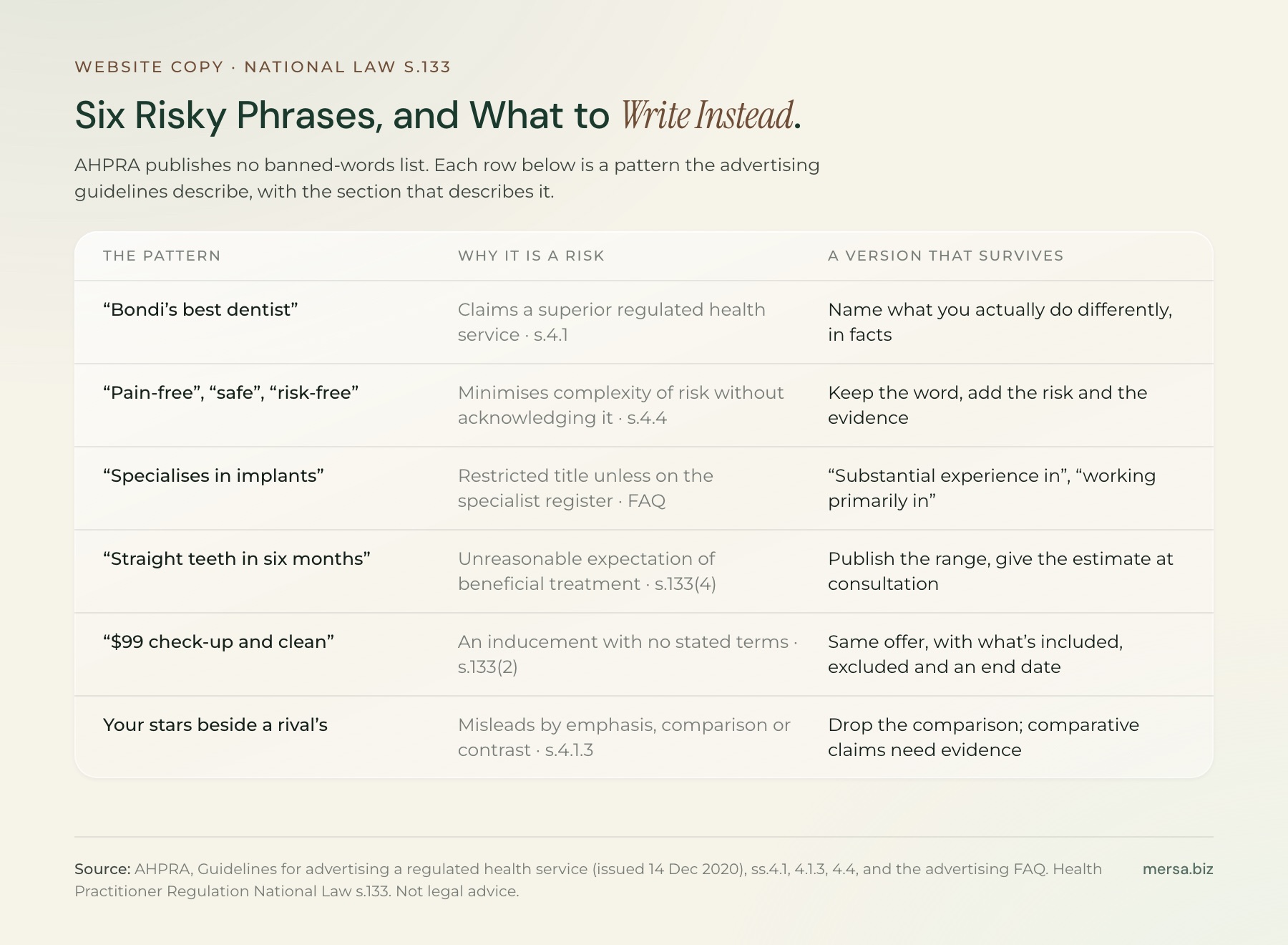
Precision matters here, because this is where secondhand summaries go wrong. AHPRA publishes no banned-words list, and never uses the word “best” or the word “superlative”. What the advertising guidelines say, at section 4.1, is that advertising may be false, misleading or deceptive if it “makes claims about providing a superior regulated health service”.
It may equally do so where it “misleads, either directly or by implication through the use of emphasis, comparison, contrast or omission”.
That is broader than a word ban and harder to game. “Bondi’s best dentist” constitutes a claim of superiority, as does “the most advanced practice in the area”, and as does a layout placing your five-star average beside a competitor’s three-star one.
The search demand behind those phrases is real, though asserting them about yourself is not available to you.
A workable version exists, because a query may be ranked for without being asserted. A page titled “Finding a dentist in Bondi Junction” explaining how to compare practices, what to ask about after-hours care, and what a first appointment involves targets the same intent without making any claim about yourself. It also happens to be a better page.
Other patterns surface repeatedly in dental website copy:
Guarantees About Outcomes
“Straight teeth in six months” sets an expectation that cannot be promised for every patient. “Most Invisalign cases at this practice run between X and Y months, and we give you your estimated range at the consultation” says more while promising less.
Pain-Free, Safe, Risk-Free
These are named directly. Section 4.4 lists advertising that “minimises the complexity of risk associated with a treatment (i.e. using words or phrases such as ‘safe’, ‘effective’, ‘risk-free’, ‘pain-free’) without acknowledging possible adverse reactions or mixed/inconclusive evidence for the treatment”.
The qualifier at the end is worth noting. The words are not forbidden outright; their use while remaining silent about risk is the problem.
Specialist, Specialises In, Specialty
AHPRA’s FAQ is direct about this one: advertising using “‘specialist’, ‘specialises in’, ‘specialty’, or ‘specialised'” may be considered false, misleading or deceptive, while “words such as ‘substantial experience in’ or ‘working primarily in’ are less likely to be misleading”.
Where you are not on the specialist register for that field, the phrasing should be changed. This appears on general practice websites constantly, usually in a services menu nobody has reread in three years.
Comparative Claims About Other Practices
Section 4.1.3 covers this and is worth reading in full where the temptation arises. Comparisons of outcomes, of practitioner competency, or of prices all need to be “clear, accurate and supported by acceptable evidence where relevant”, and complete information is hard to fit into a headline.
Before and After Galleries
These are conditional rather than banned, and the regulator’s register is softer than most summaries suggest. Section 4.4.1 says “care should be taken”, and lists what makes such images “less likely to be misleading”: images “as similar as possible in content, camera angle, background, framing and exposure”, consistent posture, clothing and make-up, consistent lighting and contrast, an explanation if anything has been altered, and the referenced treatment being “the only visible change to the person being photographed”.
Most galleries fail on lighting before they fail on anything else.
Prices Without Conditions
Limb 2, as above. Easy to fix, frequently broken.
Who Carries the Liability Under the AHPRA Advertising Rules
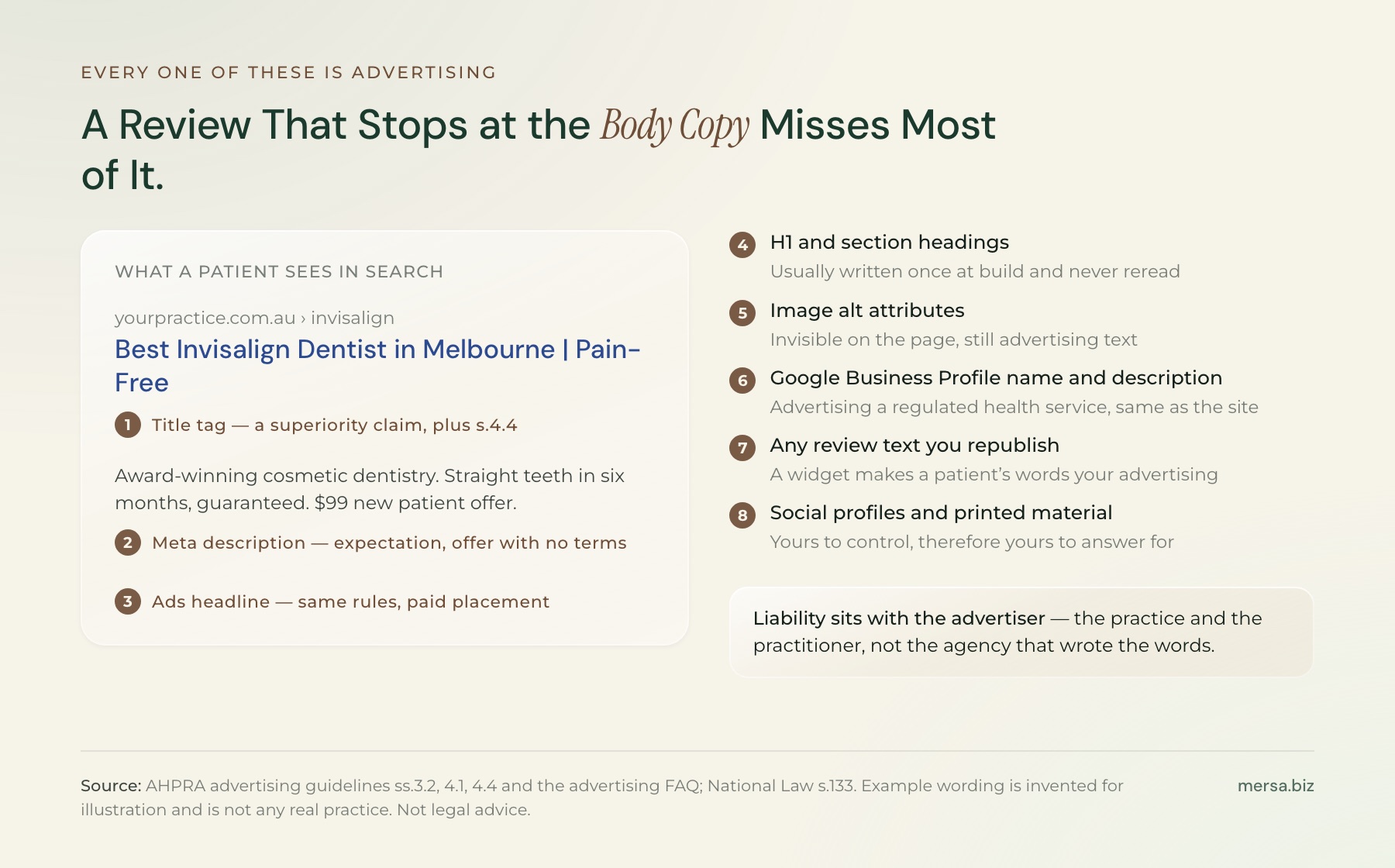
The National Law applies to the advertiser, meaning the practice and the practitioner rather than the agency.
An agency writing non-compliant copy has created a problem it does not carry. Any provider pitching should be asked how this is handled before anything is signed, with “we’ll check with your lawyer” treated as a real answer and “AHPRA is pretty relaxed about it these days” treated as a reason to walk.
A second and quieter exposure exists. AHPRA’s advertising requirements sit alongside the Australian Consumer Law, and the ACCC is indifferent to what a professional board thinks. A misleading claim can constitute a problem in two places simultaneously.
What Compliant Marketing Looks Like
The rules remove one category of persuasion rather than persuasion itself.
What may be said is broad: the treatments provided, your qualifications and registration, how long the practice has operated, your equipment, your fees and payment options with conditions attached, your hours, your languages, your accessibility, your approach to anxious patients, what happens at a first visit, and how emergencies are handled. Factual, verifiable and specific.
That last word rewards attention. The reason so much dental website copy reaches for superlatives is that the practice has not done the work of recording what makes it different in concrete terms. “Award-winning care” is what gets written in the absence of “we hold two hours a day for same-day emergencies and publish our wait time on the homepage”.
Compliance pressure, properly applied, tends to produce better copy than it removes. The specific beats the superlative on conversion regardless, and it is the only kind of claim a search engine or an AI assistant can verify against anything.
Where the AHPRA Advertising Rules Intersect With Your Rankings
Three practical consequences follow.
Your Title Tags and Headings Are Advertising
A <title> containing “Best Dentist Melbourne” constitutes advertising of a regulated health service, as does a meta description, an image alt attribute, a Google Business Profile description, and the text of a Google Ads headline. Compliance reviews stopping at the visible body copy miss all of it.
Across every audit run here, the title and heading layer is where non-compliant language appears most often, because it is usually written by whoever set up the site and never reviewed again.
Review Content on Your Own Pages Carries the Risk With It
Embedding a Google reviews widget on a homepage pulls patient text about clinical care into material you control, and the widget is what makes it yours. The companion piece on reviews is worth reading before one is installed.
You Cannot Mark Up Your Own Reviews for Star Ratings
Separate issue, same page. Google’s review snippet documentation, updated 24 July 2026, states that when the entity being reviewed controls the reviews about itself, those pages are ineligible for the star review feature, “including through an embedded third-party widget (for example, Google Business reviews or Facebook reviews widget)”. Any agency selling review schema for stars on your own site is selling something Google has ruled out in writing.
Common Questions
Can we use patient reviews on our website at all?
Only where they carry no reference to clinical aspects, meaning symptoms, diagnosis, treatment or outcome. Comments about service, communication or the experience of the visit are not testimonials under the National Law. Comments about the work performed are, and those may not appear in material you control.
What about reviews on Google that mention treatment?
Not your responsibility. AHPRA states that advertisers are not responsible for removing unsolicited testimonials on platforms they do not control, and that boards do not expect monitoring of forums outside that control. They should be left alone, the risk beginning at the point of reproduction somewhere you do control.
Can we offer a discount for new patients?
Yes, with the terms and conditions of the offer stated in the advertisement, that being limb 2 of section 133 in full. What may not be done is structuring an offer so that it encourages unnecessary treatment, which is limb 5.
Are before and after photos banned?
No, and AHPRA does not say they are. Section 4.4.1 of the advertising guidelines says “care should be taken”, and describes the conditions under which such images are “less likely to be misleading”: consistent content, camera angle, background, framing, exposure, posture, clothing, make-up, lighting and contrast, disclosure of any alteration, and the treatment being the only visible change. Anyone stating that before-and-afters are prohibited is overstating the AHPRA advertising rules.
Can we describe ourselves as specialists?
Only where you are registered as one in that field. AHPRA’s FAQ warns that “specialist”, “specialises in”, “specialty” and “specialised” may be false, misleading or deceptive, and suggests “substantial experience in” or “working primarily in” as lower-risk alternatives.
What is the actual maximum penalty under the AHPRA advertising rules?
$60,000 per offence for an individual and $120,000 for a body corporate, everywhere except Western Australia, where it remains $30,000 and $60,000. The increase came in with the 2022 amendments to the National Law.
Does AHPRA enforce this?
It publishes advertising cases heard by courts and tribunals, and has run compliance campaigns directed at specific professions. The Dental Board issued a public statement in May 2024 urging compliance with advertising rules, which is not the behaviour of a regulator that has ceased looking.
Our agency writes our copy. Are they liable?
No. The liability is yours, because the National Law binds the advertiser.
Is it against AHPRA rules to say we are the best dentist in our suburb?
AHPRA publishes no banned-words list and never uses the word “best”. Section 4.1 of the advertising guidelines says advertising may be false, misleading or deceptive if it “makes claims about providing a superior regulated health service”. A claim to be the best in a suburb constitutes a claim of superiority, and substantiation would be required. In practice nobody can provide it.
Can we put “pain-free dentistry” or “painless treatment” on our website?
Both assert an outcome that cannot be guaranteed for every patient, which is where limbs 1 and 4 of section 133 bite. The lower-risk version describes what is actually done, covering the sedation options offered, the anaesthetic technique, and what happens where a patient is anxious, rather than promising the result.
Does AHPRA apply to our Google Ads and our Instagram, or only to our website?
Every surface on which a regulated health service is advertised. That includes Google Ads headlines, Google Business Profile descriptions, Instagram and Facebook posts, printed material, signage and the text inside images. The rules attach to the advertising rather than to the medium.
Are our page titles and meta descriptions covered by the advertising rules?
Yes. A <title> reading “Best Dentist Melbourne” advertises a regulated health service in precisely the manner section 4.1 describes, as does a meta description, a heading and an image alt attribute. This is where non-compliant language most often survives, because it is usually written once during a site build and never reviewed again.
Can we advertise a free consultation or a $99 check-up and clean?
Yes, provided the advertisement states the terms and conditions of the offer, covering what is included, what is excluded, and when it ends. That is limb 2 of section 133 in full. The separate constraint is limb 5: the offer must not be structured so that it encourages unnecessary treatment.
Who is responsible if a patient posts a testimonial on our Facebook page?
A practice Facebook page constitutes advertising you control, so a comment about clinical care sitting on it is your responsibility to remove. A review the same patient leaves on Google is not, because that platform is outside your control.
How often do the AHPRA advertising guidelines change?
They are revised periodically, and the penalty figures moved as recently as the 2022 amendments to the National Law. Any summary, this one included, should be treated as a starting point, with the current text on ahpra.gov.au checked before it is relied upon.
Before You Brief Anyone on the AHPRA Advertising Rules
Read your own site as if you were AHPRA. Start with the title tags and headings rather than the body copy, because that is where the superlatives usually survive.
Check every offer for stated conditions. Check every review that appears on a page you control for clinical content. Check whether your before-and-after images would survive a question about lighting.
Then check the penalty figure on your marketing provider’s website. If it says $30,000 and they are not in Perth, you have learned something useful about how carefully they read primary sources.
We publish a fixed-price audit that covers the advertising-compliance layer alongside the technical and search work, and a longer explanation of how we approach search for Australian practices on the SEO for dentists page.
This article describes publicly available regulatory requirements and is not legal advice. AHPRA’s guidelines are the authoritative source and are revised periodically. Verify against ahpra.gov.au and dentalboard.gov.au before relying on anything here.
Sources
- AHPRA: Advertising and the law (penalty amounts, 2022 amendment, WA exception)
- AHPRA: Summary of the advertising requirements (testimonial definition, scope of advertiser responsibility)
- Dental Board of Australia: Advertising a regulated health service
- AHPRA: Dental Board urges compliance with advertising rules, 6 May 2024
- Google: Review snippet structured data, updated 24 July 2026